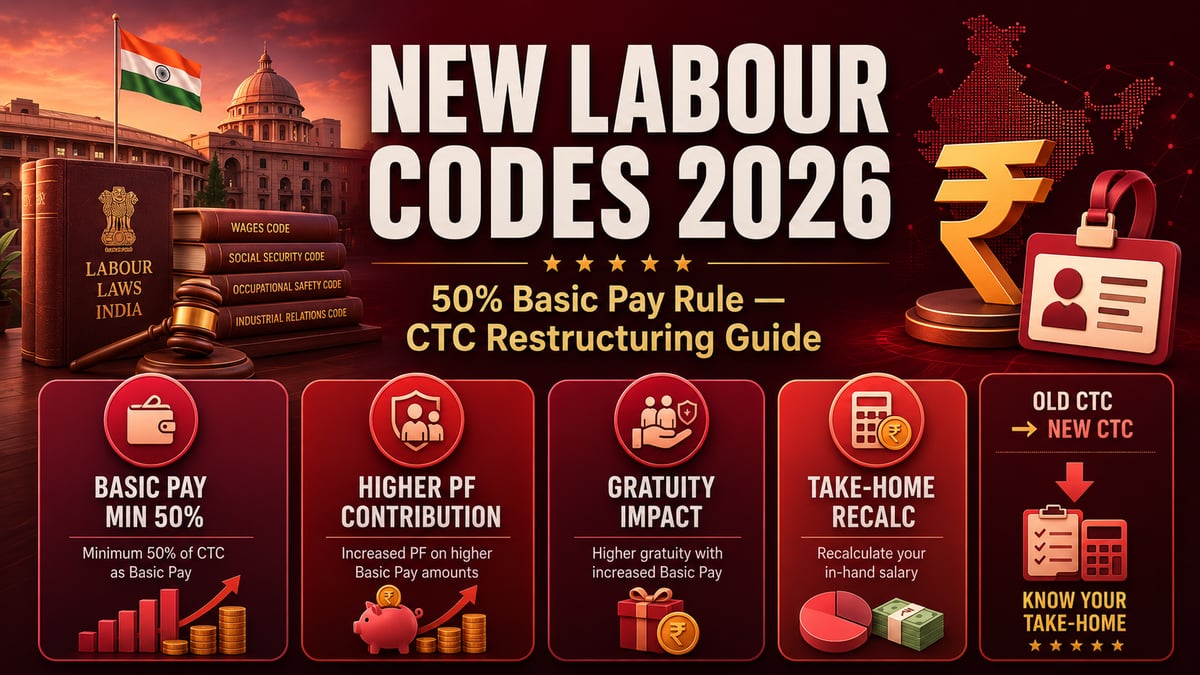
If your salary slip shows basic pay at 30-40% of your CTC, your employer is almost certainly going to restructure it upward. The Code on Wages requires basic wages to be at least 50% of total remuneration, and companies that have been keeping basic pay artificially low to reduce their PF/gratuity liability are running out of time.
What counts as "wages" under the new definition
The Code defines wages as: Basic pay + Dearness Allowance + Retaining Allowance. Everything else (HRA, conveyance, special allowances) is an "allowance" and cannot exceed 50% of total remuneration.
So if your CTC is ₹12,00,000: your basic + DA must be at least ₹6,00,000.
Why companies kept basic pay low
Employer PF contribution = 12% of basic pay. Gratuity = 4.81% of basic pay. The lower your basic, the less the company pays toward these statutory benefits. A ₹12L CTC employee with 30% basic (₹3.6L) costs the employer ₹43,200 less in PF and ₹8,600 less in gratuity per year versus 50% basic.
For the employee, lower basic meant higher take-home (less deducted for PF) but weaker retirement savings and lower gratuity at exit.
The restructuring impact
When basic rises from 30% to 50% of CTC:
- Your monthly PF deduction increases → lower immediate take-home
- Your employer's PF contribution increases → better retirement corpus
- Your gratuity at exit increases significantly
- Your HRA exemption calculation changes (HRA is a % of basic)
Net effect for most employees: ₹1,000-₹3,000/month less take-home but ₹2,000-₹5,000/month more flowing into retirement savings.