What is the Difference Between Your Marginal and Effective Tax Rates?
To understand the difference between your marginal and effective tax rates, you must analyze how progressive tax brackets work: your marginal tax rate is the percentage of tax applied to the very last dollar of your taxable income, whereas your effective tax rate is the average rate you pay on your entire income. Because the US utilizes progressive brackets, your effective tax rate is always lower than your marginal rate.
Quick Answer Summary
- Marginal Tax Rate: The tax bracket that your highest dollar of income falls into (e.g. 10%, 12%, 22%, 24%, 32%, 35%, 37%). This rate is applied only to the income within that specific range.
- Effective Tax Rate: The actual percentage of your total income that you pay in taxes. It is calculated by dividing your total tax owed by your gross income.
- The Golden Rule: Moving into a higher tax bracket only taxes the additional income at the higher rate, meaning a pay raise will always increase your net take-home pay.
For a complete step-by-step walkthrough of how to apply these brackets and deductions, see our guide: How to Calculate Your US Federal Income Tax in 2026.
How Progressive Tax Brackets Create Two Different Rates
In a flat tax system, there is only one rate. If the tax rate is 15%, everyone pays 15%, and your marginal and effective rates are identical.
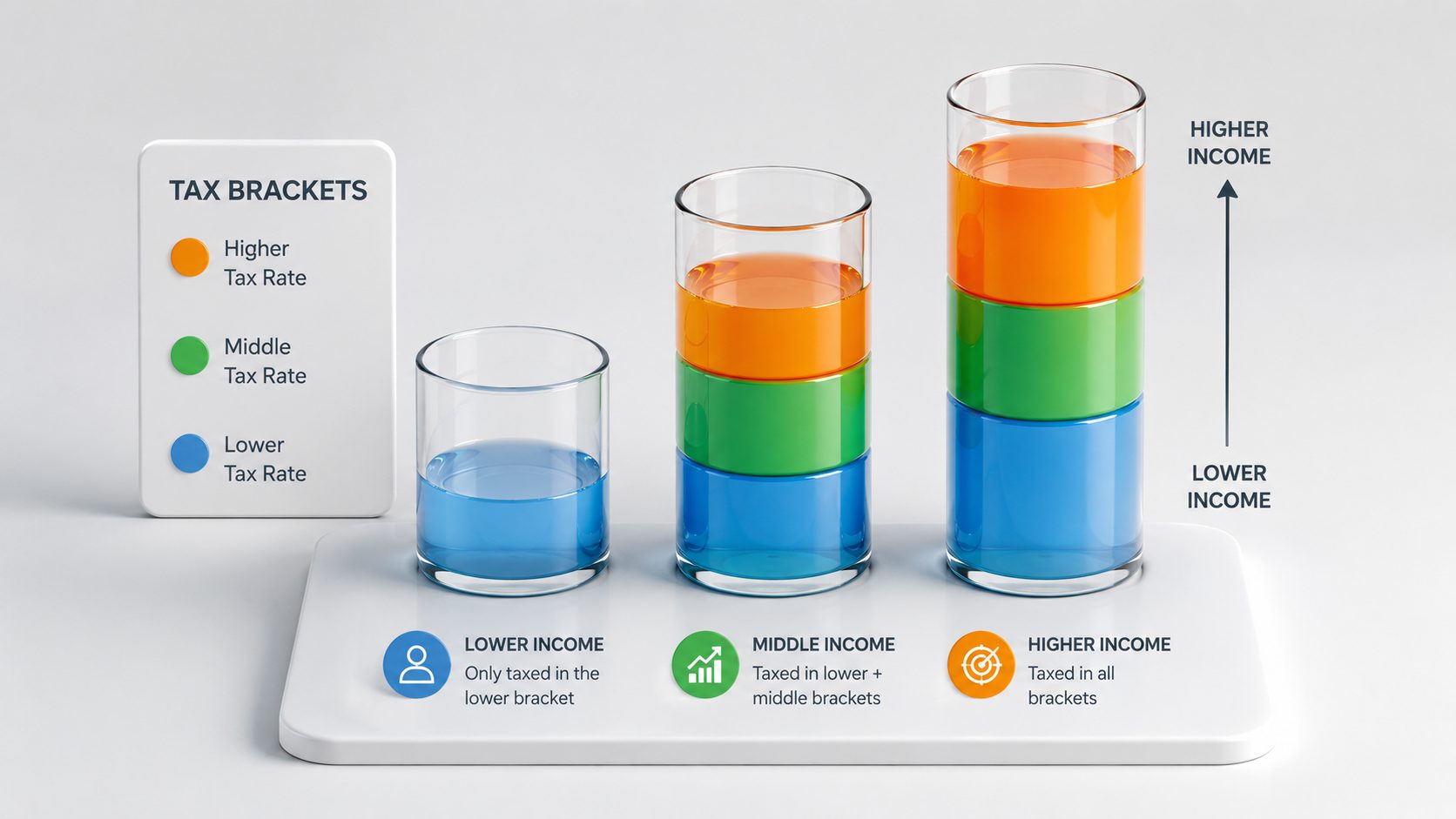
However, the United States uses a progressive tax system. This means that as you earn more, the tax rate on your additional earnings increases. To visualize this, think of tax brackets as a series of buckets.
- The first bucket is taxed at 10%.
- The second bucket is taxed at 12%.
- The third bucket is taxed at 22%, and so on.
Your first dollar of income goes into the 10% bucket. Only when that bucket is full does your next dollar spill over into the 12% bucket. Because your income is split across these different brackets, your average tax rate (effective tax rate) is a weighted average of all the brackets you span.
Official IRS 2026 Federal Income Tax Brackets (Single Filers)
To calculate your rates, you must refer to the current tax brackets. For the 2026 tax year, the brackets for individual filers are:
| Ordinary Income Tax Rate | Taxable Income Range (2026) | Cumulative Tax Owed Base |
|---|---|---|
| 10% | $0 to $12,400 | 10% of taxable income |
| 12% | $12,400 to $50,400 | $1,240 + 12% of amount over $12,400 |
| 22% | $50,400 to $105,700 | $5,800 + 22% of amount over $50,400 |
| 24% | $105,700 to $201,775 | $17,966 + 24% of amount over $105,700 |
| 32% | $201,775 to $256,225 | $41,024 + 32% of amount over $201,775 |
| 35% | $256,225 to $640,600 | $58,448 + 35% of amount over $256,225 |
| 37% | Above $640,600 | $192,979.25 + 37% of amount over $640,600 |
Step-by-Step Case Study: Sarah's Tax Rates in 2026
Let's return to Sarah, our 32-year-old software engineer in Austin, Texas. Sarah has a gross salary of $95,000 and claims the standard deduction of $16,100:
- Gross Income: $95,000
- Standard Deduction: -$16,100
- Taxable Income: $95,000 - $16,100 = $78,900
Let's calculate Sarah's total tax bill across the brackets:
- First Bucket (10%): $12,400 taxed at 10% = $1,240
- Second Bucket (12%): ($50,400 - $12,400) = $38,000 taxed at 12% = $4,560
- Third Bucket (22%): ($78,900 - $50,400) = $28,500 taxed at 22% = $6,270
- Total Tax Owed: $1,240 + $4,560 + $6,270 = $12,070
Calculating Sarah's Rates:
- Sarah's Marginal Tax Rate: Her taxable income of $78,900 sits in the 22% bracket. If she earns $1 more, it will be taxed at 22%. Thus, her marginal tax rate is 22%.
- Sarah's Effective Tax Rate: We calculate this by dividing her total tax by her gross income:
Effective Tax Rate = (Total Tax Owed ÷ Gross Income) × 100
Effective Tax Rate = 95,000 = 12.70%
Sarah's $12,070 tax bill by bracket layer
Notice the massive gap: Sarah's marginal rate is 22%, but she only pays 12.70% of her gross income to the IRS. This is due to the combined effect of her standard deduction and the lower 10% and 12% tax tiers.
Debunking the "Raise Trap" Myth
A common fear is: "If I get a raise that pushes me into a higher bracket, I will take home less money because of higher taxes."
Let's prove mathematically why this is impossible. Suppose Sarah receives a $30,000 raise, pushing her gross salary from $95,000 to $125,000:
- New Gross Income: $125,000
- Taxable Income: $125,000 - $16,100 = $108,900
Now, her taxable income spans into the 24% bracket (which starts at $105,700 for single filers). Her tax calculation is:
- 10% bracket: $12,400 taxed at 10% = $1,240
- 12% bracket: $38,000 taxed at 12% = $4,560
- 22% bracket: ($105,700 - $50,400) = $55,300 taxed at 22% = $12,166
- 24% bracket: ($108,900 - $105,700) = $3,200 taxed at 24% = $768
- New Total Tax: $1,240 + $4,560 + $12,166 + $768 = $18,734
The Take-Home Pay Comparison:
- Old Take-Home Pay: $95,000 - $12,070 = $82,930
- New Take-Home Pay: $125,000 - $18,734 = $106,266
- Net Increase in Take-Home Pay: $106,266 - $82,930 = +$23,336
The $30,000 raise 'trap' that never happens
Sarah's salary increased by $30,000, and her take-home pay increased by $23,336. She paid $6,664 more in tax, but she is still far better off. Earning more money always results in more take-home pay.
How to Lower Both Your Marginal and Effective Tax Rates
To reduce your tax burden, you must focus on strategies that lower your Taxable Income:
- Pre-Tax Deferrals: Maximize your Traditional 401(k) (up to $24,500 in 2026) and Traditional IRA (up to $7,500). If Sarah contributes $10,000 to her 401(k), her taxable income drops, which lowers both her effective tax rate and her marginal rate.
- HSA Contributions: Contribute to a Health Savings Account (up to $4,400 for individuals in 2026) to reduce taxable income.
- Tax Credits: Seek out tax credits (like the Child Tax Credit or clean energy credits). Unlike deductions (which reduce your taxable income), credits reduce your tax bill dollar-for-dollar, directly lowering your effective tax rate.
Use the Marginal vs Effective Tax Rate Calculator to compare your brackets and visualize your overall tax split.
Advanced Strategic Implementation & Optimization for Tax Rates
Understanding the relationship between marginal and effective tax rates is vital for making smart career and investment decisions.
Tax Rate Optimization Checklist
- Focus on AGI Reduction: Direct your energy toward strategies that lower your Adjusted Gross Income, which reduces tax across all brackets.
- De-escalate Marginal Brackets: Use pre-tax accounts (401(k), HSA) to keep your top income layer below higher marginal thresholds.
- Model Bonus Scenarios: Estimate the tax impact of end-of-year bonuses using your marginal rate to avoid under-withholding surprises.
Step-by-Step Tax Bracket Analysis
- Calculate Taxable Income: Subtract your standard or itemized deductions from your gross salary.
- Identify Your Marginal Bracket: Find where your top dollar of income falls in the IRS tax tables.
- Compute Your Total Tax Bill: Calculate the progressive tax across all applicable brackets.
- Divide Tax by Gross Income: Find your effective tax rate to understand your actual overall tax burden.
Common Pitfalls & Audit Warnings
- The Raising-Tax Myth: Turning down salary increases out of fear that a higher bracket will reduce net pay is mathematically incorrect.
- Under-withholding on Side Income: Neglecting to pay estimated taxes on freelance or investment income can lead to underpayment penalties.
- Miscalculating Capital Gains: Mixing up ordinary income tax brackets with capital gains tax brackets can lead to incorrect projections.
Advanced Tax Liability Scenario Modeling & Worksheets
This modeling compares how progressive tax brackets impact different income levels to demystify the difference between marginal and effective rates.
Scenario Comparison Table
| Metric | Bracket A: Basic | Bracket B: Moderate | Bracket C: High-Earner |
|---|---|---|---|
| Taxable Income | $45,000 | $95,000 | $220,000 |
| Marginal Bracket | 12% | 22% | 32% |
| Total Federal Tax | $5,152 | $14,412 | $46,876 |
| Effective Rate | 11.44% | 15.17% | 21.30% |
| Net Take-Home Pay | $39,848 | $80,588 | $173,124 |
Marginal vs effective rate at three income levels
Step-by-Step Bracket Progression Math
Profile B: Moderate ($95,000 Taxable Income, Single)
- Layer 1 (10%): First $12,400 is taxed at 10% = $1,240.
- Layer 2 (12%): Income between $12,400 and $50,400 ($38,000) is taxed at 12% = $4,560.
- Layer 3 (22%): Remaining income ($95,000 - $50,400 = $44,600) is taxed at 22% = $9,812.
- Sum of Layers: $1,240 + $4,560 + $9,812 = $15,612 (before tax adjustments).
4. The Bonus Myth: Does a Raise Ever Actually Lower Your Take-Home Pay?
A common misconception in progressive tax systems is that getting a raise or bonus can push you into a higher tax bracket, resulting in less take-home pay than you had before.
Why this is Mathematically Impossible
Progressive tax systems only tax the income that falls within each specific bracket. For example, if the 22% bracket starts at $45,000, and your income increases from $44,000 to $46,000:
- Only the $1,000 that exceeds the $45,000 mark is taxed at 22%.
- The first $44,000 remains taxed at the lower 10% and 12% rates.
- Your take-home pay is guaranteed to increase.
The only exceptions are "cliff-edge" government benefit phase-outs (such as child benefit clawbacks), but within the income tax brackets themselves, a raise will always result in more money in your pocket.
5. How to Use Your Marginal Rate to Decide Between Roth vs. Traditional Accounts
Your current marginal tax rate is the primary factor in deciding whether to contribute to a Traditional (pre-tax) or Roth (after-tax) account.
- High Marginal Rate (e.g., 24% or higher): Prioritize Traditional contributions to save tax at your current high rate, as you will likely be in a lower bracket at retirement.
- Low Marginal Rate (e.g., 12% or lower): Prioritize Roth contributions to lock in tax-free growth, as you are paying very little tax today and will likely be in a higher bracket in retirement.