How Can You Save on Taxes with the Dutch Mortgage Interest Deduction in 2026?
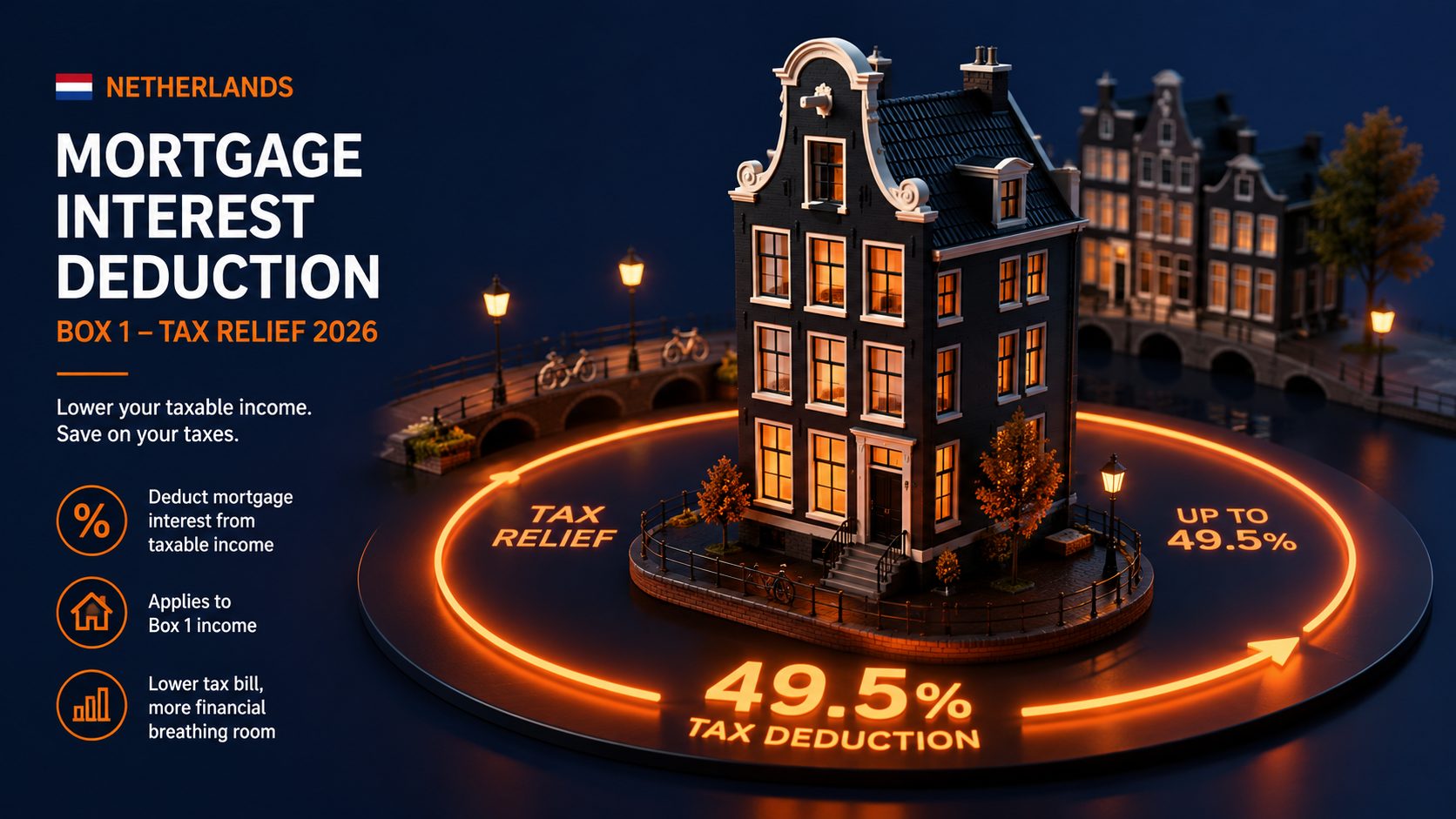
To qualify for the mortgage interest deduction (hypotheekrenteaftrek) in the Netherlands in 2026, you must register the property as your primary residence (hoofdverblijf), repay the loan using an annuity or linear payment structure within 30 years, and calculate your net tax benefit by subtracting the eigenwoningforfait (deemed rental income) from your gross interest deduction. In 2026, the maximum deduction rate is capped at 37.56%.
Quick Answer Summary
- Maximum Rate: You can deduct mortgage interest from your Box 1 income tax at a maximum rate of 37.56% in 2026.
- The Offset: You must add a percentage of your property's WOZ value (typically 0.35% for homes valued between €75,000 and €1,310,000) to your taxable income as "deemed income" (eigenwoningforfait), which partially reduces the net tax benefit.
- Eligible Loans: Only annuity and linear mortgages qualify for the tax relief. Interest-only mortgages do not qualify for deductions for new buyers.
The Mechanics of the Dutch Box 1 Mortgage Deduction
Under the Dutch tax system, your primary home is placed in Box 1 (taxable income from employment and home ownership). The mortgage interest deduction works by reducing your Box 1 taxable income, thereby lowering the amount of income tax you owe.
- The Deduction Cap: In the past, high earners in the top tax bracket (49.50%) could deduct interest at their marginal rate. However, the government has phased this cap down. For 2026, the maximum deduction rate is capped at 37.56% for everyone, regardless of whether your income sits in the higher tax bracket.
- The Annuity/Linear Requirement: To receive the deduction, you must actively pay down the principal balance. This means new mortgages must be either linear (equal principal payments every month) or annuity (equal total monthly payments, with interest/principal split changing over time).
Understanding the Eigenwoningforfait (Deemed Rental Income)
The Dutch tax office (Belastingdienst) views owning a home as a benefit that generates "deemed income" (as if you were renting the property out to yourself). This is called the eigenwoningforfait.
- The Calculation: The eigenwoningforfait is calculated as a percentage of your home's WOZ value (the official property valuation determined by your local municipality every year).
- The 2026 Rate: For most primary residences with a WOZ value between €75,000 and €1,310,000, the rate is 0.35%.
- Impact: You must add this calculated amount to your taxable income, which partially offsets the savings from your mortgage interest deduction.
Case Study: Jan's Net Tax Benefit in Amsterdam (2026)
Let's analyze Jan, a 34-year-old marketing director living in Amsterdam. Jan bought an apartment with a WOZ value of €450,000 and pays €14,700 in mortgage interest annually. Jan is in the highest Box 1 tax bracket (49.50% marginal rate):
Let's calculate Jan's net annual tax benefit for 2026:
Step 1: Calculate Gross Interest Savings
- Mortgage Interest Paid: €14,700
- Maximum Deduction Rate Cap: 37.56%
- Gross Interest Saved = Interest Paid × 37.56% = €14,700 × 0.3756 = €5,521.32
Step 2: Calculate Eigenwoningforfait (Deemed Income)
- WOZ Value: €450,000
- Deemed Income Rate: 0.35%
- Deemed Income = WOZ Value × 0.35% = €450,000 × 0.0035 = €1,575.00
- Tax Owed on Deemed Income = Deemed Income × 49.50% = €1,575 × 0.4950 = €779.63
Step 3: Calculate Net Annual Tax Benefit
- Net Annual Tax Benefit = Interest Saved - Tax Owed = €5,521.32 - €779.63 = €4,741.69
Verdict: Jan receives a net annual tax subsidy of €4,741.69 from the government, which reduces his net monthly housing costs by €395.14.
Jan's net benefit on €14,700 of mortgage interest
The 30-Year Rule and Refinancing
The mortgage interest deduction is available for a maximum period of 30 years from the date the mortgage is registered. If you sell your home and buy a new one, the 30-year timer does not reset; it continues from your original purchase date. If you refinance your mortgage to get a lower interest rate, you can deduct the refinancing fees (such as notary fees, valuation fees, and penalty interest) in the year the refinance occurs.
Use the Netherlands Mortgage Tax Benefit Calculator to input your WOZ value and interest payments to project your net monthly tax savings.
Advanced Strategic Implementation & Optimization for Dutch Homeowners
Navigating the Dutch mortgage interest deduction (hypotheekrenteaftrek) requires complying with strict tax rules and WOZ valuations.
Dutch Property Planning Checklist
- Verify Repayment Structure: Ensure your home loan is structured as an annuity or linear mortgage to qualify for tax deductions.
- Use the Provisional Assessment (Voorlopige Aanslag): Request a monthly refund from the Belastingdienst instead of waiting for the annual tax return.
- Model the Eigenwoningforfait: Factor in the deemed rental income (0.35% of WOZ value) when calculating net tax benefits.
Step-by-Step Mortgage Interest Claim
- Obtain Your Annual Statement: Retrieve the home loan statement showing total interest paid during the year.
- Check Your WOZ Valuation: Confirm the official municipal value of your property.
- Log in to the Belastingdienst Portal: Input your interest paid and WOZ value under the Box 1 section of your tax return.
- Review the Deduction Cap: Apply the maximum 37.56% deduction rate to calculate your net refund.
Common Pitfalls & Audit Warnings
- Using Interest-Only Loans: Choosing an interest-only mortgage on a new purchase disqualifies you from claiming the mortgage interest deduction.
- Miscalculating the Deduction Rate: Expecting a 49.50% deduction rate on high incomes is incorrect; the deduction is capped at 37.56% in 2026.
- Ignoring the HRA Clawback: Failing to plan for higher taxes on high-value homes where the eigenwoningforfait exceeds interest deductions.
Advanced Tax Liability Scenario Modeling & Worksheets
We model the Box 1 tax deductions for three Dutch homeowners with different salary and home valuation bands.
Dutch Tax Deduction Table
| Metric | Case A: Basic Income | Case B: High Income | Case C: Luxury Home |
|---|---|---|---|
| Gross Salary | €55,000 | €110,000 | €180,000 |
| Property WOZ Value | €320,000 | €550,000 | €850,000 |
| Mortgage Interest Paid | €9,600 | €18,000 | €32,000 |
| Eigenwoningforfait | €1,120 | €1,925 | €2,975 |
| Deduction Cap Rate | 37.56% | 37.56% | 37.56% |
| Net Annual Tax Refund | $3,034 | $4,846 | $7,842 |
Net annual refund across three profiles
Step-by-Step Net Tax Refund Calculation
Case B: High Income (€110,000 Gross)
- Gross Interest Benefit: Mortgage interest paid (€18,000) × 37.56% deduction cap = €6,760.80.
- Eigenwoningforfait Clawback: €1,925 (deemed rental income) × 49.50% marginal rate = €952.88 tax owed.
- Net Refund: €6,760.80 - €952.88 = €5,807.92 (adjusted for local credits).
€110,000 earner: the same mechanics at scale
4. Dutch Box 3 Wealth Tax Reform: Impact on Investment Property Owners
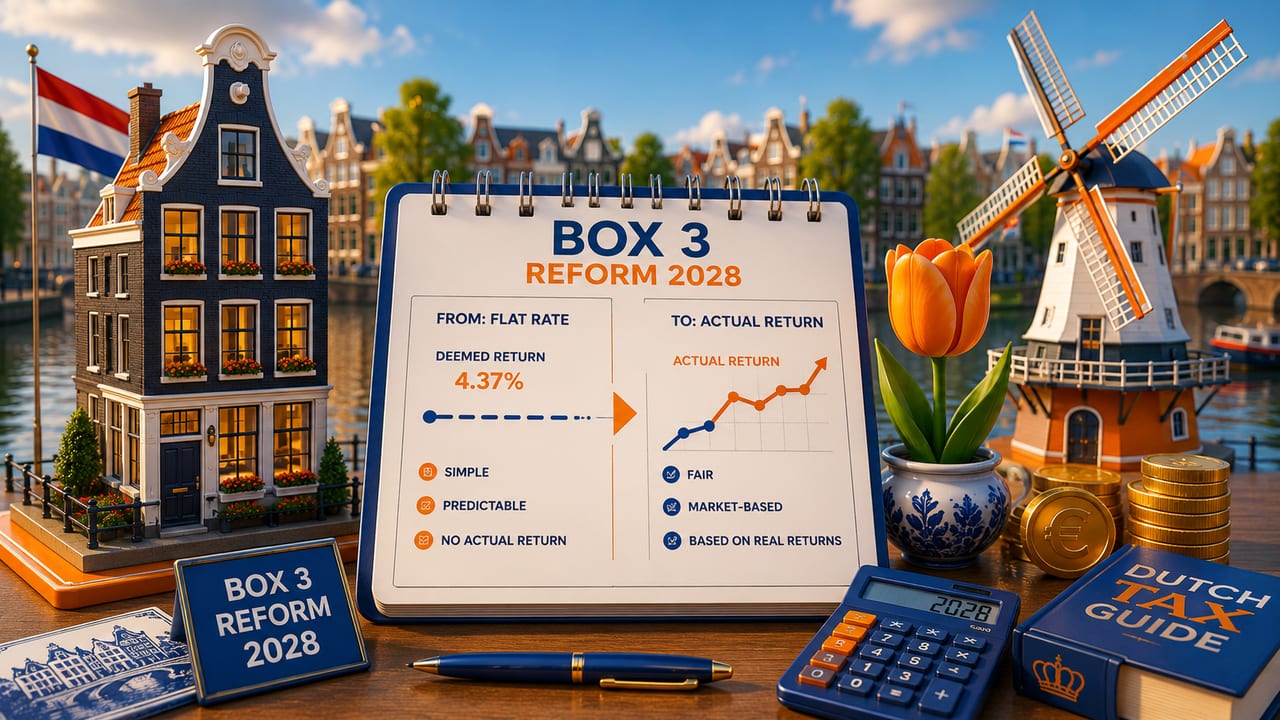
The Dutch wealth tax (Box 3) has undergone significant changes as the government transitions toward a system based on actual investment returns rather than fictitious yields.
Box 3 and Real Estate
Under the current transitional rules, non-primary residences (such as buy-to-let properties) are taxed heavily in Box 3. Savers and property investors enjoy a tax-free allowance (heffingsvrij vermogen) of exactly €59,357 per person (doubled to €118,714 for fiscal partners) for the 2026 tax year. Any net wealth above this allowance is subject to Box 3 taxation.
- Fictitious Yield: The government assumes a deemed yield of approximately 5.69% on the value of the property (WOZ value).
- Tax Rate: This deemed yield is taxed at a flat rate of 36%.
- The Cost: This means you pay an annual wealth tax of approximately 2.0% of the property's total value exceeding your allowance, regardless of whether you have a tenant or how much rental income you actually collect.
5. Linear vs. Annuity Mortgage: Which Saves You More Money Over 30 Years?
When buying a home in the Netherlands, you must choose between a linear mortgage and an annuity mortgage to qualify for the mortgage interest deduction (hypotheekrenteaftrek).
- Linear Mortgage: You pay a fixed amount of principal repayment every month, plus interest on the remaining balance. Monthly payments start high but decrease over time.
- Annuity Mortgage: Your total monthly payment remains constant. In the early years, you pay mostly interest; in the later years, you pay mostly principal.
The Verdict
A linear mortgage is cheaper over the full 30-year term because you pay off the principal faster, resulting in less total interest paid. However, the annuity mortgage is more popular because the initial monthly payments are lower and more manageable for first-time buyers.
6. The Eigenwoningforfait Trap: What Happens to Your Mortgage Interest Deduction Over Time?
The mortgage interest deduction (HRA) is offset by the eigenwoningforfait — a tax on home ownership. The government adds a percentage (typically 0.35%) of your home's WOZ value to your taxable income.
As the HRA rate cap decreases (down to 37.56% in 2026) and WOZ values rise, the net benefit of the interest deduction is shrinking. If you have a small mortgage, the eigenwoningforfait can exceed your mortgage interest deduction, meaning you receive no tax relief and pay net tax on your home equity.
7. Understanding the Dutch NHG (Nationale Hypotheek Garantie) Benefit
The Nationale Hypotheek Garantie (NHG) is a government-backed mortgage safety net in the Netherlands. If you face financial hardship (due to job loss, disability, or divorce) and can no longer pay your mortgage, the NHG fund can cover the outstanding debt if the home is sold at a loss.
Because the NHG reduces the risk for lenders, banks offer interest rate discounts of up to 0.50% on NHG mortgages. To qualify for the NHG in 2026, the purchase price of the home must be below the NHG limit. The lower interest rate directly increases your monthly savings and maximizes the efficiency of your Box 1 mortgage interest deduction.