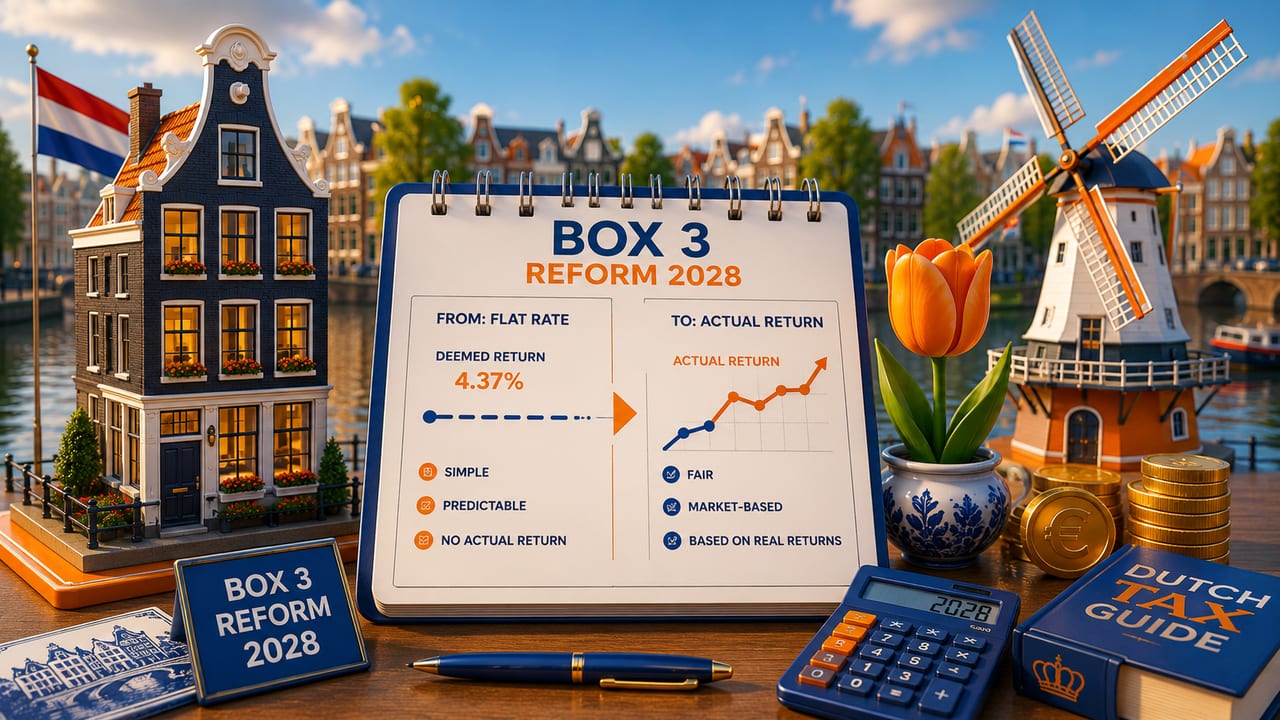
Box 3 2026 (Current) vs Box 3 2028 (Proposed)

In 2026 the Belastingdienst taxes a fictional 6.00% return on your investments whether you earned it or not. From 2028 you pay 36% on what you actually made: including paper gains. Same portfolio, very different bills.

Interactive Comparison Simulator

Adjust the variables below to simulate outcomes, compare rates, and see real-time projections.

Side-by-Side Comparison

A direct comparison of features, rules, limits, and eligibility requirements.

Feature / DetailBox 3 2026 (Deemed Return)Box 3 2028 (Actual Return)
Tax rate
36% on a fictional return
36% on your real return
Deemed rates 2026
Savings 1.28%, investments 6.00%, debts −2.70%
None: actual interest, dividends and value changes count
Tax-free allowance
€59,357 of wealth (€118,714 with partner)
€1,800 of return (€3,600 with partner)
A year with losses
Deemed tax is still calculated: you must invoke the rebuttal scheme (tegenbewijsregeling) and prove your real return to get it to €0
€0 automatically, and losses can offset future years
Paper gains before you sell
Never taxed above the 6.00% forfait
Taxed every year for liquid assets (vermogensaanwasbelasting)
Debt interest
Only a −2.70% deemed rate, even if you pay 5% interest
Actual interest paid is fully deductible
Administration
Declare your 1 January balances, done
Track every dividend, trade and year-end valuation; costs like broker fees are not deductible
Legal status
Patched interim system after the Hoge Raad struck down deemed returns (Kerstarrest 2021, confirmed June 2024)
Passed the Tweede Kamer on 12 February 2026; planned start 1 January 2028

Pros & Cons Breakdown

Analyze the advantages and drawbacks of each financial product before making a decision.

Box 3 2026 (Deemed Return) Pros & Cons

Advantages of Box 3 2026 (Deemed Return)

  • Returns above 6.00% are tax-free: a 15% portfolio year is still taxed as if you made 6%.
  • One January balance declaration: no transaction tracking, no year-end valuations.
  • Predictable: you can compute your bill on 1 January and be done.
  • The €59,357 wealth exemption keeps modest savers out of Box 3 entirely.

Disadvantages of Box 3 2026 (Deemed Return)

  • You owe tax on returns you never made unless you file rebuttal evidence yourself.
  • Cash-heavy savers are hit hardest: real savings interest is far below what the mixed forfait assumes on larger portfolios.
  • Debt relief is capped at a −2.70% deemed rate even when your actual loan rate is higher.
  • The rebuttal route means collecting broker statements and filing extra forms: the simplicity is gone the moment markets fall.

Box 3 2028 (Actual Return) Pros & Cons

Advantages of Box 3 2028 (Actual Return)

  • A loss year automatically means €0 Box 3 tax, with loss carry-forward to later years.
  • Actual debt interest is fully deductible instead of a capped deemed rate.
  • No more paying tax on fictional income: the core unfairness the Hoge Raad condemned.
  • Ends the tax incentive to park everything in cash just to dodge the 6% investment forfait.

Disadvantages of Box 3 2028 (Actual Return)

  • Paper gains on shares, funds and crypto are taxed every year before you sell: you may owe cash on gains you have not banked.
  • The tax-free amount collapses from €59,357 of wealth to €1,800 of return.
  • Full record-keeping of every dividend, trade and valuation; broker and advisory fees are not deductible.
  • Strong bull years get expensive: 36% of the whole real gain instead of 36% of a capped 6%.

What this choice actually costs you

The same portfolio, two very different rulebooks

Take Jeroen, 41, with €100,000 in savings earning 1.5%, €150,000 in ETFs that returned 6% this year, and a €10,000 investment loan at 4%. Under the 2026 rules the Belastingdienst ignores all of that and applies its own numbers: 1.28% on his savings (€1,280), 6.00% on his investments (€9,000), minus 2.70% on his debt (−€270). Deemed return: €10,010. After the wealth exemption of €59,357 his taxable share works out to roughly €7,530, and the bill at 36% is about €2,712.

Under the 2028 rules the fiction disappears. Jeroen's actual return, €1,500 interest plus €9,000 investment gain minus €400 loan interest: is €10,100. Subtract the new €1,800 tax-free return and he pays 36% of €8,300: €2,988.

In this average year the two systems land within €300 of each other. That is by design. The forfait percentages are calibrated to long-run averages. The gap appears the moment your year is not average.

Where the pain moves: lean years vs boom years

Keep Jeroen's portfolio fixed and only change how the markets behave. In a lean year his real return is €2,000. The 2026 system does not care: still €2,712, unless he files rebuttal evidence. The 2028 system charges 36% of (€2,000 − €1,800), €72.

Now a boom year: €25,000 of real gains, most of it unsold paper profit on his ETFs. The 2026 bill is unchanged at €2,712 because the forfait caps out at 6.00%. The 2028 bill is 36% of €23,200, €8,352: payable in cash even though he sold nothing.

That is the trade in one picture. The 2028 system removes the injustice at the bottom and sends the bill to the top. If your portfolio is volatile, expect your Box 3 tax to become volatile with it, and plan liquidity for the years your screen is green.

Why 88% of your 2026 bill comes from the investment forfait

Look inside Jeroen's €10,280 of positive deemed return: €1,280 comes from €100,000 of savings, €9,000 from €150,000 of investments. Investments are 60% of his assets but drive 88% of the taxed return, because the 6.00% forfait is nearly five times the 1.28% savings rate.

This is why the current system quietly punishes anyone the Belastingdienst classifies as an 'investor': including holders of a second home or crypto that went nowhere. It is also why the Hoge Raad intervened twice: the 2021 Kerstarrest ruled that taxing fictional returns breaches the European Convention's property protections, and the June 2024 ruling forced the rebuttal scheme that now lets you prove a lower real return for 2025-2027.

Until 2028 arrives, the practical move is simple: check every year whether your real return is below the deemed one. If it is, the tegenbewijsregeling exists precisely for you: use the opgaaf werkelijk rendement form and pay tax on reality instead of fiction.


The Verdict

2028 is fairer when you lose; 2026 is cheaper when you win big.

For the portfolio in the simulator (€100,000 savings, €150,000 invested, €10,000 debt), the 2026 system charges about €2,712 while the 2028 rules on the same actual returns would charge about €2,988: nearly identical. The systems only diverge when your real return strays from the forfait: earn 12% and 2028 costs you roughly triple; lose money and 2028 drops to zero automatically while 2026 makes you prove it. Since you cannot choose between them, 2028 arrives for everyone. The real question is what to do before the switch: investors sitting on large unrealized gains should price in annual taxation of paper gains from 1 January 2028.

Choose Box 3 2026 (Deemed Return) if...

Investors who consistently beat 6% and want zero administration: enjoy it while it lasts.

Choose Box 3 2028 (Actual Return) if...

Savers with modest real returns, anyone holding Box 3 debt, and investors tired of paying tax on returns they never earned.

Built & MaintainedBuilt by Galvin Mendonca, Finance Researcher
All figures from primary government sources. Last updated July 25, 2026.

Frequently Asked Questions

You Might Also Like

View All

Sources & references

The rules and figures on this page are researched from official primary sources:

Disclaimer: The comparison data, simulator outputs, and projections on this page are provided for general informational and educational purposes only. They do not constitute financial, investment, tax, or legal advice. All values are estimates based on statutory data and hypothetical inputs. Interest rates, contribution limits, tax brackets, and regulatory rules change frequently and vary by jurisdiction. Always consult a qualified professional advisor and verify critical figures with official government publications before making any financial decisions.