Introduction: Freelancing as a ZZP'er in the Netherlands
Operating as a self-employed professional in the Netherlands—commonly referred to as a ZZP'er (Zelfstandige zonder personeel)—offers immense freedom, schedule flexibility, and a highly competitive tax structure. However, unlike salaried employees whose taxes are withheld monthly by employers, self-employed individuals must manage their own tax liabilities and file annual returns with the Dutch Tax Office (Belastingdienst).
To encourage entrepreneurship, the Dutch government offers several powerful tax deductions that reduce your taxable income base. However, the regulatory environment is changing. For 2026, the Belastingdienst has made significant adjustments to primary allowances to align tax rates for freelancers and employees.
This guide provides an exhaustive breakdown of the ZZP tax deduction environment for the 2026 tax year, outlines the 1,225-hour urencriterium, explains the MKB-winstvrijstelling, and details healthcare contributions (Zvw).
ZZP vs. Salaried Employee Tax Matrix (2026)
| Feature / Bracket | ZZP Freelancer (1,225 hours) | Salaried Employee (Loondienst) |
|---|---|---|
| Tax Bracket 1 (Up to €38,883) | 35.75% Box 1 tax | 35.75% payroll tax |
| Tax Bracket 2 (€38,883 – €78,426) | 37.56% Box 1 tax | 37.56% payroll tax |
| Tax Bracket 3 (Above €78,426) | 49.50% Box 1 tax | 49.50% payroll tax |
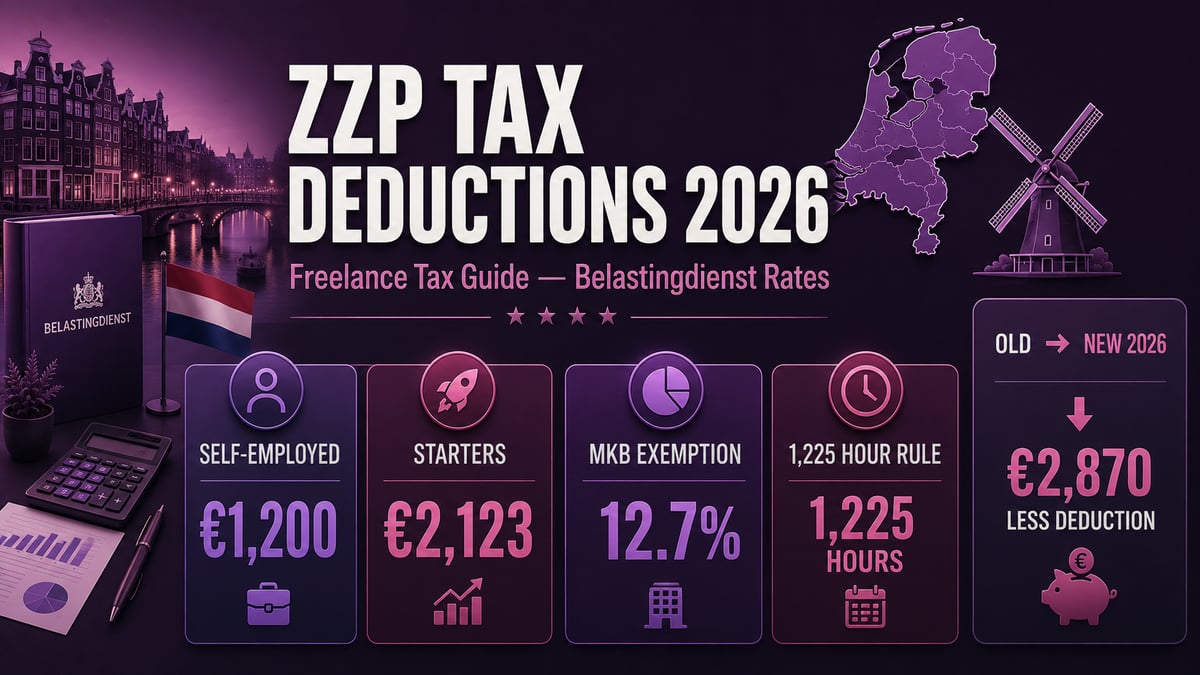
| Zelfstandigenaftrek | €1,200 deduction | Not eligible |
| Startersaftrek | €2,123 deduction (first 3 of 5 years) | Not eligible |
| MKB-winstvrijstelling | 12.7% profit exemption | Not eligible |
| ZVW Healthcare Surcharge | 4.85% (paid by ZZP'er, capped at €79,409) | 6.57% (paid fully by employer) |
| Holiday Pay & Sick Leave | None (self-funded) | 8% holiday pay + minimum 20 days paid leave |
2026 Box 1 tax brackets for ZZP profit
Important
Self-employed deductions only apply if the Belastingdienst recognizes you as an entrepreneur for income tax purposes (ondernemer voor de inkomstenbelasting). Simply registering with the Chamber of Commerce (KVK) is not sufficient. For details, consult our Zelfstandigenaftrek Glossary Entry.
1. Primary Deductions: Zelfstandigenaftrek & Startersaftrek
To qualify for primary deductions, the most critical step is meeting the Uren-criterium (hours criterion), which requires you to work at least 1,225 hours in a calendar year on your business. For details, see the Uren-criterium Glossary Entry.
Zelfstandigenaftrek (Self-Employed Deduction)
If you satisfy the urencriterium, you can claim the Zelfstandigenaftrek. For the 2026 tax year, this deduction is €1,200 (down from €3,750 in 2024). The government is phasing this deduction down towards €0 over the coming years to reduce tax discrepancies between freelancers and workers. If your business profit is too low to use the full deduction, you can carry forward the unused amount for up to 9 years.
Startersaftrek (Starters Allowance)
If you are a new freelancer, you can claim the Startersaftrek as an addition to the self-employed deduction. For 2026, this allowance is €2,123. You can claim this deduction up to 3 times in your first 5 years of business, provided you meet the 1,225-hour rule and did not operate as a tax entrepreneur in at least one of the last five years. Review the rules in our Startersaftrek section above.
2. SME Profit Exemption (MKB-winstvrijstelling)
Unlike the primary deductions, the MKB-winstvrijstelling (SME profit exemption) is available to all entrepreneurs recognized by the tax office, even if you do not meet the 1,225-hour rule. This makes it an incredibly valuable tax relief for side-hustlers and part-time freelancers.
For 2026, the MKB-winstvrijstelling is 12.7% (reduced from 13.31% in 2024). This exemption is calculated after subtracting the self-employed and starters deductions from your gross business profit. The remaining profit is reduced by 12.7%, and Box 1 income tax is assessed on the remaining 87.3%.
Taxable Profit Formula:
Use our ZZP Net Tax Calculator to compute this base.
3. The Healthcare Contribution (ZVW) and Social Security
In the Netherlands, every resident must pay health insurance premiums. Salaried employees have their income-dependent healthcare contribution (Zvw) covered fully by their employer (6.57% of salary). However, self-employed individuals must pay this contribution themselves:
- 2026 ZVW Rate: Self-employed professionals pay a rate of 4.85% of their taxable profit.
- Cap: The contribution is capped at a maximum annual taxable profit base of €79,409.
Furthermore, because you do not pay standard employee social security premiums, you are not covered under state unemployment (WW) or disability (WIA) insurance. You must buy private disability insurance (AOV) and open a tax-deferred pension account (pensioensparen) to secure your retirement.
Breaking Down the 1,225-Hour Urencriterium
Meeting the urencriterium is the gateway to almost every meaningful entrepreneur deduction. The rule itself sounds simple—you need to spend at least 1,225 hours per calendar year on your business. But the Belastingdienst counts a surprisingly broad range of activities. Many freelancers assume only billable client work counts. Actually, the following all qualify:
- Client meetings, project work, and deliverables
- Administrative tasks including bookkeeping, invoicing, and bank reconciliations
- Writing proposals and quotes for potential projects
- Marketing activities including social media, website maintenance, and content creation
- Networking events and industry conferences
- Professional development courses and training relevant to your business
- Travel time directly related to client work
- Maintaining your workspace and equipment
A common trap: if you also hold part-time employment, the Belastingdienst requires that you spend more than half of your total working hours on your business. There is an exception for startups in their first years—the starter exception. Also note that the 1,225-hour requirement is not pro-rated. If you register your business halfway through the year, you still need to log 1,225 hours before December 31. This catches many mid-year starters off guard.
Practical Hour Logging Tips
The Belastingdienst can request proof of your hours, and they do audit this. Keep a simple spreadsheet or use a time-tracking app. Record your hours daily—trying to reconstruct months of work from memory does not hold up in an audit. Save supporting documents: calendar entries, emails, invoices, train tickets, and meeting notes. Dutch law requires you to keep your administration for 7 years.
If you become unable to work due to illness or injury, a reduced criterion of 800 hours replaces the standard 1,225 for that year. Pregnant freelancers also get 16 weeks credited at their average weekly hours.
For a quick check: if you work 40 weeks per year, you need roughly 31 hours per week on your business. That is about 6 hours per day, 5 days a week. Many freelancers meet this without realizing it simply through normal operations.
Business Expense Deductions: What You Can Actually Write Off
One of the biggest advantages of being a ZZPer is the ability to deduct legitimate business expenses from your revenue before tax is calculated. The Belastingdienst allows deductions for costs that are incurred for the purpose of generating business income. Here is what typically qualifies:
Fully Deductible Business Costs
- Office supplies, software licenses, and cloud subscriptions
- Professional services (accountant, legal advice, notary)
- Business insurance premiums (aansprakelijkheidsverzekering, bedrijfsinventaris)
- Bank fees for your business account
- Domain names, website hosting, and online advertising costs
- Telephone and internet costs (if you can show business use)
- Travel expenses for client visits using public transport
- Representation costs (client meals are 80% deductible, gifts to clients up to a threshold)
- Costs of your home office workspace under certain conditions
The Home Office Deduction (Thuiswerkplek)
A common question: can you deduct your home office? The answer is generally no unless your workspace meets strict criteria. You can only claim a home office deduction if the room has a separate entrance and private toilet facilities, and you rent it out to your business at a fair market rate. Simply working from your dining table does not qualify for a separate deduction—your general housing costs (rent, mortgage interest, utilities) are considered private expenses.
The KIA (Kleinschaligheidsinvesteringsaftrek)
If you make significant investments in business assets (equipment, machinery, vehicles), you may qualify for the Small-Scale Investment Deduction. For 2026, investments between €2,901 and €398,236 can qualify. The exact deduction percentage depends on the investment amount. This is separate from the zelfstandigenaftrek and does not require the 1,225-hour rule.
VAT (BTW) Obligations for ZZPers
Most ZZPers who supply taxable goods or services in the Netherlands must charge VAT (BTW) on their invoices and file regular returns. The standard VAT rate is 21% for most goods and services. A reduced rate of 9% applies to food, medicines, books, and some cultural services. A 0% rate applies to exports and certain international services.
VAT returns are typically filed quarterly, though the Belastingdienst may assign monthly or annual filing periods depending on your business size. The deadline is one month after the end of the filing period.
The KOR (Kleineondernemersregeling) Exemption
If your annual turnover is below €20,000, you can apply for the KOR—the small business VAT exemption. Once approved, you do not charge VAT on your invoices, and you also cannot reclaim VAT on your business expenses. The KOR removes the administrative burden of quarterly filing. However, if you work mainly with VAT-registered business clients who could reclaim your VAT, the KOR might not be beneficial since your invoices would not show a VAT amount they can reclaim.
Worked Example: A Typical ZZPers 2026 Tax Calculation
Let us put all the pieces together with a concrete example. Suppose you are a freelance web developer with the following numbers for 2026:
- Gross revenue: €65,000
- Business expenses: €8,500 (laptop, software, home office materials, travel, accountant)
- You meet the 1,225-hour urencriterium
- You are not eligible for startersaftrek (you have been freelancing for 6 years)
Step 1: Calculate profit before entrepreneur deductions
Revenue minus expenses = €65,000 minus €8,500 = €56,500
Step 2: Apply zelfstandigenaftrek
€56,500 minus €1,200 = €55,300
Step 3: Apply MKB-winstvrijstelling (12.7%)
12.7% of €55,300 = €7,023
The deduction stack in the €65,000 worked example
Taxable profit = €55,300 minus €7,023 = €48,277
Step 4: Calculate Box 1 income tax
First bracket (up to €38,883): €38,883 × 35.75% = €13,900
Second bracket (€38,883 to €48,277): €9,394 × 37.56% = €3,528
Total Box 1 tax = €17,428
Step 5: Add ZVW healthcare contribution
4.85% of €48,277 = €2,341
Step 6: Calculate net income
€56,500 minus €17,428 minus €2,341 = €36,731 net
From €65,000 revenue to €36,731 net
This means from €65,000 in revenue, you keep roughly €36,731 after taxes and healthcare contributions—an effective tax rate of about 35%. While that sounds reasonable, remember this does not account for general tax credits (heffingskortingen) which can reduce your overall bill by several thousand euros depending on your circumstances.
The Big Risk in 2026: False Self-Employment Crackdown
A critical development for 2026 that every ZZPer should understand: the Belastingdienst has begun actively enforcing rules against false self-employment (schijnzelfstandigheid). If you work for a single client full-time, essentially functioning as an employee without the benefits, the tax office may reclassify you as an employee. This means your client becomes liable for payroll taxes and social premiums, and you lose access to entrepreneur deductions.
The enforcement has ramped up significantly from 2026 onward. If your situation is ambiguous—long-term single-client contracts, working at the clients premises, using their equipment—discuss your contract structure with a belastingadviseur (tax advisor) to ensure your ZZP status is defensible.
Filing Deadlines and Practical Tips
For the 2026 tax year, these are the key dates to remember:
- March 1, 2026: The Belastingaangifte form becomes available online
- May 1, 2026: Deadline to submit your 2025 income tax return
- September 1, 2026: Extended deadline if you requested an extension before May 1
- Quarterly: Your BTW returns are due one month after each quarter ends
Practical tips for staying organized: open a separate savings account and deposit 35-40% of every invoice payment you receive. This covers your estimated tax bill so you are not caught short when the assessment arrives. Keep all receipts digitally—the Belastingdienst accepts scanned copies and photos.