Quick Answer: What Are the LRS TCS Rates for 2026-27?
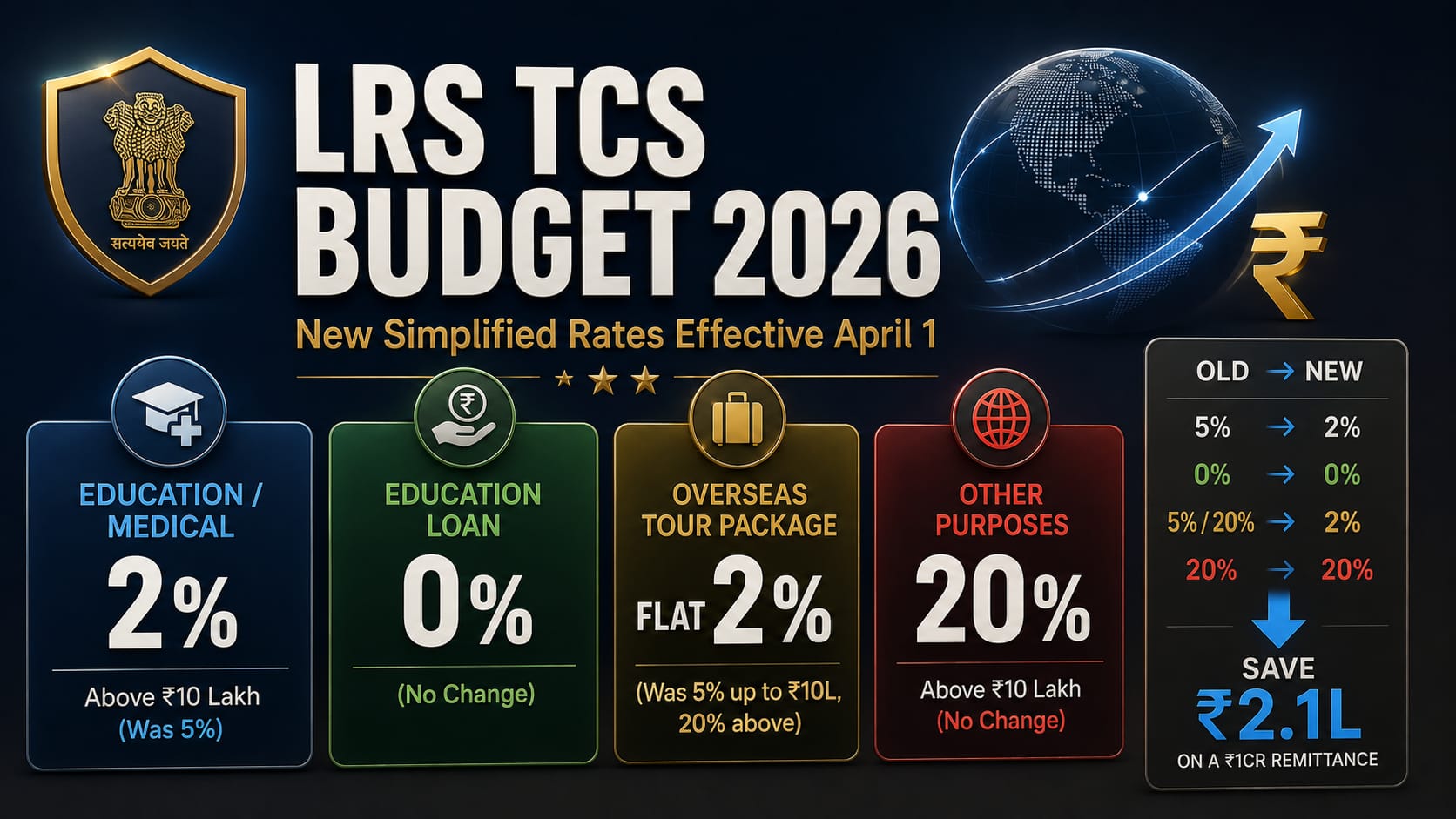
If you're sending money abroad from India, here is exactly what you pay in Tax Collected at Source (TCS) under the Liberalised Remittance Scheme (LRS) effective April 1, 2026:
- Self-funded education: 2% TCS on the portion of your remittance that pushes your total LRS outflow above ₹10 lakh in the financial year.
- Medical treatment: Same as education—2% TCS only on amounts exceeding ₹10 lakh cumulative LRS.
- Education (recognized loan): 0% TCS with no amount cap. Full stop.
- Overseas tour package: 2% TCS on the full amount—from the first rupee, no ₹10 lakh threshold.
- All other LRS purposes (gifts, investments, family maintenance, buying property abroad): 20% TCS on the portion exceeding ₹10 lakh cumulative.
Use our free LRS TCS Calculator to instantly compute your exact TCS liability for any remittance scenario.
Introduction: The Most Significant LRS TCS Reform in Years
The Union Budget 2026, presented on February 1, 2026, brought sweeping changes to Tax Collected at Source (TCS) on foreign remittances under the Liberalised Remittance Scheme (LRS). Effective April 1, 2026, these changes represent the most significant simplification of cross-border remittance taxation in India in recent years.
The headline changes: education and medical treatment remittances saw TCS slashed from 5% to 2% above the ₹10 lakh threshold. Overseas tour packages were completely overhauled—the old two-tier system of 5% (up to ₹10L) and 20% (above ₹10L) was replaced with a single, simple 2% rate with no threshold. These reforms directly benefit students studying abroad, patients seeking overseas medical treatment, and families planning international vacations.
This full guide covers every aspect of the new LRS TCS regime: the exact rates for each purpose category, how the ₹10 lakh cumulative threshold works across multiple transactions and banks, the critical education loan exemption, how TCS flows back as credit in your Form 26AS, practical examples for common scenarios, and answers to the most frequently asked questions.
How the ₹10 Lakh Cumulative Threshold Works
The single most misunderstood aspect of LRS TCS is the ₹10 lakh threshold. Here is the precise rule:
- The threshold is cumulative across all LRS outward remittances you make in a financial year.
- It applies across all banks—remitting ₹4L from HDFC and ₹4L from ICICI counts as ₹8L total.
- It applies across all purpose codes—education + medical + gift remittances all pool into one cumulative total.
- Once your total crosses ₹10L, TCS applies to subsequent amounts at the rate applicable to each purpose.
Critical exception: Overseas tour packages ignore the threshold entirely. 2% TCS applies from the first rupee of every tour package remittance, regardless of your cumulative total.
Example: You remit ₹6L for education in June, ₹3L for a medical procedure in August, and ₹4L for a gift in November. Your cumulative total is ₹13L. TCS applies on the last ₹3L:
- Education portion crossing threshold: ₹0 (already accounted in first ₹6L, but education already consumed portion of threshold)
- The first ₹10L is exempt from TCS. The remaining ₹3L comes from the November gift remittance, so the 20% rate applies to that ₹3L portion, resulting in ₹60,000 TCS.
TCS by Purpose: Complete Rate Table
| Purpose | TCS Rate | Threshold | Notes |
|---|---|---|---|
| Education (self-funded) | 2% | Above ₹10L cumulative LRS | Reduced from 5% by Budget 2026 |
| Education (recognized loan) | 0% | None | Loan must qualify under Section 80E |
| Medical treatment | 2% | Above ₹10L cumulative LRS | Reduced from 5% by Budget 2026 |
| Overseas tour package | 2% | None (first rupee) | Was 5%/20% tiered; now flat 2% |
| Gift / Investment / Other | 20% | Above ₹10L cumulative LRS | Unchanged from prior regime |
| Family maintenance | 20% | Above ₹10L cumulative LRS | Covers monthly support to family abroad |
TCS rate by remittance purpose (2026-27)
Worked Examples
Example 1: Education Remittance (Self-Funded)
Scenario: Parent sends ₹15 lakh in June 2026 for child's tuition in the US. No other LRS remittances this year.
- Cumulative LRS: ₹15L
- Threshold: ₹10L
- Taxable: ₹5L
- TCS at 2%: ₹10,000
- Total outflow: ₹15,10,000
Example 2: Education with Recognized Loan
Scenario: Same ₹15L but financed by a bank education loan under Section 80E.
- TCS: ₹0 (regardless of amount)
- Total outflow: ₹15,00,000
- Saving vs Example 1: ₹10,000 in upfront cash flow
₹15 lakh of tuition: self-funded vs loan-funded
Example 3: Overseas Tour Package
Scenario: Family tour package costing ₹20 lakh.
- Old regime: ₹10L × 5% + ₹10L × 20% = ₹50,000 + ₹2,00,000 = ₹2,50,000 TCS
- New regime (flat 2%): ₹20L × 2% = ₹40,000 TCS
- Saving: ₹2,10,000 in upfront cash flow—a dramatic improvement
TCS on a ₹20 lakh tour package: old vs new regime
Example 4: Multiple Remittances, One FY
Scenario: You remit ₹4L for education (July), ₹3L for medical (September), and ₹5L as a gift to parents (December).
- Cumulative: ₹12L | Exempt portion: First ₹10L
- Last ₹2L (part of the gift remittance) is taxable
- Gift TCS at 20%: ₹2L × 20% = ₹40,000
- Education and medical portions fall within the ₹10L threshold, so 0% TCS on those
How TCS Credit Works at Tax Filing
TCS is not a final cost—it is an advance collection of tax. Here's how the lifecycle works:
- At remittance: Your bank debits the remittance amount + TCS. The bank issues Form 27D (TCS certificate) detailing the collection.
- During the year: The TCS appears in your Form 26AS under the TCS section (Part VI). It also shows in your Annual Information Statement (AIS).
- At ITR filing: When you file your Income Tax Return, you claim the TCS amount as a credit under "Tax Collected at Source" in Schedule TCS.
- Net effect: If your total tax liability (salary + other income) is ₹1,50,000 and you paid ₹40,000 in TCS, you owe ₹1,10,000 more. If your tax liability is ₹20,000, you get ₹20,000 as a refund (TCS credit exceeds tax due).
Important: You must file ITR to claim TCS credit. If your income is below the taxable threshold, file a Nil return to claim the TCS refund.
Comparison: Old vs New LRS TCS Regime
| Aspect | Before April 1, 2026 | After April 1, 2026 |
|---|---|---|
| Education TCS (above ₹10L) | 5% | 2% |
| Medical TCS (above ₹10L) | 5% | 2% |
| Tour package (up to ₹10L) | 5% | 2% flat |
| Tour package (above ₹10L) | 20% | 2% flat |
| Education loan TCS | 0% (already exempt by Budget 2025) | 0%—completely exempt |
| Gift/Investment TCS | 20% (above ₹10L) | 20% (unchanged) |
| Threshold | ₹10L (introduced in 2025) | ₹10L (unchanged) |
LRS Annual Limit
Beyond TCS, remember the RBI's LRS framework limits total outward remittances to USD 250,000 per individual per financial year. This limit is per person—a family of four can remit up to USD 1,000,000 combined. Remittances exceeding this limit require RBI approval.
Quick Decision Guide by Scenario
You're a parent sending tuition fees: Use the education purpose (self-funded). 2% TCS on amounts above ₹10 lakh total LRS this FY. If you can get a recognized education loan, switch to loan-funded for 0% TCS.
You're a patient seeking overseas medical treatment: Use the medical purpose. 2% TCS on amounts above ₹10 lakh total LRS this FY. Same rate as self-funded education.
You're booking a family vacation: Use the tour package purpose. 2% TCS on the full amount—no ₹10 lakh threshold, no tiered rates. On a ₹20L package, you save ₹2.1 lakh in upfront TCS vs the old regime.
You're gifting money or investing abroad: Use the other/gift purpose. 20% TCS on amounts above ₹10 lakh total LRS. This rate is unchanged from the prior regime.
You're below the taxable income limit: Pay TCS upfront (it's mandatory), but file your ITR to claim a full refund. TCS is a deposit, not a cost.
One rule to remember: The ₹10 lakh threshold is cumulative across ALL your LRS remittances in a financial year—across all banks, all purposes, all transactions. Track your total before remitting.