Count the depositor and the bank, not passbooks
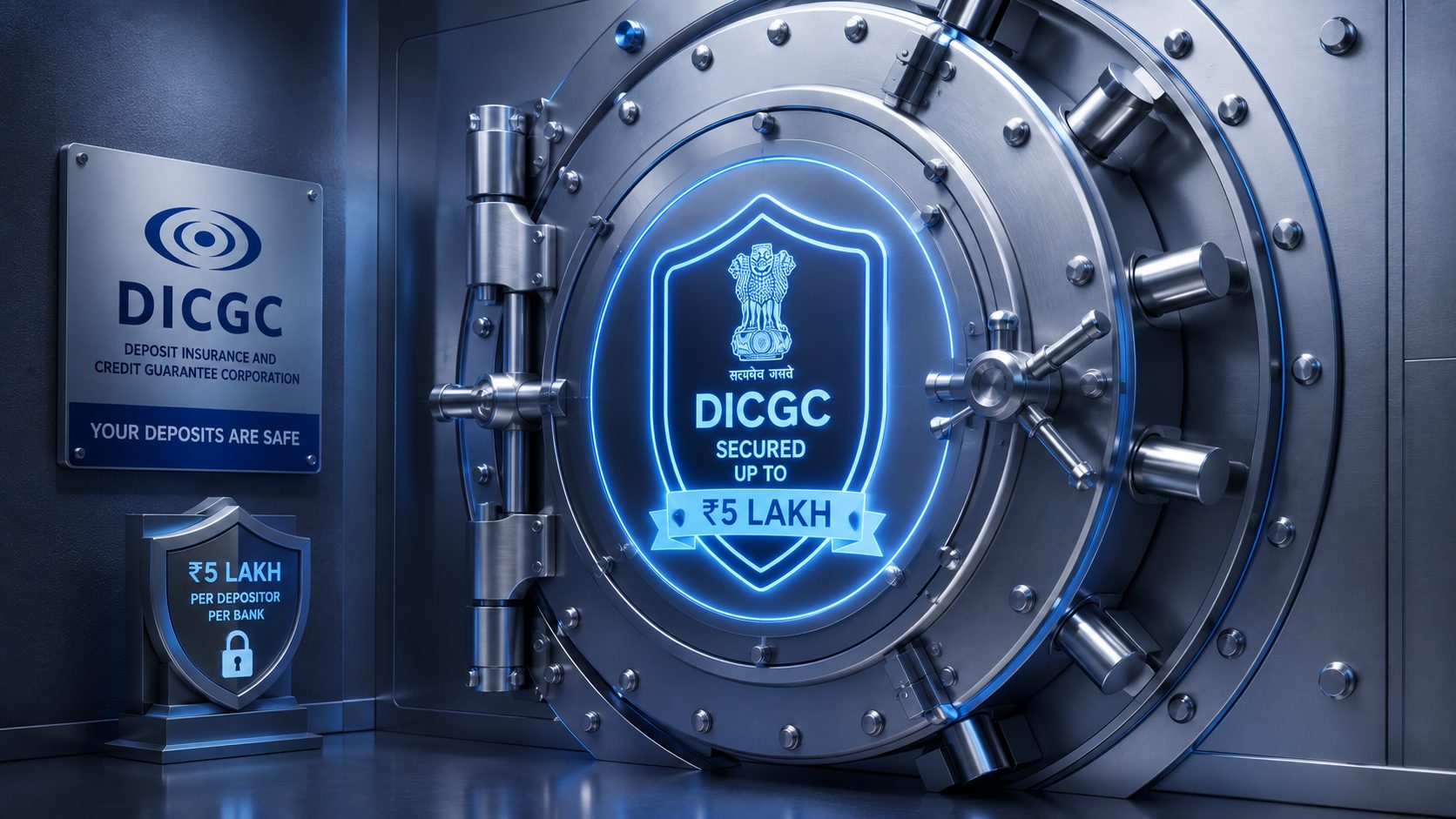
DICGC deposit insurance is a legal ceiling, not a guarantee that every rupee at every financial company is protected. For an eligible depositor at an insured Indian bank, the maximum is ₹5,00,000 for principal and accrued interest together, held in the same right and capacity at that bank. The DICGC FAQ explicitly aggregates deposits across branches and across savings, fixed, current and recurring accounts in that ownership capacity. The figure is measured at the applicable bank-resolution date, not at the date a saver made the first deposit. The DICGC FAQ gives a useful threshold example: ₹4,95,000 principal plus ₹4,000 accrued interest totals ₹4,99,000, all within the cap. If principal alone is ₹5,00,000, another ₹4,000 of interest is outside the limit. The interest does not receive a separate allowance. This matters when a fixed deposit is close to the ceiling and interest accumulates between statement dates.
That aggregation is the detail a generic “bank deposits are safe” headline misses. Opening four fixed deposits at four branches of the same bank does not create four ₹5 lakh limits. Holding deposits at two legally separate insured banks can create separate limits, but you should confirm which legal bank issued each account. A payment app, brokerage product or non-bank investment is not transformed into an insured bank deposit merely because it looks like a savings balance. The DICGC guide lists covered deposit types and exceptions.
Asha's interest pushes one bank over the cap
Assume Asha holds ₹3,20,000 in a savings account and ₹1,60,000 in a fixed deposit at the same insured bank. Accrued interest at the trigger date is ₹25,000, making ₹5,05,000 in the same right and capacity. Up to ₹5,00,000 falls within the DICGC ceiling; ₹5,000 exceeds it. This is a limit calculation, not a prediction that a bank will fail or that she will lose the excess. DICGC's booklet confirms that both principal and interest count.
If Asha instead had moved ₹1,00,000 of that deposit to a different insured bank before the trigger date, the first bank would hold ₹4,05,000 and the second ₹1,00,000, assuming nothing else changed. Each total is within its own ₹5 lakh limit, so the illustrated ₹5,05,000 would be within the two separate ceilings. This does not make either bank risk-free or give instant access during a resolution. A transfer between two brands of one legal bank might not create a second ceiling.
Insurance ceiling in Asha’s ₹5,05,000 example
The same-right-and-capacity rule means account title matters. Joint accounts with different holders or ordering can have different treatment under the DICGC FAQ; do not multiply limits casually by adding a name. DICGC also notes that the bank may set off a depositor's dues before determining the insured amount. Ask the bank to identify the legal institution and account ownership if the balances are material.
Which money is outside this protection?
DICGC lists insured savings, fixed, current and recurring deposits at insured banks. Its exclusions include foreign-government deposits, central or state-government deposits, inter-bank deposits and deposits received outside India. A mutual fund, share, bond or investment account is not a DICGC-covered deposit merely because a bank distributes it. Nor should you assume an entity calling itself a finance company is an insured bank. The DICGC guide and the bank's own insurance leaflet give the scope.
The phrase “₹5 lakh per depositor per bank” also does not mean a joint account always adds a fresh ₹5 lakh on top of each holder's individual accounts. DICGC applies the same-right-and-capacity test to account combinations. The exact titles, holder order and rights are important, and a simple web calculator cannot substitute for checking them. For a household with several large accounts, make a table of the legal bank, holder names and order, account type, principal and accrued interest. That gives you something to verify with the bank rather than assuming a branch label is enough.
What the 90-day rule actually covers
For a bank placed under RBI All Inclusive Directions with withdrawal restrictions, DICGC's guide describes a statutory sequence: the bank furnishes a depositor list within 45 days; DICGC verifies within 30 days after receiving it; payment follows within 15 days after verification, with the overall period from the restriction date to payment not exceeding 90 days under Section 18A. These figures are statutory processing limits for that route, not a promise that a customer can withdraw all their deposits within 90 days or that every kind of bank failure uses the same process.
Statutory maximum stages under the AID route
Payment still depends on the claim list, identity and account information. The DICGC claim-status page covers specified banks and warns that the data are supplied by the bank; a missing result there is not proof of no entitlement. For liquidation or merger, the claim path and recipient can differ. DICGC publishes its settled-claims records, which show why processing context matters more than a universal “48-hour refund” promise.
A practical coverage check
Confirm that the institution, not merely its brand or app, is an insured bank. List your balances and accrued interest by legal bank and ownership capacity, then compare each total with the ₹5 lakh ceiling. If you are above the limit, splitting deposits across genuinely separate insured banks is one possible risk-management choice, but consider accessibility, interest terms and record keeping as well. Keep nominee and contact details current so a legitimate claim can be identified. DICGC insurance is a backstop for specified bank-resolution events; it is not a substitute for an emergency-fund liquidity plan or a guarantee against every financial loss.