
Introduction: The New Weekly Credit reporting Era in India
Effective July 1, 2026, the Reserve Bank of India (RBI) has implemented a landmark credit reporting reform under Direction RBI/DOR/2025-26/119. This new rule mandates that all Credit Institutions (CIs)—including public sector banks, private commercial banks, NBFCs, and co-operative banks—transition from the traditional fortnightly or monthly reporting schedule to a weekly credit data submission cycle.
Historically, banks reported borrower payment histories to Credit Information Companies (CICs) once a month. This led to reporting lags of 30 to 45 days, causing delayed reflections of debt clearances and loan payoffs on credit files. Under the 2026 weekly framework, your credit record will update in near-real-time, allowing borrowers to rebuild their credit scores much faster after settling outstanding balances.
This guide explains the operational mechanics of the new cycle, details the bank submission and credit bureau ingestion windows, and outlines how Days Past Due (DPD) records are affected.
Before vs. After RBI Credit Reporting Timelines
| Operational Stage | Pre-July 1, 2026 Reporting Cycle | Post-July 1, 2026 Weekly Cycle | RBI Mandated Duration |
|---|---|---|---|
| Reporting Frequency | Monthly or Fortnightly | Weekly (4 specific reference dates) | 4 times per month |
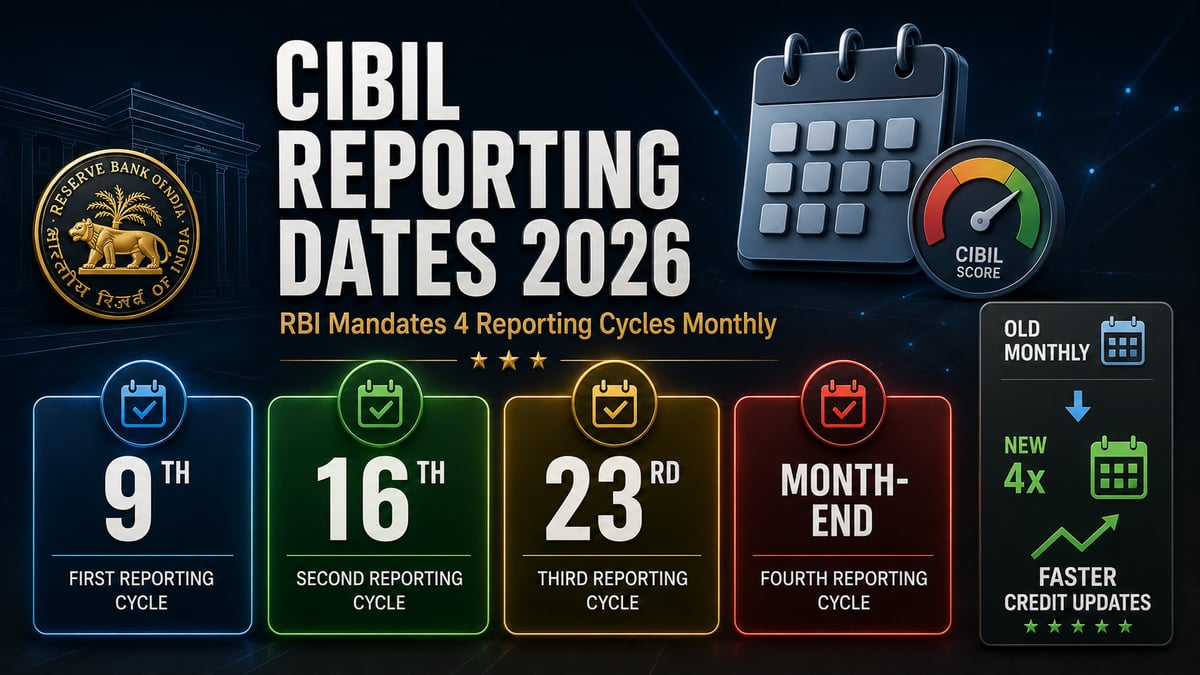
| Designated Reference Dates | 15th and month-end | 9th, 16th, 23rd, and last day of the month | Fixed dates |
| Bank Submission Window | 7 to 15 calendar days from reference date | 4 calendar days from reference date | Max 4 days limit |
| CIC Ingestion Window | 7 calendar days from file receipt | 5 calendar days from file receipt | Max 5 days limit |
| Total Update Lag | 30 to 45 calendar days | 1 to 9 calendar days | Max 9 days limit |
Worst-case lag from repayment to credit report
Important
Banks that fail to report data within the mandated 4-day window will be flagged by CICs and reported to the RBI via the DAKSH supervisory portal on a half-yearly basis. For more details on credit regulations, see our CIC Glossary Entry.
1. The Four Monthly Reference Dates and Bank Timelines
Under the new weekly reporting directions, banks and NBFCs must compile borrower files as of four specific calendar dates each month:
- 9th of the month
- 16th of the month
- 23rd of the month
- Last day of the month (e.g. 30th or 31st)
Full vs. Incremental Reporting Files
Lenders submit two types of data files:
- Full File Submission: A full file representing all active and closed borrower accounts as of the last day of the month. This file must be submitted to the bureaus by the 5th of the following month.
- Incremental File Submission: For the other three dates (9th, 16th, and 23rd), banks are only required to submit incremental updates. This includes new accounts opened, accounts closed, repayments received, and updates to accounts with overdue interest or installments.
The Bank Submission Deadline
Banks have a maximum of 4 calendar days from the reference date to submit the data file. For example, data captured on the 9th must be received by CIBIL and other bureaus by the 13th of the month. This short window forces banks to automate their credit reporting software.
2. Bureau Ingestion Timelines and Reflection Windows
Once a Credit Information Company (such as TransUnion CIBIL, Experian, Equifax, or CRIF High Mark) receives a credit data file from a bank, it has a maximum of 5 calendar days to ingest, validate, and reflect the updates on the borrower's credit report.
Therefore, the total time from the reference date to the update appearing on your report is at most 9 days (4 days bank submission + 5 days bureau ingestion). In practice, if a bank submits data on day 1 and the bureau ingests it on day 1, your report could update in as little as 2 days.
Credit Score Volatility
Because data is ingested weekly, your credit score may change four times a month instead of once. While this may cause minor fluctuations, it benefits borrowers who pay off outstanding debt, as their score will rise almost immediately, rather than weeks later.
3. Days Past Due (DPD) and the Late Payment Recovery Gap
If you miss a loan payment or pay late, your bank registers a positive value under the Days Past Due (DPD) field (e.g., '030' for 30 days late). DPD flags are highly damaging to credit scores and make it difficult to qualify for new loans.
Under the old monthly cycle, if you cleared a late payment on the 5th of the month, the bank might not report the clearance until the end of the month, and CIBIL might not ingest it until the 10th of the next month, leaving a 'late' flag on your file for 35 days. Under the 2026 rules, if you clear a late payment on the 20th of the month, the bank captures the clearance in the 23rd reference file (submitted by the 27th), and CIBIL updates your DPD status to '000' (on-time) by the 2nd of the next month. This represents a massive benefit for consumers recovery-wise.
What Triggered the Reform?
Before July 2026, credit institutions in India reported borrower data to credit bureaus either monthly or fortnightly, depending on the institution type. This created reporting lags of 30 to 45 days. If you paid off a credit card or closed a loan, the clearance could take weeks to reflect on your CIBIL report. Meanwhile, if you were applying for a new loan, the lender would see outdated data showing higher outstanding balances or missed payments that had already been resolved.
The RBI recognized that India's rapidly expanding credit market — growing at 15-18% annually — needed faster, more accurate data to support responsible lending. Direction RBI/DOR/2025-26/119, issued in December 2025 and effective July 1, 2026, applies to all categories of credit institutions: commercial banks, NBFCs, cooperative banks, local area banks, all India financial institutions, and non-banking financial companies.
The Full Timeline: From Reference Date to Your Credit Report
Here is exactly how the timeline works for each reference date:
| Reference Date | Bank Submits By | Bureau Ingests By | Expected Report Update |
|---|---|---|---|
| 9th | 13th | 18th | 18th-20th |
| 16th | 20th | 25th | 25th-27th |
| 23rd | 27th | 1st/2nd of next month | 1st-4th |
| Last day of month | 5th of next month | 10th of next month | 10th-12th |
Processing windows: old vs weekly regime
For the last day of the month, a full file is submitted (all active and closed accounts). For the 9th, 16th, and 23rd, only incremental files are submitted. This means if your data did not change since the last reference date, the bank does not need to resend your full record for those mid-month snapshots. Only the month-end file contains the complete picture.
What Is in an Incremental File?
For the 9th, 16th, and 23rd reference dates, banks only submit data that has changed. The incremental file includes:
- Accounts opened since the last reporting reference date
- Accounts where the relationship has ended since the last reporting date (closed accounts)
- Accounts with any borrower-initiated change: repayment, change in outstanding balance, updated demographic details, changes in related parties, guarantors, or account ownership
- Accounts where an interest installment or principal is overdue, including changes in Days Past Due (DPD)
- Accounts where only the DPD has changed — yes, even if nothing else changed, a DPD update triggers inclusion
This targeted approach reduces data transmission volumes by an estimated 60-70% compared to sending full files four times a month.
CKYC Requirement and Data Quality
An important addition in the amended directions: banks must now include the Central KYC (CKYC) number in their credit reports. CKYC is a unified KYC registry maintained by CERSAI that stores identity documents (Aadhaar, PAN, passport) in a central repository. By mandating CKYC in credit reports, the RBI aims to eliminate duplicate or fragmented credit histories caused by different ID documents across different lenders.
If your CKYC number is not correctly mapped to your credit accounts, your bank's data submission may be rejected by the bureau. If you notice discrepancies in your credit report, check that your CKYC is properly linked to all your credit accounts. You can obtain your CKYC number from any bank where you have an account.
What Happens When a Bank Misses the Deadline?
The RBI has introduced a strict compliance mechanism. Credit Information Companies (CICs) are now required to report non-compliant credit institutions to the RBI through the DAKSH portal — the RBI's supervisory platform. This reporting happens semi-annually, as of March 31 and September 30 each year.
For a bank to be flagged, it must have failed to adhere to the data submission timelines. The consequences of being reported include regulatory scrutiny, potential penalties, and increased supervisory attention. This creates a strong incentive for banks to automate and improve their reporting systems.
How Borrowers Can Benefit From Weekly Reporting
The shift to weekly reporting creates several practical advantages for borrowers:
Faster score improvement after settling dues: If you settle a loan or pay off a credit card, the clearance will reflect in your CIBIL score within 9 days instead of 30-45 days. This is especially valuable if you are planning to apply for a new loan soon after settling an old one.
Earlier detection of errors: Incorrect late payment flags can be identified and disputed sooner. Since data refreshes weekly, you can catch errors within days rather than waiting a full month.
Better credit utilization tracking: If you use a credit card with a high limit, your reported utilization ratio (balance divided by limit) will update weekly. Paying down your balance before a specific reference date can quickly improve your utilization ratio — which accounts for 30% of your CIBIL score.
Smarter payment timing: If you know your bank reports data as of the 9th, 16th, or 23rd, you can time your payments to ensure they are captured before those dates. For example, if your credit card bill is due on the 15th, paying it on the 13th means the bank captures the zero balance in the 16th snapshot.
A Warning on DPD Volatility
While faster updates are generally beneficial, they can also work against you. Under the old monthly system, a single missed payment might take weeks to appear, giving you a grace period to fix it. Under the weekly system, any missed payment — even just a few days overdue — will appear on your credit report within 9 days. There is no more grace period hiding in the reporting lag.
Conversely, clearing a missed payment immediately fixes your DPD status within the same short window. The system is more responsive in both directions: good and bad.
Practical Strategy: Align Your Bill Payments
To maximize the benefit of weekly reporting, align your payment schedule with the RBI reference dates:
- Find out your credit card statement date and due date
- Set up auto-pay to clear the full balance 3-4 days before the nearest reference date
- For loan EMIs, ensure the auto-debit is set for a date at least 3 days before the reference date
- If you are planning a large loan application, make an extra payment before the reference date to lower your outstanding balance and utilization ratio
Use our CIBIL Update Date Predictor tool to calculate exactly when your payment will reflect on your credit report based on your specific bank's reporting pattern.