Calculator
8-City HRA Exemption Calculator (FY 2026-27)
Calculate your HRA tax exemption under the 8-city expanded rule (adding Bengaluru, Pune, Hyderabad, Ahmedabad) for FY 2026-27.
Try it nowSee how India's New Labour Codes 50% basic salary rule reshapes your CTC: changes in employee and employer PF, gratuity, and net monthly take-home pay.
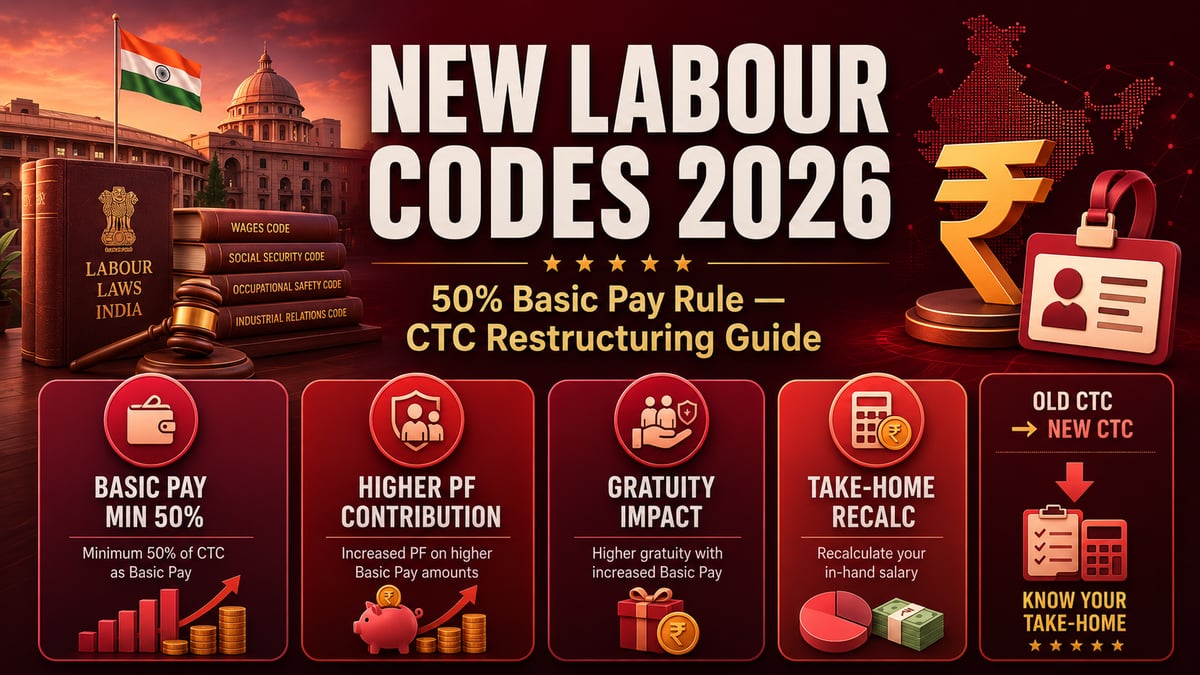
Use our CTC Restructuring Calculator to model your salary layout under India's New Labour Codes. The central rules require that your Basic Salary plus Dearness Allowance (DA) must constitute at least 50% of your total Cost to Company (CTC). Restructuring your salary can significantly increase your provident fund (PF) and gratuity savings while adjusting your monthly net take-home pay.
Under the new Code on Wages, the definition of wages has been standardized. Basic Pay plus DA must constitute at least 50% of the total CTC. Other allowances (such as HRA, travel allowances, special allowances) cannot exceed 50% of the CTC. If they do, the excess is treated as wages, and PF must be calculated on the revised base.
Provident Fund contributions are calculated at 12% of your Basic salary. Restructuring your CTC to raise Basic Pay to 50% increases the base for both employee and employer PF contributions. Gratuity, which is calculated as 15/26 of a month's basic salary for every year of service, also increases, so the same restructure that trims monthly cash quietly grows the retirement corpus.
Because both employee and employer PF contributions are deducted from the total CTC, a higher Basic Pay increases these retirement deductions. While your long-term retirement accumulation rises, your immediate monthly cash in hand (net take-home) may decrease, especially if your basic salary was previously set at a very low percentage of your CTC (e.g., 30%).
For two decades Indian employers engineered pay slips the same way: keep basic salary at 30-40% of CTC and stuff the rest into allowances, because PF, gratuity, and leave encashment all key off basic. Lower basic meant higher take-home and lower statutory cost. The Code on Wages ends the game: 'wages' (basic plus DA) must be at least 50% of total remuneration, and anything engineered below that line gets added back for every statutory calculation anyway.
The rule rewires your payslip without changing your CTC by a rupee. Basic rises to half the package, the allowance pool shrinks to make room, and every basic-linked statutory item, both PF contributions, gratuity accrual, moves up in lockstep. The calculator shows your exact before-and-after split rather than the vague 'take-home will fall' headlines.
Meera's monthly cash drops about ₹2,881 because her own 12% PF contribution now bites a bigger basic. That is the headline people resent, but the ledger has a second side: her annual retirement accumulation, employer PF plus employee PF plus gratuity accrual, rises by roughly ₹40,000 a year, earning EPF's tax-free interest and compounding until she leaves service.
Framed honestly, the Codes force-shift about 3% of her package from spendable cash into locked retirement savings. For a 28-year-old that forced ₹40,000 a year at EPF rates compounds to a very large number by 58; for a household living paycheck-to-paycheck the cash squeeze is real and immediate. Both facts are true, which is why the calculator shows the monthly loss and the annual savings gain side by side instead of picking a narrative.
Tax adds a mild sweetener: the employee PF share sits in 80C under the old regime, and gratuity remains tax-exempt up to ₹20 lakh at exit, so part of the 'lost' take-home returns as lower tax or later tax-free payout.
Check three things before signing the revised annexure. First, that CTC itself did not shrink, the Codes mandate the SPLIT, not a pay cut, and a restructure that quietly trims special allowance beyond what the 50% rule requires is negotiation, not compliance. Second, how gratuity is funded: if it was previously outside your CTC and now appears inside it, your package absorbed a cost the employer used to carry. Third, HRA: it is typically set as a percentage of basic, so a higher basic can RAISE your HRA and its tax exemption, partially offsetting the PF squeeze for renters who claim it under the old regime.
Timing note for 2026: the central rules under the four Codes were notified in May 2026, with employers given transition windows to re-paper salary structures. If your payslip has not changed yet, it will, and running your own numbers before the HR email arrives converts an unpleasant surprise into a checked expectation.
High earners have one extra wrinkle: employer PF contributions above ₹7.5 lakh a year (across PF, NPS, and superannuation) are taxable as perquisite, so a big basic jump at senior CTCs can create a new tax line the old structure avoided. The restructure still binds; the tax planning just moves to the NPS/VPF allocation instead, and the calculator's before-and-after split is the starting point for that conversation with your CA.
The New Labour Codes CTC Restructuring Calculator models the changes in salary components (Basic Pay, allowances, PF, and gratuity) mandated by India's Code on Wages, 2019.
The math engine restructures your total CTC package so that Basic Pay plus Dearness Allowance (DA) constitutes exactly 50% of the CTC, adjusting HRA and other allowances to maintain the same total CTC value while calculating revised PF and gratuity allocations.
Meera, a Bengaluru product analyst, has an annual CTC of ₹12,00,000 and a current monthly basic of ₹40,000, so ₹4,80,000 basic a year, just 40% of CTC.
Her current annual employer PF is ₹4,80,000 × 12% = ₹57,600, and current gratuity is ₹4,80,000 × 4.8077% = ₹23,077.
Current annual allowances are ₹12,00,000 - ₹4,80,000 - ₹57,600 - ₹23,077 = ₹6,39,323.
Under the new Codes her annual basic must be 50% of CTC: ₹6,00,000.
New annual employer PF: ₹6,00,000 × 12% = ₹72,000; new gratuity: ₹6,00,000 × 4.8077% = ₹28,846.
New annual allowances: ₹12,00,000 - ₹6,00,000 - ₹72,000 - ₹28,846 = ₹4,99,154.
Monthly take-home (pre-income-tax) moves from ((₹4,80,000 + ₹6,39,323) - ₹57,600) / 12 = ₹88,477 to ((₹6,00,000 + ₹4,99,154) - ₹72,000) / 12 = ₹85,596.
Net effect: ₹2,881 less cash each month, ₹40,338 more flowing into PF and gratuity each year.
Review the glossary of terms used in the calculation model below. Click on highlighted links to read more in-depth definitions in our financial glossary:
| Parameter | Definition & Context |
|---|---|
| Annual CTC (₹) | Your total annual Cost to Company package as defined by your employer, including gross salary, allowances, and statutory employer benefits. |
| Current Monthly Basic Salary (₹) | Your current monthly basic salary before restructuring, which is typically found on your monthly payslips. |
The rules and figures on this page are researched from official primary sources: