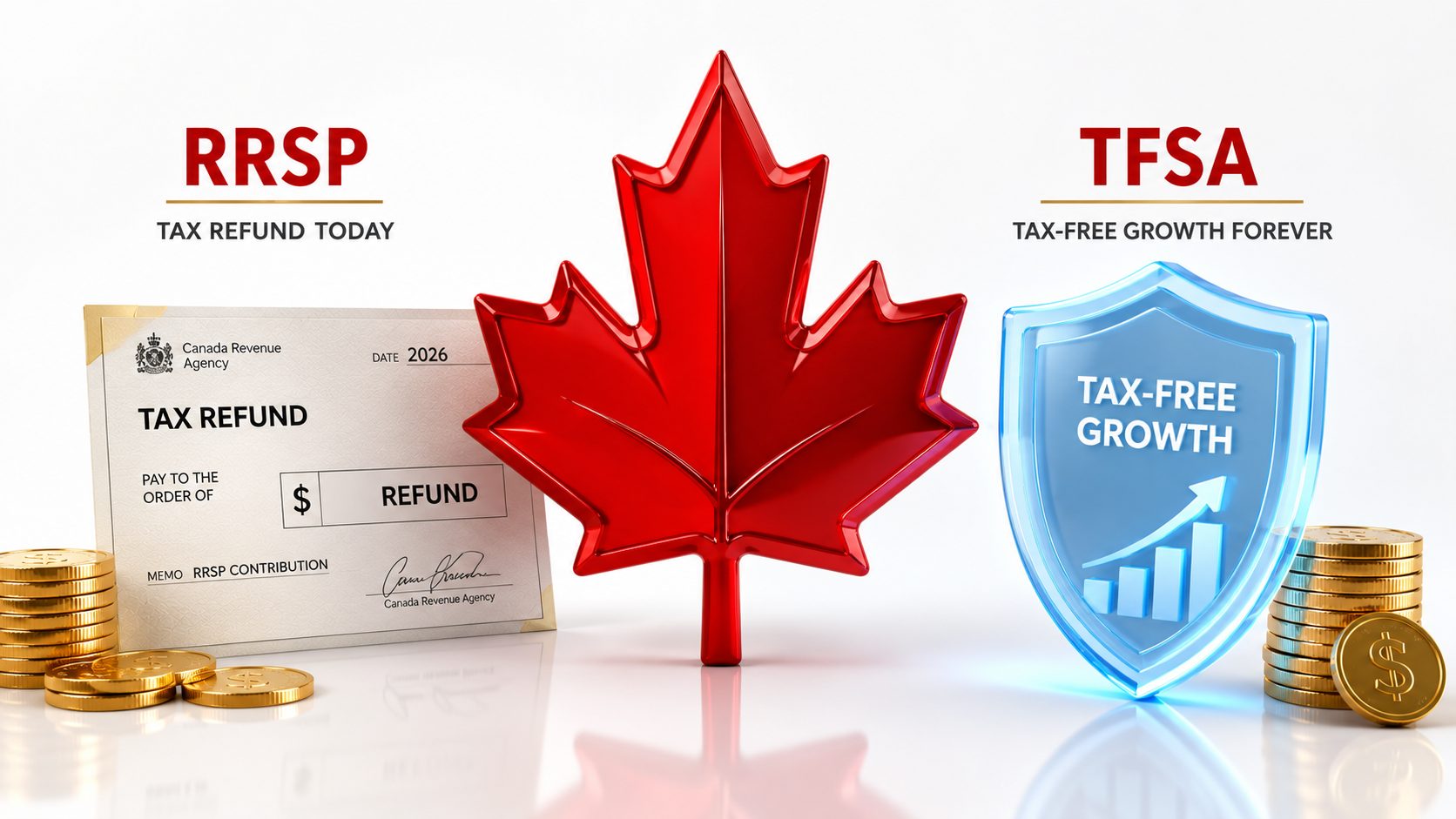
FHSA vs RRSP Home Buyers' Plan (2026)

The FHSA hands a 30%-bracket saver $2,400 back per year and never asks for the money again. The RRSP Home Buyers' Plan lends you up to $60,000 of your own retirement: then bills you for 15 years. Use both, but in the right order.

Interactive Comparison Simulator

Adjust the variables below to simulate outcomes, compare rates, and see real-time projections.

Side-by-Side Comparison

A direct comparison of features, rules, limits, and eligibility requirements.

Feature / DetailFHSARRSP (Home Buyers' Plan)
Withdrawal for a first home
Tax-free and never repaid
Tax-free but must be repaid to your RRSP over 15 years
How much you can pull
$40,000 of contributions ($8,000/yr) plus all growth
Up to $60,000 per person (limit raised in Budget 2024)
Tax deduction on the way in
Yes: every contribution reduces taxable income
Yes: standard RRSP deduction
If you never buy
Roll the whole balance into your RRSP tax-free, without using RRSP room
Nothing happens; the money was already in your RRSP
Deadlines
Use within 15 years of opening or by age 71
Repay 1/15th per year, starting the 5th year after withdrawal (Budget 2024 grace)
Contribution room
Separate from RRSP room; only $8,000 of carry-forward allowed
18% of prior-year earned income, up to $33,810 for 2026

Pros & Cons Breakdown

Analyze the advantages and drawbacks of each financial product before making a decision.

FHSA Pros & Cons

Advantages of FHSA

  • RRSP-style deduction going in, TFSA-style tax-free exit: no other Canadian account combines both.
  • Zero repayment obligation after a qualifying purchase.
  • Never buy? The balance rolls into your RRSP tax-free without touching your RRSP room.
  • Holds stocks, ETFs and GICs like any registered brokerage account.

Disadvantages of FHSA

  • $40,000 lifetime cap covers only part of a down payment in Toronto or Vancouver.
  • Room accrues at $8,000 a year: a windfall cannot be deposited at once.
  • The 15-year clock starts at opening, so opening early with $0 has an expiry cost.
  • Principal residence only; rental and vacation properties are excluded.

RRSP (Home Buyers' Plan) Pros & Cons

Advantages of RRSP (Home Buyers' Plan)

  • Up to $60,000 per person, available immediately if your RRSP already holds it.
  • Couples can withdraw $120,000 combined from existing RRSP balances.
  • First repayment now deferred to the fifth year after withdrawal.
  • Ideal for savers whose employer matching built a large RRSP years ago.

Disadvantages of RRSP (Home Buyers' Plan)

  • It is a loan from your retirement: every dollar must go back over 15 years.
  • Repayments generate no new deduction: the tax benefit was spent years ago.
  • Miss a year's repayment and that 1/15th is added to your taxable income permanently.
  • $60,000 out of the market for years costs real compounding in your retirement plan.

What this choice actually costs you

The refund machine: what five maxed FHSA years look like

Mia earns $90,000 in Ontario: a combined marginal rate near 30%. Each January she puts $8,000 into her FHSA and invests it in a broad index ETF. Every spring, the CRA sends back about $2,400, because the contribution deducts straight off her taxable income.

After five years she has contributed the full $40,000. At 7% average growth the account holds roughly $46,000, and she has collected about $12,000 in refunds along the way. Her effective out-of-pocket cost for $46,000 of down payment: around $28,000.

When she buys, the entire balance, contributions and growth, comes out tax-free with no repayment schedule. Compare that with a plain savings account, where the same $40,000 of deposits earns taxable interest and triggers no refunds at all.

The HBP's fine print: a 15-year IOU to yourself

The Home Buyers' Plan looks similar at withdrawal time: up to $60,000 out of your RRSP, tax-free, for the same first home. The difference starts afterward. Beginning in the fifth year after withdrawal, the CRA expects 1/15th back into your RRSP every year: $4,000 annually on a full $60,000, until roughly 2046 for a 2026 purchase.

Those repayments are tax-dead. A normal $4,000 RRSP contribution earns a refund; an HBP repayment earns nothing, because the deduction was claimed when the money first went in years ago. And skipping a year is expensive: the missed $4,000 is added to your taxable income: a $1,200 tax hit at a 30% rate, and that RRSP room is gone for good.

There is also the quiet cost nobody invoices: $60,000 missing from your retirement portfolio during what are often your best compounding decades. The HBP is genuinely useful, but it is a bridge loan from 65-year-old you, and the interest is paid in lost growth.

Stacking both: how a couple assembles $200,000 tax-free

Nothing stops you using both programs on the same purchase, and for expensive markets that is exactly the play. Each partner: up to $40,000 FHSA (plus growth) and up to $60,000 HBP. A couple who planned ahead can put over $200,000 of registered money on the table: every dollar tax-free at withdrawal.

The order of operations matters more than the total. First: both partners open FHSAs now, even with small deposits: the $8,000 annual room only starts accruing once the account exists. Second: max FHSA room each year before making new RRSP contributions earmarked for the house. Third: only lean on the HBP for the shortfall, and prefer withdrawing from RRSP money that has been there for years rather than making fresh RRSP deposits to withdraw (deposits need 90 days inside the RRSP to qualify anyway).

One more eligibility note that surprises people: 'first-time buyer' resets. If neither you nor your spouse owned and occupied a home in the current year or the four preceding calendar years, you qualify again: for both programs.

The Verdict

Max the FHSA first, every year, without exception; the HBP is the top-up, not the plan.

The FHSA wins the first $8,000 of every year on structure alone: same deduction as the RRSP, but the withdrawal is a clean exit rather than a 15-year repayment schedule. A couple who both max their FHSAs from 2026 can put roughly $92,000 of tax-free, never-repaid money toward a home in five years: after collecting around $24,000 in combined refunds along the way. Reach for the HBP only after FHSA room is exhausted, or when a large RRSP balance already exists from employer plans; it works, but you will be repaying yourself until the 2040s. And if home ownership never happens, the FHSA loses nothing: it converts into bonus RRSP room, which makes opening one this year close to a free option.

Choose FHSA if...

Every eligible first-time buyer, starting with this year's $8,000, and even renters unsure they'll ever buy, thanks to the RRSP rollover fallback.

Choose RRSP (Home Buyers' Plan) if...

Buyers in expensive markets needing more than the FHSA can hold, and savers with large employer-built RRSP balances ready to deploy.

Built & MaintainedBuilt by Galvin Mendonca, Finance Researcher
All figures from primary government sources. Last updated July 25, 2026.

Frequently Asked Questions

You Might Also Like

View All

Sources & references

The rules and figures on this page are researched from official primary sources:

Disclaimer: The comparison data, simulator outputs, and projections on this page are provided for general informational and educational purposes only. They do not constitute financial, investment, tax, or legal advice. All values are estimates based on statutory data and hypothetical inputs. Interest rates, contribution limits, tax brackets, and regulatory rules change frequently and vary by jurisdiction. Always consult a qualified professional advisor and verify critical figures with official government publications before making any financial decisions.