Fixed vs Variable Mortgage Canada

On a $450,000 mortgage, fixed at 4.90% costs $2,592 a month and variable at 5.30% costs $2,710, but break the fixed early and the IRD penalty can run $15,000-$40,000 against the variable's capped ~$6,000. The real comparison is the exit, not the rate.

Interactive Comparison Simulator

Adjust the variables below to simulate outcomes, compare rates, and see real-time projections.

Side-by-Side Comparison

A direct comparison of features, rules, limits, and eligibility requirements.

Feature / DetailFixed Rate MortgageVariable Rate Mortgage
Payment stability
Frozen for the whole term, typically 5 years
Moves with prime (ARM), or stays flat while your amortization stretches (static-payment VRM)
Penalty to break early
Greater of 3 months' interest or the Interest Rate Differential: routinely $15,000-$40,000 on a 5-year fixed
Capped at 3 months' interest, about $6,000 on a $450,000 loan
If rates fall
You keep paying the old rate until renewal
Your interest cost drops automatically with prime
If rates rise
Nothing changes until renewal
ARM payments jump; static-payment VRMs risk hitting their trigger rate
Compounding
Semi-annual, mandated by the federal Interest Act: slightly cheaper per point of rate
Typically monthly off prime
Renewal reality (2026)
Since July 2026, uninsured borrowers switching lenders at renewal (straight switch) no longer face a new stress test
Same straight-switch exemption applies

Pros & Cons Breakdown

Analyze the advantages and drawbacks of each financial product before making a decision.

Fixed Rate Mortgage Pros & Cons

Advantages of Fixed Rate Mortgage

  • Payments cannot move for the term: budgeting is arithmetic, not forecasting.
  • Full protection from Bank of Canada hikes for the length of the contract.
  • Semi-annual compounding makes each point of fixed rate slightly cheaper than it looks.

Disadvantages of Fixed Rate Mortgage

  • IRD break penalties regularly reach $15,000-$40,000 when rates have fallen since signing.
  • No benefit from rate cuts until renewal.
  • Canadian terms cap around 5 years, so you re-roll rate risk twice a decade regardless.

Variable Rate Mortgage Pros & Cons

Advantages of Variable Rate Mortgage

  • Break penalty capped at 3 months' interest: flexibility worth five figures if life changes.
  • Interest cost falls automatically when prime falls.
  • Convertible to a fixed rate at most lenders, penalty-free, at any point in the term.

Disadvantages of Variable Rate Mortgage

  • Payments (or amortization) grow whenever prime rises.
  • Static-payment variables can hit the trigger rate, forcing higher payments or a lump sum at the worst time.
  • You carry the rate risk yourself: the certainty premium runs in reverse.

What this choice actually costs you

The monthly gap is small; the exit gap is not

At today's simulator defaults, $450,000 over 25 years. The fixed at 4.90% costs about $2,592 a month and the variable at 5.30% about $2,710. A $118 monthly gap: real money, but roughly $7,000 over five years if nothing changes.

Now price the exits. Break the variable at any point and the penalty is three months' interest: about $5,960. Break the fixed in year two after rates have dropped 1.5 points, and the Interest Rate Differential penalty on the remaining three years runs near $19,700 on the same balance. The 'cheaper' mortgage just became the expensive one, thirteen years of monthly savings gone in one closing statement.

This is why brokers ask about your five-year life before your rate preference. In Canada — where most people sign five-year terms and most lives don't hold still for five years. The penalty structure is the product.

Trigger rates: how a 'stable' payment quietly stops repaying your house

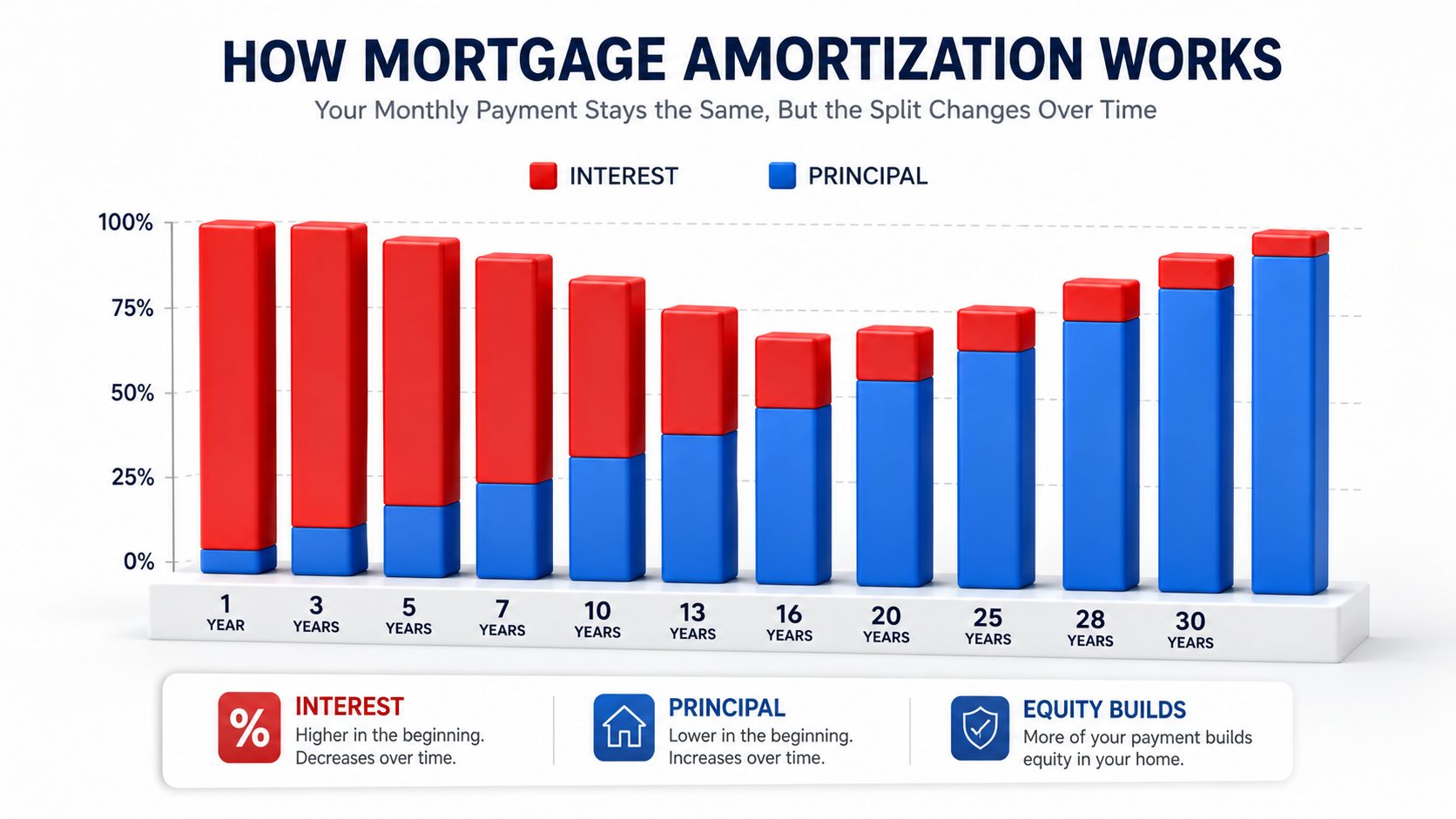
Canada sells two kinds of variable. The adjustable-rate version (Scotiabank, National Bank) moves your payment whenever prime moves: transparent, occasionally painful. The static-payment version (TD, RBC, CIBC and others) keeps your payment flat and silently rebalances it: rates rise, more of the same payment goes to interest, less to principal, and your amortization stretches.

Push rates far enough and you reach the trigger rate: the point where your flat payment no longer covers even the month's interest. The 2022-23 cycle marched thousands of static-payment borrowers into exactly this wall: banks called, demanding higher payments, lump sums, or conversion to fixed at the worst possible moment.

If you take a static-payment variable, know your trigger rate the day you sign (your lender can quote it), and treat any payment that isn't shortening your amortization as a warning light, not a convenience.

What changed in July 2026: renewals became a real market

For years, uninsured borrowers were half-trapped at renewal: switching lenders meant re-passing the stress test at the higher of contract-plus-2% or the qualifying floor, so many just signed whatever their bank offered. OSFI removed that wall: since July 2026, a straight switch (same balance, same amortization, new lender) requires no new stress test.

The practical effect is leverage. Fixed-rate borrowers whose term ends can now genuinely shop 5-10 lenders; variable borrowers can jump ship without requalifying. Renewal letters from your own bank are opening offers, not verdicts: data from rate comparison sites consistently shows first-offer renewal rates running 0.2-0.5 points above what switching secures.

Two boxes to tick before you switch: the exemption covers straight switches, not refinances (no new money, no re-amortization), and start shopping 120 days out: that is how long most lenders will hold a rate for you.

The Verdict

Pick by exit odds, not by rate: any real chance of breaking early favours variable; a tight budget that must survive the term favours fixed.

Canadians break roughly six in ten five-year mortgages before term: divorce, relocation, upsizing, and that statistic decides this comparison more than any rate forecast. If your five-year plan has real uncertainty in it, the variable's capped ~$6,000 penalty is insurance the fixed cannot offer: one IRD bill can erase years of a fixed rate's 'savings'. Take the fixed when the household budget genuinely cannot absorb a payment jump, when you are confident you'll hold the full term, or when fixed prices meaningfully below variable: as it does at today's defaults. And whichever you sign: since OSFI's July 2026 straight-switch exemption, you can shop your renewal to any lender without re-passing the stress test, so never accept your bank's first renewal letter.

Choose Fixed Rate Mortgage if...

Tight-margin budgets that must survive the full term unchanged, first buyers at the edge of affordability, and anyone certain they will not move or refinance for 5 years.

Choose Variable Rate Mortgage if...

Anyone with a realistic chance of selling, refinancing or relocating mid-term, and borrowers with room to absorb payment swings in exchange for a capped exit.

Built & MaintainedBuilt by Galvin Mendonca, Finance Researcher
All figures from primary government sources. Last updated July 25, 2026.

Frequently Asked Questions

You Might Also Like

View All

Sources & references

The rules and figures on this page are researched from official primary sources:

Disclaimer: The comparison data, simulator outputs, and projections on this page are provided for general informational and educational purposes only. They do not constitute financial, investment, tax, or legal advice. All values are estimates based on statutory data and hypothetical inputs. Interest rates, contribution limits, tax brackets, and regulatory rules change frequently and vary by jurisdiction. Always consult a qualified professional advisor and verify critical figures with official government publications before making any financial decisions.