Introduction: The Choice-Based Era of Ontario Auto Insurance
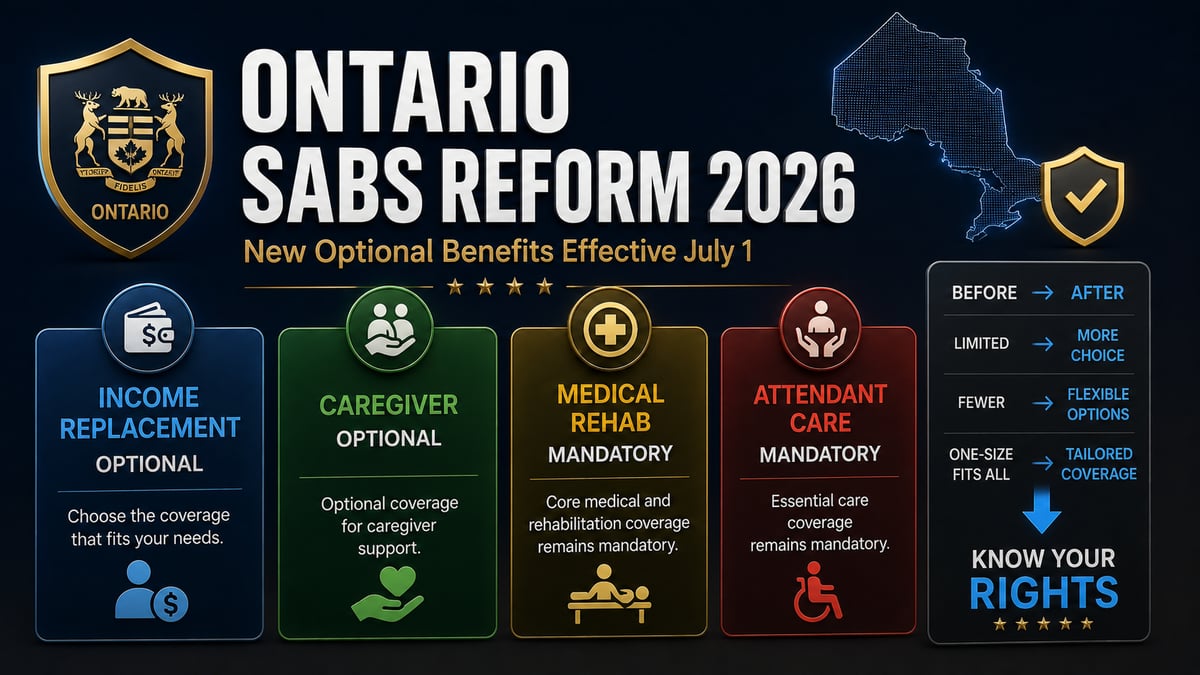
Effective July 1, 2026, Ontario has implemented its most sweeping modernization of the auto insurance system in over a decade. Under the oversight of the Financial Services Regulatory Authority of Ontario (FSRA), the province has transitioned from a mandatory-bundle model to a highly flexible, choice-based system. This reform is designed to address rising premium pressures by giving drivers more agency to customize their coverage.
However, this flexibility introduces significant financial and legal risks. In the past, purchasing a standard auto policy in Ontario automatically guaranteed a strong suite of Statutory Accident Benefits (SABS), including wage replacement and non-earner assistance. Under the 2026 rules, only medical, rehabilitation, and attendant care benefits remain mandatory in a standard policy. All other benefits—including Income Replacement, Non-Earner, Caregiver, and Housekeeping coverage—have become optional.
This full guide provides an exhaustive breakdown of the new modular framework. We compare mandatory and optional coverages, analyze the critical pedestrian and passenger coverage gap.
Before/After SABS Coverage Matrix
| Benefit Category | Pre-July 1, 2026 Standard Policy | Post-July 1, 2026 Standard Policy | Optional Upgrades Available? |
|---|---|---|---|
| Medical, Rehab & Attendant Care | Mandatory (MIG: 65k / CAT: $1M) | Mandatory (MIG: 65k / CAT: $1M) | Yes (Up to 2,000,000 CAT) |
| Income Replacement Benefit (IRB) | Mandatory (70% gross up to $400/week) | Optional ($0 standard unless purchased) | Yes (Increases to $600, $800, or $1,000/week) |
| Non-Earner Benefit (NEB) | Mandatory ($185/week after 4-week wait) | Optional ($0 standard unless purchased) | Yes (Restores standard $185/week benefit) |
| Caregiver Benefit | Mandatory for CAT injuries; Optional for others | Optional ($0 standard unless purchased) | Yes (Up to $250/week + $50/week per extra dependant) |
| Housekeeping & Maintenance | Mandatory for CAT injuries; Optional for others | Optional ($0 standard unless purchased) | Yes (Up to $100/week) |
| Death & Funeral Benefits | Mandatory (10k dependant / $6k funeral) | Optional ($0 standard unless purchased) | Yes (Up to 20k dependant / $8k funeral) |
Weekly benefits that fall to $0 unless you buy them back
Important
If you are an existing customer, your policy will generally renew with your current coverage unless you agree in writing to decline or change your benefits. If you purchase a new policy or make changes at renewal, you must actively choose which optional benefits to add. To learn more about SABS rules, consult our SABS Glossary Entry.
1. Mandatory Core Benefits: The Three Tiers of Injury
Under the July 1, 2026 reform, the mandatory core of every Ontario auto policy is restricted to Medical, Rehabilitation, and Attendant Care benefits. These coverages pay for treatments, physiotherapy, modifications to your home, and professional care. However, the available funds are strictly capped based on the severity of your injuries, which fall into three distinct tiers:
Minor Injury Guideline (MIG)
- Standard Limit: $3,500
- Scope: Applies to common, soft-tissue injuries such as whiplash, sprains, strains, and minor contusions. This guideline is intended to ensure fast access to basic treatment without administrative delays, but the $3,500 limit is frequently exhausted within the first few weeks of therapy.
Non-Catastrophic Impairment
- Standard Limit: $65,000
- Scope: Applies to more serious injuries that do not meet the legal threshold for catastrophic impairment, such as simple fractures, torn ligaments, or moderate concussions. The $65,000 cap covers both medical/rehabilitation expenses and attendant care for up to five years (or until age 18 for minors).
Catastrophic Impairment (CAT)
- Standard Limit: $1,000,000
Mandatory medical limits by injury tier (unchanged)
- Scope: Reserved for life-altering injuries such as severe traumatic brain injuries (TBI), paraplegia, quadriplegia, or total blindness. This $1,000,000 lifetime benefit is critical for funding long-term 24/7 care and specialized housing modifications.
The First Payer Rule for Medical Benefits
Another important aspect of the 2026 reforms is the reinforcement of the First Payer rule. Auto insurers are now the primary or 'first payer' for all medical and rehabilitation expenses resulting from a motor vehicle accident, with one key exception: prescription medication costs. If you require prescription drugs due to an accident, you must submit those claims to your workplace or private extended health plan first. For all other medical expenses (like physiotherapy or chiropractic treatments), your auto insurance policy pays first, saving your workplace benefits for non-accident needs.
2. Optional SABS Benefits: What You Must Actively Add
By making most SABS benefits optional, the Ontario government has shifted the responsibility of financial protection onto the consumer. If you do not actively select and pay for these coverages, you will receive $0 in benefits for these categories if you are injured in an accident.
Income Replacement Benefit (IRB)
If you are employed or self-employed and cannot work due to an accident, the standard optional IRB provides 70% of your gross weekly income, up to a maximum of $400 per week. This benefit begins after a 1-week waiting period and is paid for a maximum of 104 weeks (two years). Because $400 per week (approximately $20,800/year gross) is insufficient for most working Ontarians, you can optionally purchase higher weekly limits of $600, $800, or $1,000 per week to match your salary.
Non-Earner Benefit (NEB)
Designed for individuals who were not employed at the time of the accident—such as students, homemakers, retirees, or the unemployed. If you suffer a complete inability to carry on a normal life, the optional NEB provides $185 per week for up to 104 weeks, starting after a 4-week waiting period.
Caregiver Benefit
If you are the primary caregiver for a dependant (a child or an elderly relative) and cannot perform those duties, this optional benefit pays up to $250 per week for the first dependant, plus $50 per week for each additional dependant to help cover the cost of hiring professional care.
Housekeeping & Home Maintenance
If you are responsible for running a household and can no longer perform chores (cleaning, cooking, mowing the lawn), this optional benefit provides up to $100 per week for up to 104 weeks to hire professional help.
Death & Funeral Benefits
If a policyholder dies in an accident, the optional death benefit pays a lump sum of $25,000 to the surviving spouse, $10,000 to each dependant, and up to $6,000 for funeral expenses.
Death benefits: optional standard vs maximum upgrade
3. The Pedestrian, Cyclist, and Passenger Coverage Gap
The most critical and overlooked legal consequence of the July 1, 2026 reforms is the narrowing of who is covered by optional accident benefits. Under the new regulations, any optional benefits you purchase (such as Income Replacement or Caregiver benefits) only protect:
- The named insured (you)
- Your spouse
- Your dependants
- Persons listed as drivers on your policy
This creates a severe coverage gap for unlisted individuals who do not own their own auto insurance policies, specifically passengers, pedestrians, and cyclists:
Scenario A: An Unlisted Passenger in Your Vehicle
If you carry a friend as a passenger in your vehicle and are involved in an accident, that passenger is only eligible for the mandatory core benefits (medical/rehab) under your policy. If your friend cannot work due to their injuries, they cannot access the optional Income Replacement Benefit on your policy, even if you paid extra to add it to your plan. To receive wage replacement, your friend must either have their own auto insurance policy or rely on private short-term/long-term disability plans.
Scenario B: A Pedestrian or Cyclist Struck by Your Vehicle
If you strike a pedestrian or cyclist, that individual claims accident benefits through your insurance policy (since they are not in a vehicle). Similar to passengers, the struck pedestrian can only access the mandatory core benefits of your policy. They are completely excluded from any optional benefits you purchased. If they do not have their own auto policy, they will receive $0 in wage replacement from your insurer, regardless of how severe their injuries are.
Caution
If you frequently drive passengers or live in a dense urban area with high pedestrian traffic, you should discuss this coverage gap with your broker. While you cannot purchase optional benefits to cover unlisted third parties, understanding this gap highlights the importance of maintaining high Third-Party Liability coverage (at least $2 million) to protect yourself against potential personal injury lawsuits from injured passengers or pedestrians seeking compensation for lost wages.
4. How to Audit Your Coverage and Avoid Pitfalls
To ensure you are fully protected under the 2026 framework, follow this step-by-step audit process before your next renewal:
- Verify Your Employment and Disability Status: If you are employed, check if you have short-term and long-term disability (LTD) coverage through your employer. If you do, verify the benefit amount and duration. If you have strong workplace disability benefits, you may choose to decline the optional auto Income Replacement Benefit to save on premiums. However, if you are self-employed or lack workplace benefits, declining the IRB is highly risky.
- Check Your Extended Health Coverage: Review your workplace or private extended health care plans. If you have excellent coverage for physiotherapy, massage therapy, and chiropractic care, the standard $65,000 non-catastrophic limit may be sufficient. If you lack private coverage, consider purchasing optional higher medical/rehab limits (up to $130,000).
- Assess Dependant Care Needs: If you have young children or care for elderly parents full-time, the Caregiver benefit is essential. Do not assume it is included; verify that it is listed as an active optional benefit on your coverage summary.
- Review All Drivers and Household Members: Ensure every person in your household who drives your vehicle is explicitly listed on your policy. If an unlisted family member is injured while driving your car, the insurer may deny access to optional benefits, leaving them with only the basic mandatory coverage.
- Discuss Limits with a Licensed Professional: Do not make decisions solely to reduce your premiums. Speak with a licensed insurance broker or agent. Have them explain the cost-benefit ratio of each optional SABS item based on your specific lifestyle and household demographics.
The FSRA Mandate and Consumer Protection
The Financial Services Regulatory Authority of Ontario (FSRA) was established as an independent regulatory agency to oversee the province's financial services sector, including auto insurance. The 2026 SABS reforms are part of FSRA's broader auto insurance modernization initiative, which aims to address rising premiums while maintaining consumer protection.
FSRA's stated goals for the reform include:
- Giving consumers more choice and control over their coverage
- Allowing drivers to avoid paying for benefits they already have through workplace or private plans
- Making auto insurers the first payor for medical and rehabilitation claims to preserve workplace benefits
- Encouraging competition and innovation in the auto insurance market
To support the transition, FSRA published full filing specifications, cost benchmarks, rating factors, and consumer transparency expectations. Insurers were required to submit filings demonstrating compliance with the new framework before July 1, 2026.
Updated Forms Under the Reform
The transition to optional SABS requires several updated insurance forms. Key forms impacted include:
| Form | Description | Status |
|---|---|---|
| OPCF 47R | Optional accident benefits coverage & priority of payment (new) | Complete |
| OCF-1 | Application for Accident Benefits | Complete |
| OCF-10 | Election of Income Replacement, Non-Earner or Caregiver Benefit | Complete |
| OCF-19 | Application for Determination of Catastrophic Impairment | Complete |
| OAF-1 | Ontario Application for Automobile Insurance Owners Form | Complete |
If you are purchasing a new policy or making changes at renewal, your insurer or broker will present you with the relevant forms. The OPCF 47R endorsement form specifically lists which optional benefits you are selecting. Read it carefully before signing.
Who Bears the Cost? The Savings Myth vs. Reality
Early media coverage of the SABS reforms suggested that drivers could save significant money by dropping optional benefits. The reality is more measured. FSRA estimates that removing all optional accident benefits saves the average driver approximately $100 per year — roughly $8 per month. For that saving, you lose:
- Income replacement if you cannot work (potential value: thousands per month)
- Non-earner benefit if you are a student or unemployed
- Caregiver benefit if you have dependants
- Housekeeping and home maintenance support
- Death and funeral benefits for your family
When you consider that one day in a hospital costs more than 8 per month for full accident benefits is arguably the best value insurance you will ever buy. The $100 annual saving is not nothing, but it is tiny compared to the potential financial catastrophe of being underinsured after a serious accident.
The First Payor Rule: How Claims Are Now Processed
A significant change that applies regardless of which optional benefits you choose: auto insurers are now the first payor for medical and rehabilitation expenses resulting from a motor vehicle accident. This means:
- You are injured in a car accident
- Your auto insurance policy pays for physiotherapy, chiropractic care, massage therapy, and other rehabilitation costs first
- Your workplace or private extended health benefits are preserved for non-accident related claims
The one exception is prescription medication costs. If your accident requires prescription drugs, you must claim these through your workplace or private health plan first. Only if you do not have medication coverage does your auto policy pay.
This change is designed to help Ontarians preserve their workplace health benefits for other medical needs, rather than exhausting them on accident-related treatment.
How to Discuss Coverage at Renewal
When your auto policy comes up for renewal, your broker or insurer should discuss the optional benefits with you. Here are the questions you should ask:
- Which optional SABS benefits are included in my current policy?
- What is the premium difference if I remove each optional benefit?
- Do I have workplace disability insurance that covers income replacement?
- Do I have extended health benefits that cover physiotherapy and rehabilitation?
- Who in my household relies on my policy for coverage?
- What is the recommended minimum coverage for someone in my situation?
Do not make coverage decisions based solely on premium savings. The right approach is to understand exactly what each benefit covers, whether you have duplicate coverage elsewhere, and what the financial consequences would be if you were injured without that benefit.
The Passenger and Pedestrian Gap: Why It Matters
The narrowing of optional benefits coverage to named insured individuals, their spouses, dependants, and listed drivers has significant implications for Ontario households. Consider these scenarios:
The carpool parent: You drive three neighbourhood children to school each day. If you are in an accident, those children can only access mandatory medical and rehabilitation benefits under your policy. They cannot access income replacement, caregiver, or other optional benefits through your policy. If they do not have their own auto insurance or workplace benefits, their families would need to rely on legal action or social services.
The urban cyclist: You cycle to work daily. A driver hits you at an intersection. You are seriously injured and cannot work for 6 months. If the driver has only mandatory medical coverage, you receive treatment but no income replacement through their policy. Your only option for lost wages is to sue the driver — a process that can take years.
The elderly pedestrian: Your elderly parent is struck in a crosswalk. They are retired and have no auto insurance of their own. They receive medical treatment under the driver's mandatory benefits, but they cannot claim caregiver benefits (if you take time off work to care for them) or housekeeping benefits under the driver's policy.
These gaps highlight the importance of maintaining adequate Third-Party Liability coverage on your own policy. While you cannot purchase optional benefits to cover third parties, having at least $2 million in liability coverage protects your assets if an injured third party sues you for damages.