
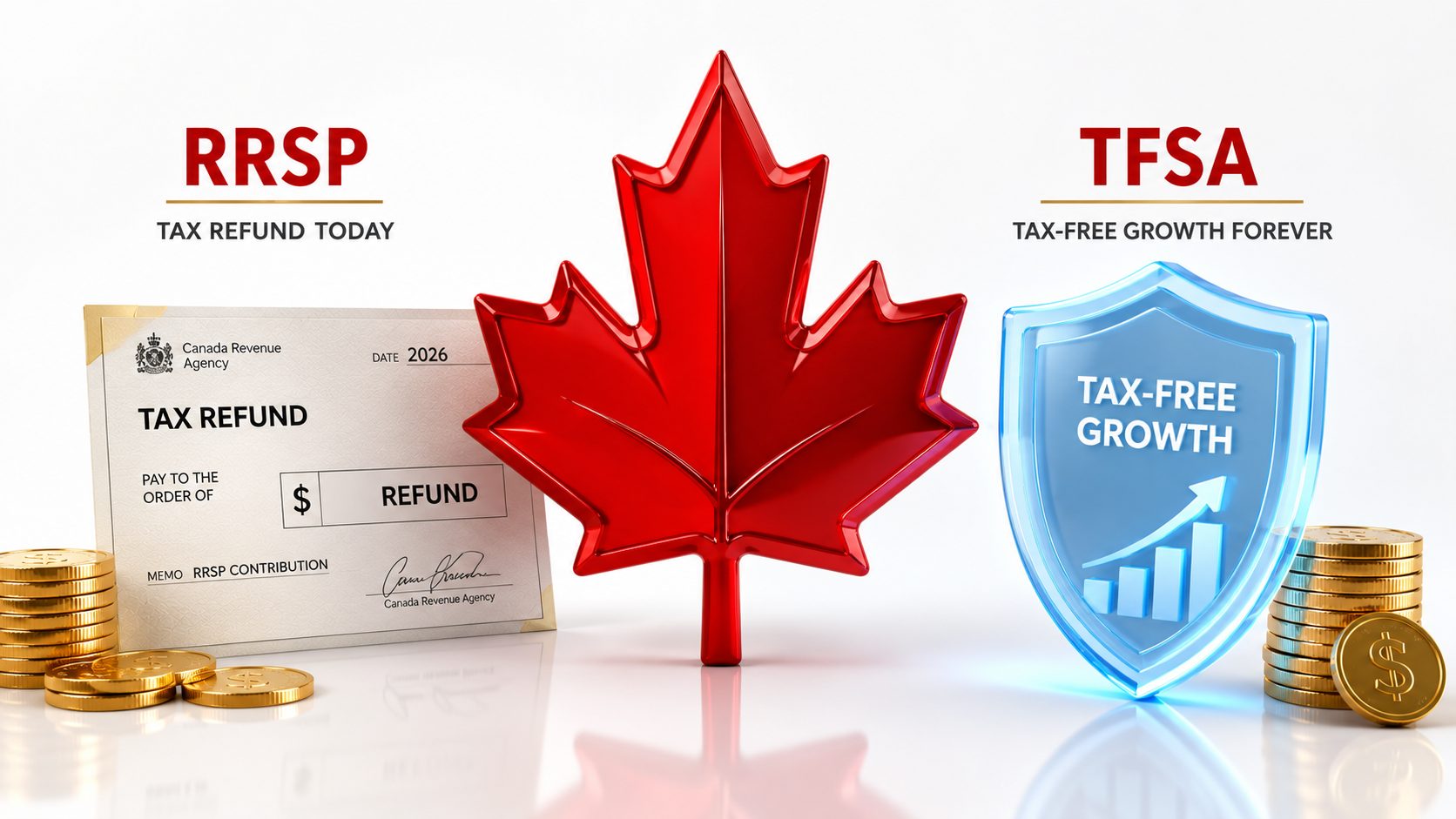
How Do You Choose Between an RRSP and a TFSA in Canada for 2026?
To choose between a Registered Retirement Savings Plan (RRSP) and a Tax-Free Savings Account (TFSA) in Canada in 2026, you must compare your current marginal tax bracket with your expected tax bracket in retirement: if your tax rate is higher today, prioritize the RRSP to defer taxes at a high rate; if your tax rate will be higher in retirement (or you are early in your career), prioritize the TFSA for tax-free growth and withdrawals.
Quick Answer Summary
- RRSP: Pre-tax contributions (immediate tax refund), tax-deferred growth, and withdrawals are taxed as ordinary income. Best for high earners. The 2026 dollar limit is $33,810.
- TFSA: After-tax contributions (no tax refund), tax-free growth, and withdrawals are 100% tax-free at any age. Best for younger, mid-career, or lower-income earners. The 2026 annual limit is $7,000.
- The Rule of Thumb: High-income earners should maximize their RRSP first to lower their tax bracket, whereas lower-to-mid-income earners should prioritize the TFSA to preserve RRSP contribution room for future peak-earning years.
The Core Differences: Tax Deferral vs. Tax-Free Savings
Understanding the tax mechanics of the CRA-registered accounts is critical:
Registered Retirement Savings Plan (RRSP)
- The Upfront Deduction: Every dollar contributed reduces your taxable income, triggering a tax refund. If you contribute $10,000 and have a 40% marginal rate, you get a $4,000 refund.
- The Withdrawal Catch: Withdrawals are taxed as regular income. If you withdraw $10,000 in retirement, and your tax bracket is 20%, you pay $2,000 in tax.
- Retirement Conversion: You must close your RRSP by age 71 and convert it to a Registered Retirement Income Fund (RRIF) to begin taking mandatory annual payouts.
Tax-Free Savings Account (TFSA)
- After-Tax Funding: You invest after-tax cash; you do not receive a tax deduction when you contribute.
- Sovereign Tax-Free Growth: All dividends, interest, and capital gains accumulate tax-free.
- Unrestricted Withdrawals: You can withdraw any amount from your TFSA at any time, for any reason, with zero tax or penalty. The withdrawn amount is added back to your contribution room in the following calendar year.
Official CRA 2026 Registered Account Limits
For 2026, the Canada Revenue Agency has set the following limits:
2026 RRSP Contribution Limit
- Maximum Dollar Cap: $33,810 (up from previous cycles).
- General Rule: Your contribution room is capped at the lesser of $33,810 or 18% of your previous year's earned income (which would be 2025 earned income), minus any pension adjustment.
2026 TFSA Contribution Limit
- Annual Limit: $7,000.
2026 registered account limits
- Cumulative Limit: If you have been eligible to contribute since the TFSA was introduced in 2009 (i.e. you were at least 18 years old in 2009) and have never made a contribution, your total cumulative contribution room as of 1 January 2026 is $109,000.
Case Study: Chloe's Registered Account Strategy ($90,000 Salary)
Let's analyze Chloe, a 31-year-old marketing manager in Toronto. Chloe earns a gross annual salary of $90,000, putting her in a marginal tax bracket of 30.5% (combined federal and Ontario provincial taxes):
Chloe has $12,000 in savings to invest in 2026. Let's compare her strategies:
Option A: Putting All in a TFSA
Chloe deposits the full $12,000 into her TFSA (using her cumulative room):
- Upfront Tax Deduction: $0
- Tax Savings Today: $0
- Future Value (30 years at 8% return): $120,750
- Tax Owed at Payout: $0
- Net Capital at Retirement: $120,750
Option B: Putting All in an RRSP
Chloe deposits the full $12,000 into her RRSP:
- Upfront Tax Deduction: -$12,000
- Tax Refund Received (30.5% rate): $3,660 (Chloe immediately deposits this refund into her TFSA to invest)
- Future Value of RRSP (30 years at 8%): $120,750
- Future Value of Refund in TFSA (30 years at 8%): $36,830
- Total Accumulated Balance: $157,580
- Tax Owed on RRSP Withdrawal (assuming 20% tax bracket in retirement): $120,750 × 20% = $24,150
- Net Capital at Retirement = $157,580 - $24,150 = $133,430
Chloe's $12,000: net capital at retirement
Verdict: By utilizing the RRSP tax refund and investing it in her TFSA, Chloe ended up with $133,430 net of tax compared to $120,750 in the TFSA-only strategy. This shows why high-income earners should use the RRSP deduction to generate refund cash flow.
The Lifetime Registered Account Strategy
If you want to optimize your Canadian wealth building, use this phased approach:
- Early Career (Income under $55,000): Maximize your TFSA first. Your tax bracket is low, so the RRSP refund is small. Save your RRSP contribution room for future years when your salary rises.
- Mid-Career (Income $55,000 to $105,000): Split your contributions. Put enough in your RRSP to bring your taxable income down to the next tax bracket, and put the remainder (and any tax refunds) into your TFSA.
- Peak Earnings (Income above $105,000): Maximize your RRSP to shield your highest-taxed income. Then, put all remaining savings into your TFSA.
Use the Canada RRSP vs TFSA Calculator to input your provincial brackets and savings rates to map your optimal account allocation.
Advanced Strategic Implementation & Optimization for Canadian Savers
Optimizing Canadian registered accounts requires coordinating RRSP tax refunds and TFSA tax-free compounding.
Registered Accounts Optimization Checklist
- Prioritize TFSA for High Growth: Allocate equities and high-dividend assets to your TFSA to maximize tax-free growth.
- Use RRSP to Lower Bracket Slices: Contribute to your RRSP to bring your taxable income below high provincial tax brackets.
- Track TFSA Contributions Carefully: Check your CRA portal annually to verify your contribution room and avoid over-contribution penalties.
Step-by-Step Retirement Account Allocation
- Maximize Employer Matching: Fund your workplace pension or group RRSP to capture any matching contributions.
- Fund Your TFSA: Allocate savings up to the annual limit ($7,000 for 2026) into diversified equity portfolios.
- Assess RRSP Room: Calculate if contributing to an RRSP will generate a significant tax refund at your current bracket.
- Reinvest RRSP Tax Refunds: Invest any tax refunds received back into your TFSA or RRSP to accelerate compounding.
Common Pitfalls & Audit Warnings
- Over-contributing to TFSA: Depositing more than your cumulative limit results in a 1% per month penalty tax on the excess amount.
- Withdrawing from RRSP Early: Withdrawing RRSP funds before retirement results in immediate withholding tax and permanent loss of contribution room.
- Holding Foreign Assets in TFSA: Holding US dividend-paying stocks in a TFSA incurs a 15% US withholding tax, whereas RRSPs are exempt.
Advanced Investment Compounding & Equity Scenario Modeling
This modeling compares the net values of RRSP and TFSA portfolios over a 25-year investment term.
Canadian Portfolio Comparison Table
| Metric | Case A: TFSA Focused | Case B: RRSP (Refund Spent) | Case C: RRSP (Refund Reinvested) |
|---|---|---|---|
| Annual Contribution | $7,000 | $7,000 | $7,000 (+ $2,100 Refund) |
| Tax Refund | $0 | $2,100 | $0 (Direct Reinvestment) |
| Marginal Tax Rate | 30% | 30% | 30% |
| Retirement Rate | 20% | 20% | 20% |
| Portfolio (Year 25) | $552,000 | $552,000 (Before Tax) | $717,600 (Before Tax) |
| After-Tax Payout | $552,000 | $441,600 | $574,080 |
After-tax payout after 25 years of $7,000/year
Step-by-Step Retirement Payout Math
Case C: RRSP with Reinvested Refund (The Winner)
- The Move: Reinvest your $2,100 tax refund directly back into the RRSP, building a total annual contribution of $9,100.
- Final Balance: Grows to $717,600 over 25 years.
- The Tax: After paying 20% tax on retirement withdrawals, the net take-home cash is $574,080—outperforming TFSA by $22,080.
4. The Spousal RRSP Strategy: How Couples Can Split Retirement Income
Income splitting is one of the most effective tax planning tools for Canadian couples. If one partner earns significantly more than the other, they can use a Spousal RRSP to balance their retirement income and lower their overall household tax rate.
How it Works
The higher-earning spouse contributes to an RRSP registered in the lower-earning spouse's name.
- Tax Benefit: The contributor claims the tax deduction on their higher marginal tax bracket, saving immediate tax dollars.
- Retirement Benefit: When the funds are withdrawn at retirement, they are taxed in the hands of the lower-earning spouse (the owner of the account), who will be in a lower tax bracket.
- The Three-Year Rule: To prevent tax avoidance, the funds must remain in the spousal RRSP for at least three calendar years before withdrawal. If withdrawn earlier, the income is attributed back to the contributing spouse and taxed at their higher rate.
5. What Happens If You Over-Contribute to Your TFSA? (CRA Penalty Math)
Because TFSA contribution limits accumulate annually, keeping track of your exact limit is essential. Over-contributing to your TFSA can result in steep penalties from the Canada Revenue Agency (CRA).
The Over-Contribution Penalty
If you exceed your TFSA contribution room, the CRA levies a penalty tax of 1.0% per month on the highest excess amount for each month the over-contribution remains in the account.
For example, if you over-contribute by $5,000 in March and don't remove it until October:
- You held an excess balance for 8 months.
- Your penalty tax is 1.0% × $5,000 = $50 per month.
- Your total penalty fee is $400.
If you make an accidental over-contribution, withdraw the excess immediately to stop the monthly penalty accrual.
6. FHSA vs. RRSP Home Buyers' Plan (HBP): Which is Better for Your First Home?
For first-time home buyers in Canada, the choice of where to save for a down payment has been simplified by the introduction of the First Home Savings Account (FHSA).
FHSA vs. HBP Comparison
- The FHSA Advantage: You can save up to $8,000 per year (lifetime limit of $40,000). Contributions are tax-deductible, and withdrawals are tax-free. Most importantly, you do not have to repay the withdrawn amount.
- The RRSP HBP Advantage: You can withdraw up to $60,000 tax-free from your RRSP, but you are required to pay it back into your RRSP over 15 years, starting the second year after your withdrawal.
Whenever possible, prioritize the FHSA first. If you need a larger down payment, you can combine the FHSA and the RRSP Home Buyers' Plan to withdraw up to $100,000 tax-free to buy your first home.
7. TFSA and RRSP Rules for Canadian Expats
If you leave Canada to live and work in another country, your TFSA and RRSP status changes:
- TFSA for Non-Residents: You can keep your existing TFSA, and any investment growth or withdrawals remain tax-free. However, you cannot accumulate new contribution room for any year you are a non-resident, and making new contributions will trigger a 1% per month penalty tax.
- RRSP for Non-Residents: Your RRSP can remain open and continue to grow tax-deferred. You do not lose your accumulated contribution room. However, when you withdraw funds as a non-resident, they are subject to Canadian withholding tax (typically 15% to 25% depending on the country and tax treaty).