How Can You Optimize Your CPF and SRS for Maximum Returns in 2026?
To optimize your Central Provident Fund (CPF) and Supplementary Retirement Scheme (SRS) in Singapore for 2026, you must understand the new monthly Ordinary Wage (OW) ceiling of S$8,000, use the 4% risk-free interest rate of the Special Account (SA), and strategically invest your OA and SRS funds through the CPF Investment Scheme (CPFIS) to beat inflation. Singapore's dual retirement framework is a powerful wealth-building engine when managed correctly.
Quick Answer Summary
- CPF Ceilings: Starting 1 January 2026, the monthly CPF Ordinary Wage ceiling has reached its final target of S$8,000, with the annual wage limit capped at S$102,000.
- Interest Rates: The Ordinary Account (OA) yields a guaranteed 2.5%, while the Special Account (SA) and Medisave Account (MA) yield 4.0% risk-free.
- SRS Tax Relief: You can deposit up to S$15,300 (Singapore Citizens/PRs) or S$35,700 (Foreigners) per year into the SRS to reduce your taxable income dollar-for-dollar.
- Upcoming Reforms: Under Budget 2026, seniors aged 50+ will receive a S$1,500 CPF top-up in December 2026, senior worker contribution rates rise further in 2027, and a voluntary CPF lifecycle investment scheme launches in 2028. Read our detailed CPF Changes 2026 & Beyond Guide.
The Central Provident Fund (CPF) Account Framework
For employees aged 55 and below, a total of 37% of your salary (20% from you, 17% from your employer) is contributed to your CPF accounts. These funds are split across three sub-accounts:
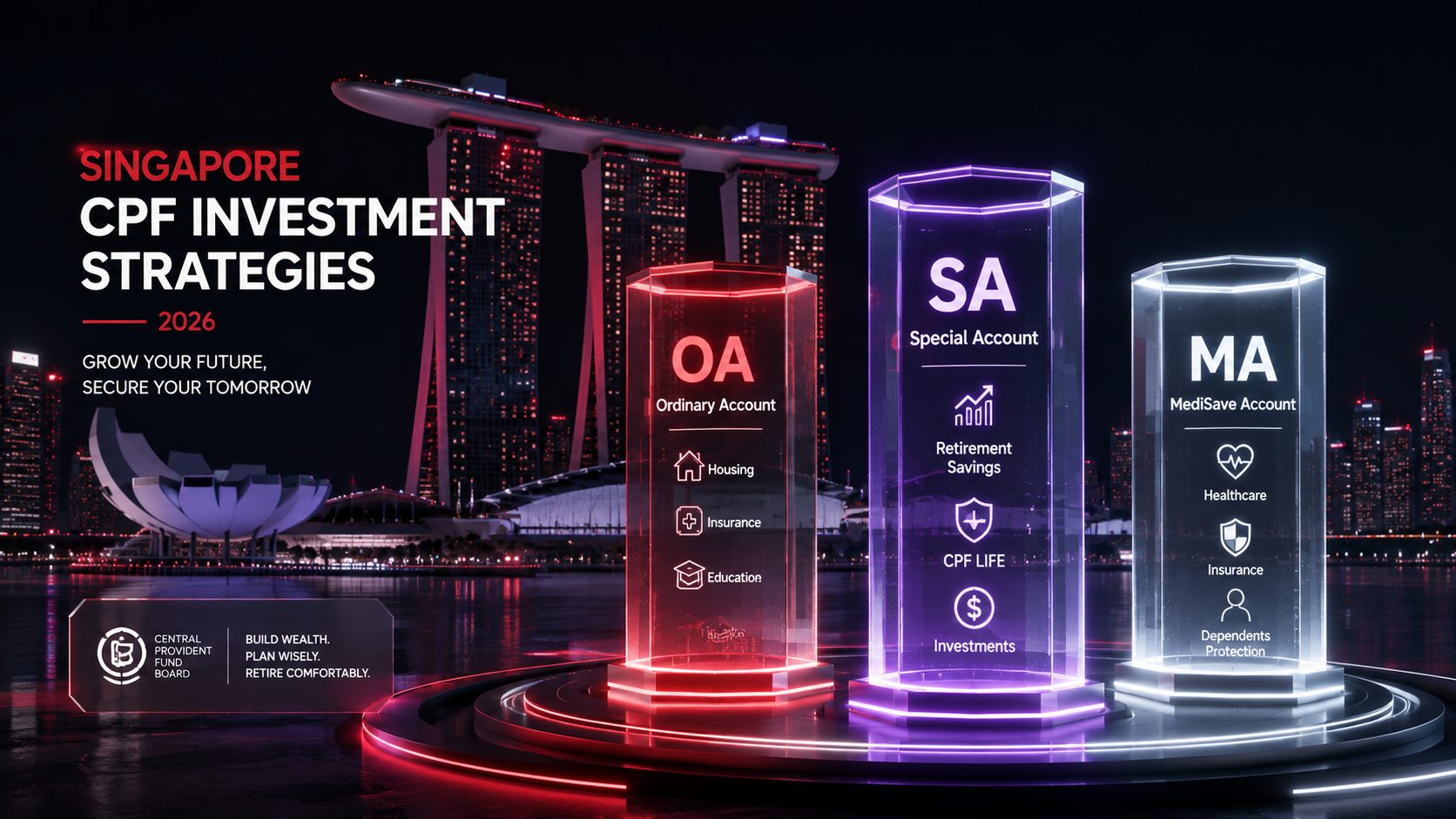
- Ordinary Account (OA): Earns 2.5% interest. These funds can be used for housing payments (mortgages and HDB loans), education, and approved investments.
- Special Account (SA): Earns 4.0% interest. These funds are reserved strictly for retirement planning and cannot be withdrawn early for housing.
- Medisave Account (MA): Earns 4.0% interest. These funds are used for healthcare insurance premiums (MediShield Life, Integrated Shield Plans) and medical bills.
Singapore CPF & SRS Key Limits for 2026
For 2026, the key regulatory figures have been adjusted as follows:
CPF Ordinary Wage (OW) Ceiling
- Monthly OW Ceiling: S$8,000 (S$8,000/month). Contributions are capped at this monthly salary level.
- Annual Salary Ceiling: S$102,000 (capping the combined Ordinary and Additional Wages eligible for CPF contributions in a year).
SRS Contribution Limits
- Singapore Citizens & PRs: S$15,300 per year.
- Foreigners: S$35,700 per year.
Case Study: Wei's Tax & CPF Optimization (S$120,000 Salary)
Let's analyze Wei, a 34-year-old product manager in Singapore earning a monthly base salary of S$10,000 (annual salary S$120,000):
- Monthly CPF Contribution Calculation: In 2026, since the monthly OW ceiling is S$8,000, Wei's CPF contributions are calculated on S$8,000 rather than his S$10,000 salary:
- Wei's Employee Contribution (20% of S$8,000): S$1,600
- Employer Contribution (17% of S$8,000): S$1,360
- Total Monthly Deposit: S$2,960
Wei's monthly CPF inflow on a S$10,000 salary
Wei's remaining S$2,000 of monthly salary is not subject to CPF deductions, which increases his immediate take-home cash.
Wei's SRS Tax Saving Strategy
Wei is in the 11.5% marginal tax bracket for Singapore personal income tax. To reduce his tax bill, Wei decides to contribute the maximum S$15,300 to the Supplementary Retirement Scheme (SRS) before 31 December:
- Wei's Taxable Income Deduction: -S$15,300
- Immediate Tax Savings: S$15,300 × 11.5% = S$1,759.50
By depositing S$15,300 into his SRS account, Wei instantly saves S$1,759.50 in income tax for the year. He then invests this SRS balance in a low-fee S&P 500 ETF to compound tax-free until retirement.
How to Invest Your CPF and SRS Balances
Leaving your funds in cash yields low interest (especially the OA at 2.5% and SRS at a tiny 0.05%). To beat inflation, you should invest:
- Ordinary Account (OA) Investing: You can invest any OA balance exceeding S$20,000. Through the CPF Investment Scheme (CPFIS), you can invest in low-cost global equity index funds or Singapore Treasury Bills (T-Bills) to achieve yields higher than 2.5%.
- Special Account (SA) Investing: You can invest any SA balance exceeding S$40,000. Because the SA pays a guaranteed, risk-free 4% return, the hurdle rate for investing SA funds is very high. Most financial planners recommend leaving the SA balance in cash to earn the risk-free 4.0% return unless you are highly confident in long-term equity returns.
- SRS Investing: SRS cash only earns 0.05% interest. You should immediately invest your SRS contributions in dividend-paying stocks, REITs, or exchange-traded funds (ETFs) to let your capital grow.
Where idle money earns what
Use the CPF Investment Calculator to model your accounts and project your future Singapore retirement sum.
Advanced Strategic Implementation & Optimization for Singapore CPF
Singapore's Central Provident Fund (CPF) is a full social security system that can be optimized to build substantial retirement portfolios.
Singapore CPF Optimization Checklist
- Transfer Ordinary Account (OA) to Special Account (SA): Capture a higher interest rate (4% vs 2.5%) for long-term compounding.
- Invest OA Funds Wisely: Allocate excess OA funds above S$20,000 to low-cost equities via the CPF Investment Scheme (CPFIS).
- Maximize Voluntary Cash Top-Ups: Make cash deposits to your SA to enjoy personal tax relief up to S$8,000.
Step-by-Step CPFIS Investment Process
- Pass the Self-Assessment Test: Complete the mandatory CPFIS questionnaire on the CPF website.
- Open a CPF Investment Account: Set up an investment account with a partner bank (DBS, OCBC, or UOB).
- Select Eligible Low-Cost Funds: Allocate CPF OA funds exceeding S$20,000 into approved global equity funds.
- Monitor Fund Performance: Periodically review allocations to ensure they beat the default 2.5% OA interest rate.
Common Pitfalls & Audit Warnings
- Transferring OA to SA Irreversibly: Transfers from OA to SA are one-way; you cannot move funds back to OA to pay for housing loans.
- Investing CPF SA Funds in High-Fee Products: Allocating CPFIS funds to active unit trusts with high wrap fees can result in underperforming the risk-free SA rate.
- Exceeding the CPFIS Limits: Attempting to invest the first S$20,000 of OA or first S$40,000 of SA is prohibited.
Singapore CPF Advanced Scenario Modeling & Calculation Worksheets
We model three different CPF accumulation strategies over a 30-year career to demonstrate the power of OA-to-SA transfers and CPFIS investments.
CPF Accumulation Table
| Metric | Strategy A: Default | Strategy B: SA Optimizer | Strategy C: CPFIS Investor |
|---|---|---|---|
| Starting Balance | S$30,000 (OA) | S$30,000 (OA) | S$30,000 (OA) |
| Annual Contribution | Standard Payroll | Standard Payroll | Standard Payroll |
| OA-to-SA Transfer | No | Yes (Full) | No |
| Investment Returns | 2.5% (OA) / 4.0% (SA) | 4.0% (SA) | 6.5% (Global Equities) |
| Balance (Year 15) | S$185,000 | S$212,000 | S$248,000 |
| Balance (Year 30) | S$445,000 | S$582,000 | S$738,000 |
S$30,000 OA after 30 years, by strategy
Step-by-Step Strategy Walkthroughs
Strategy B: Special Account (SA) Optimizer
- The Transfer: Transfer CPF OA funds exceeding S$20,000 to the SA to lock in the 4% interest rate.
- Compound Advantage: The SA interest compounds 1.5% faster than the OA rate.
- The Result: Adds over S$137,000 in risk-free retirement savings over 30 years compared to Strategy A.
4. The Ordinary Account (OA) to Special Account (SA) Transfer: Is It Always Worth It?
One of the most common CPF optimization strategies is transferring funds from the Ordinary Account (OA) to the Special Account (SA) to earn a higher guaranteed interest rate (4.0% vs. 2.5%).
While the 1.5% interest rate difference compounds significantly over 20–30 years, this transfer comes with critical trade-offs:
- The Transfer is Irreversible: Once OA money is moved to SA, it cannot be transferred back to OA under any circumstances.
- Housing Limitations: OA funds can be used to pay for HDB flats or private property down payments and monthly mortgage installments. SA funds cannot.
- Emergency Cushion: Having an OA balance acts as a safety net to pay your mortgage if you lose your job.
The Recommendation
Only transfer OA funds to SA if your housing needs are fully met and you have a secure long-term plan that does not rely on CPF funds for mortgage serviceability.
5. Which CPFIS Funds Actually Beat the Guaranteed 2.5% OA Interest Rate?
The CPF Investment Scheme (CPFIS) allows members to invest OA funds above $20,000 and SA funds above $40,000 in approved mutual funds, insurance products, and gold.
However, historical data from the Ministry of Manpower shows that more than half of CPFIS investors fail to beat the passive 2.5% OA return rate after accounting for management fees and market volatility. To beat the 2.5% rate consistently, target low-cost index funds or global equities ETFs with expense ratios below 0.50%, and commit to a long-term dollar-cost averaging strategy rather than trying to time the market.
6. SRS Withdrawal Strategy: How to Minimize Singapore Income Tax at Retirement
The Supplementary Retirement Scheme (SRS) offers a tax deduction on contributions today, but withdrawals are subject to tax when you retire. Planning your withdrawals is essential to avoid a major tax bill at age 62 or later.
The 10-Year Withdrawal Window
You have a 10-year window to withdraw your SRS savings, starting from the date of your first withdrawal.
- The 50% Concession: Only 50% of your SRS withdrawals are taxable.
- The Optimal Tax Plan: To pay zero tax, you should withdraw up to S$40,000 per year. Since only 50% (S$20,000) is taxable, and Singapore has no income tax on the first S$20,000 of income, your tax liability on the withdrawal is exactly S$0. Over 10 years, you can withdraw S$400,000 completely tax-free using this strategy.
7. How to Use the CPF Housing Grant Schemes for First-Time Home Buyers
When purchasing your first HDB flat in Singapore, the upfront cost can be significantly reduced by tapping into CPF housing grants. The Housing & Development Board (HDB) offers several grants, including the Enhanced CPF Housing Grant (EHG), which provides up to S$120,000 in subsidies depending on your household income.
These grant amounts are credited directly into your CPF Ordinary Account (OA). Because they are credited as CPF funds, they must be used directly to pay for the flat purchase or to reduce the mortgage loan principal. Additionally, when you sell the flat in the future, you must refund the grant amount plus 2.5% accrued interest back into your CPF OA. This ensures your retirement nest egg remains intact even after using housing subsidies.