Two Numbers, Two Cohorts: Why the Headline Is Not the Whole Story
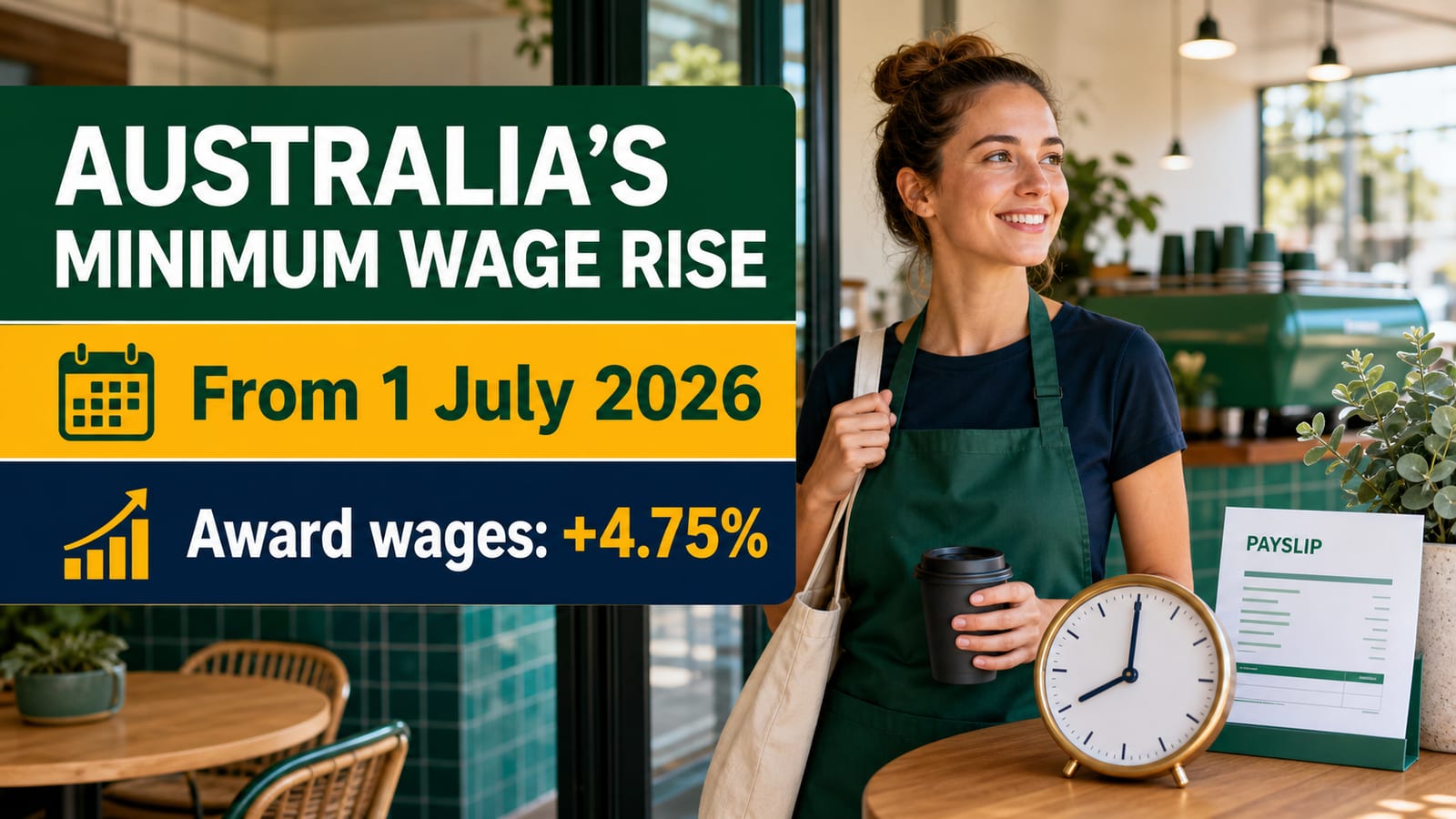
Australia's minimum wage went up on 1 July 2026, but the Fair Work Commission's Annual Wage Review decision actually delivered two different percentage increases to two different groups of workers. The National Minimum Wage (NMW)—the absolute floor for workers not covered by a Modern Award—rose approximately 6% to $26.44 per hour ($1,004.90 per week). Meanwhile, all Modern Award minimum wage rates increased by 4.75%.
Why the difference? The NMW and award rates are separate legal instruments. The NMW is a single hourly and weekly figure set by the Fair Work Commission as the irreducible minimum for all adult employees in the national system. Modern Awards are industry-specific instruments that set minimum rates for specific classifications—a Level 1 retail worker, a Grade 1 hospitality employee, a C14 manufacturing worker. The 4.75% applies to every classification in every Modern Award.
The decision, announced on 2 June 2026 , affects more than 2.7 million Australian workers who rely on award or minimum wage rates. It takes effect from the first full pay period starting on or after 1 July 2026.
Important
The NMW increase (~6%) and the award increase (4.75%) are not the same thing. If you are covered by a Modern Award—and most Australian employees are—your minimum rate went up by 4.75%, not 6%. The 6% figure applies only to the small cohort of workers paid at the bare NMW floor with no award coverage.
The Exact Numbers: Before and After 1 July 2026
Here is the complete picture of what changed :
| Rate | Before 1 July 2026 | From 1 July 2026 | Increase |
|---|---|---|---|
| National Minimum Wage (hourly) | $24.95 | $26.44 | ~6.0% |
| National Minimum Wage (weekly, 38 hrs) | $948.00 | $1,004.90 | ~6.0% |
| National Minimum Wage (annual, 38 hrs) | $49,296.00 | $52,254.80 | ~6.0% |
| Modern Award minimum rates | Varies by award | +4.75% across all classifications | 4.75% |
| Casual NMW (hourly, incl. 25% loading) | $31.19 | $33.05 | ~6.0% |
| Casual NMW (weekly, incl. loading) | $1,185.00 | $1,256.13 | ~6.0% |
National Minimum Wage per hour: before and after 1 July 2026
The casual loading remains at 25% on top of the base hourly rate. This loading compensates casual employees for the absence of paid annual leave, paid personal/carer's leave, and other entitlements that permanent employees receive.
Case Study: Aroha's Retail Paycheck—Before and After
Let's follow Aroha, a 24-year-old retail assistant in Melbourne covered by the General Retail Industry Award 2020. She works 32 hours per week as a permanent part-time employee at a Level 1 classification.
Before 1 July 2026
- Level 1 Retail Award minimum (2025-26): $24.56/hour (after the 3.5% increase from July 2025)
- Weekly gross (32 hours): $24.56 x 32 = $785.92
- Annual gross (52 weeks): $40,867.84
After 1 July 2026 (4.75% Award Increase)
- Level 1 Retail Award minimum (2026-27): $24.56 x 1.0475 = $25.73/hour
- Weekly gross (32 hours): $25.73 x 32 = $823.36
- Annual gross (52 weeks): $42,814.72
- Weekly increase: $37.44
- Annual increase: $1,946.88
The Tax and Super Impact
Aroha's additional $1,946.88 in annual gross income triggers:
- Income tax (at her marginal rate of 15% for income between $18,201 and $45,000 under Stage 3 cuts): $1,946.88 x 15% = $292.03 additional tax
- Medicare Levy (2%): $1,946.88 x 2% = $38.94
- Superannuation (employer pays 12% SG on the increase): $1,946.88 x 12% = $233.63 additional super
- Net take-home increase: $1,946.88 after deducting $292.03 tax and $38.94 Medicare leaves $1,615.91 per year (about $31.08 per week)
Where Aroha's $1,946.88 annual raise goes
So Aroha's gross raise is $37.44/week, but her actual take-home increase is approximately $31.08 per week after tax and Medicare. Her super fund receives an extra $233.63 per year on top.
Use our Fair Work Minimum Wage Increase Calculator to input your specific award classification, weekly hours, and employment type to calculate your exact July 2026 pay increase.
Case Study 2: Jake the Casual Hospitality Worker
Jake is a 21-year-old casual barista in Brisbane, covered by the Hospitality Industry (General) Award 2020. He works 28 hours per week on a casual basis.
Before 1 July 2026
- Level 2 Hospitality Award casual rate (2025-26): approximately $29.87/hour (from base $23.90 plus 25% loading)
- Weekly gross (28 hours): $29.87 x 28 = $836.36
After 1 July 2026 (4.75% Award Increase)
- Level 2 Hospitality Award casual rate (2026-27): $29.87 x 1.0475 = $31.29/hour
- Weekly gross (28 hours): $31.29 x 28 = $876.12
- Weekly increase: $39.76
- Annual increase (assuming 48 working weeks): $1,908.48
The Casual Loading Math
Jake's 25% casual loading is calculated on his base award rate, not on the NMW :
- Base hourly rate after increase: $25.03 (Level 2, post-4.75%)
- Casual loading (25%): $25.03 x 0.25 = $6.26
- Total casual hourly rate: $25.03 base plus $6.26 = $31.29
The loading is not taxed separately—it forms part of Jake's gross income and is taxed at his marginal rate along with his base pay.
Note
Casual employees do not receive paid annual leave or paid sick leave. The 25% loading is the legal compensation for this absence. If Jake converts to permanent part-time employment (a right available after 12 months of regular casual employment under the Fair Work Act), he loses the 25% loading but gains paid leave entitlements. The trade-off is worth modeling carefully.
NMW vs. Award Rates: Which One Applies to You?
This distinction trips up more workers than you might expect. Here is the rule :
- National Minimum Wage: Applies to employees in the national workplace relations system who are not covered by a Modern Award or enterprise agreement. This is a small minority—perhaps 2-3% of the workforce.
- Modern Award minimum rates: Apply to employees covered by one of the 122 Modern Awards. Each award sets minimum rates for each classification level. The 4.75% increase applies to all of these rates.
- Enterprise Agreement rates: Apply to employees covered by a registered enterprise agreement. The 4.75% does not automatically apply—but the agreement's rates must remain above the relevant award minimum (the "better off overall test").
If you are unsure which applies, check your payslip. It should reference either your award classification (e.g., "Retail Award Level 2") or your enterprise agreement. If it references neither, you are likely on the NMW.
The Inflation Context: Is 4.75% Actually a Raise?
The Fair Work Commission's decision landed against a backdrop of headline inflation at 4.8% for the year to June 2026. This creates an uncomfortable question: if prices rose 4.8% and wages rose 4.75%, did award-reliant workers actually go backwards in real terms?
The short answer: marginally, yes—by approximately 0.05 percentage points. But the picture is more layered:
- The NMW increase of ~6% significantly outpaced inflation, delivering a real wage gain of approximately 1.2% for NMW-reliant workers.
- The 4.75% award increase roughly matched inflation, preserving purchasing power but not substantially improving it.
- The 2025 decision (3.5% increase) came when inflation was running at approximately 3.6%, meaning award workers also roughly broke even last year.
- Over two years (July 2024 to July 2026), cumulative award increases of approximately 8.4% have slightly exceeded cumulative inflation of approximately 8.5%.
The Fair Work Commission's stated reasoning balances competing considerations: maintaining the living standards of low-paid workers, the risk of a wage-price spiral, employer capacity to pay (particularly for small businesses), and the broader economic outlook.
The Superannuation Multiplier: Your Employer Pays More Too
Every dollar of wage increase triggers an additional 12% employer superannuation guarantee (SG) contribution. For Aroha (Case Study 1), the $1,946.88 annual wage increase generates an extra $233.63 in super. For the 2.7 million affected workers, the aggregate super boost is substantial.
And from 1 July 2026, the Payday Super reforms require employers to remit SG contributions on the same day they pay wages, with funds landing in your super account within 7 business days. This means your additional super from the wage increase enters your fund faster and starts compounding sooner.
For a deeper look at how Payday Super accelerates your retirement savings, see our guide on What is Payday Super and How Does It Affect You?.
The Tax Interaction: Stage 3 Cuts Meet the Wage Increase
The July 2026 wage increase interacts with the Stage 3 tax cuts that have been in effect since 1 July 2024. The relevant brackets for minimum-wage earners :
| Taxable Income | Marginal Rate | Medicare Levy | Combined Rate |
|---|---|---|---|
| $0 to $18,200 | 0% | 0% (below threshold) | 0% |
| $18,201 to $45,000 | 15% | 2% | 17% |
| $45,001 to $135,000 | 30% | 2% | 32% |
A full-time worker on the NMW earning $52,254.80 per year sits in the 30% bracket for the portion above $45,000. Their marginal rate on the wage increase is therefore 32% (30% + 2% Medicare). A part-time worker earning $42,000 remains in the 15% bracket, paying 17% combined on the increase.
This is why the take-home impact of the raise varies so much between full-time and part-time workers at different income levels. Use our Australia Income Tax Calculator to model your exact after-tax position.
What Employers Must Do: Compliance Checklist
If you employ award-covered or minimum-wage workers, the July 2026 increase creates immediate obligations:
- Update payroll rates from the first full pay period on or after 1 July 2026.
- Apply the 4.75% to all award classifications—not just the lowest level. Every classification in every Modern Award increased by 4.75%.
- Recalculate casual loadings on the new base rates. The 25% loading applies to the increased base, not the old base.
- Update superannuation calculations to reflect the higher gross wages.
- Check enterprise agreement compliance. If your agreement rates are now below the updated award minimums, you may need to top up or renegotiate.
- Issue updated payslips showing the new hourly rate and any back-pay if the increase was applied late.
Warning
Underpaying award wages is a serious compliance breach under the Fair Work Act 2009. The Fair Work Ombudsman actively prosecutes underpayment cases, with penalties of up to $93,900 per contravention for small businesses (under 15 employees) or up to $469,500 for larger companies, and up to $18,780 for individuals. If you are unsure whether your payroll reflects the July 2026 increase, audit it immediately.
The Historical Trajectory: Five Years of Minimum Wage Decisions
Placing the 2026 decision in context shows how the pace of increases has accelerated :
| Financial Year | Award Increase | NMW (hourly) | Context |
|---|---|---|---|
| 2022-23 | 4.6% | $21.38 | Post-pandemic recovery, inflation surging |
| 2023-24 | 5.75% | $23.23 | Inflation at 7%, largest increase in a decade |
| 2024-25 | 3.75% | $24.10 | Inflation moderating to ~4% |
| 2025-26 | 3.5% | $24.95 | Inflation at ~3.6% |
| 2026-27 | 4.75% | $26.44 | Inflation at 4.8%, NMW restructured upward |
Five years of annual wage review increases
The 2026 decision marks a re-acceleration after two years of more modest increases. The larger NMW percentage (~6%) reflects the Commission's decision to restructure the relationship between the NMW and the lowest award rates, narrowing the gap between the two.