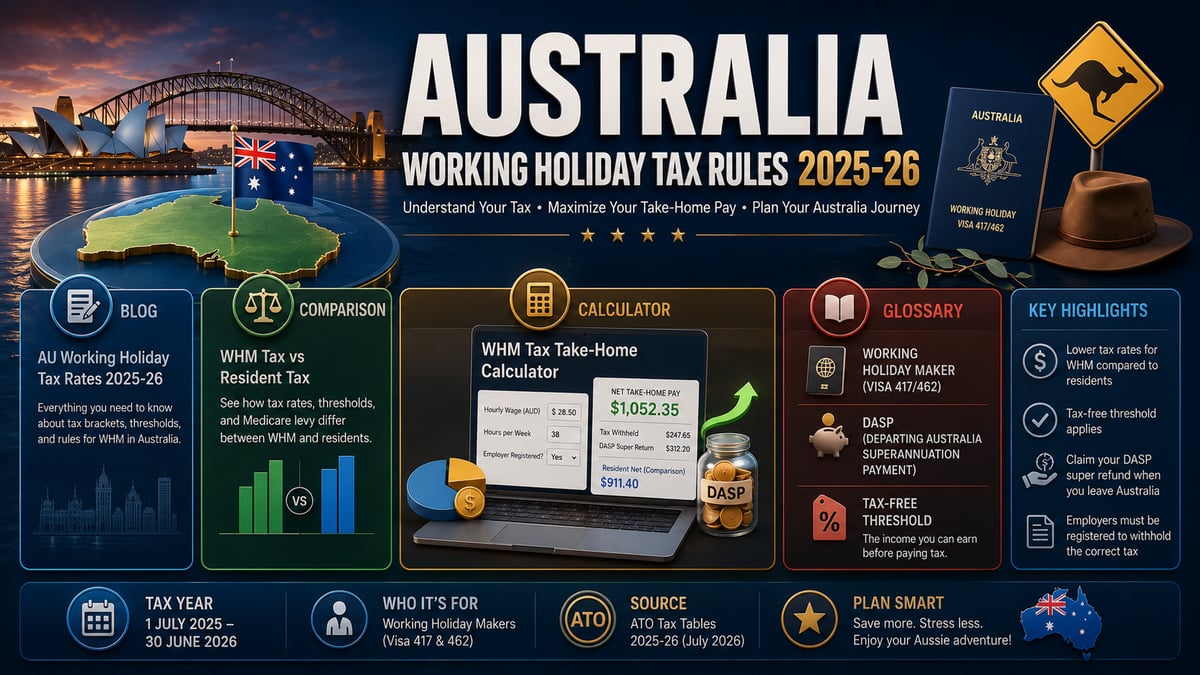
Working Holiday vs Resident Tax AU

On a $45,000 season, a backpacker pays $6,750 in tax while an Australian resident pays about $4,595, and when the backpacker leaves, the ATO keeps 65% of their super. The 2026-27 numbers, side by side.

Interactive Comparison Simulator

Adjust the variables below to simulate outcomes, compare rates, and see real-time projections.

Side-by-Side Comparison

A direct comparison of features, rules, limits, and eligibility requirements.

Feature / DetailWorking Holiday Maker (WHM)Australian Tax Resident
Tax-free threshold
None, 15% from the first dollar (citizens of the 8 non-discrimination treaty countries who pass the residency test are the exception)
First $18,200 tax-free
Rate to $45,000
15% flat, but only if your employer registered with the ATO; otherwise 30%
0% to $18,200, then 15% (2026-27 Stage 3 rate, down from 16%)
Medicare levy
Exempt, 0%, with a Medicare Entitlement Statement
2% of taxable income (reductions below ~$26,000)
Low Income Tax Offset
Not eligible, at any income
Up to $700 for incomes under $45,000ish
Super on departure
DASP taxed at 65%, a $5,000 balance pays out $1,750
Normal rules: tax-free access from preservation age 60
Rates above $45,000
30% to $135,000, 37% to $190,000, 45% beyond: same as residents
Identical brackets above $45,000

Pros & Cons Breakdown

Analyze the advantages and drawbacks of each financial product before making a decision.

Working Holiday Maker (WHM) Pros & Cons

Advantages of Working Holiday Maker (WHM)

  • Simple flat 15% withholding on seasonal earnings: no bracket maths mid-year.
  • No 2% Medicare levy: worth $900 on a $45,000 income.
  • Same marginal rates as residents once income passes $45,000.

Disadvantages of Working Holiday Maker (WHM)

  • No tax-free threshold: at $18,200 of income a WHM owes $2,730 where a resident owes $0.
  • DASP takes 65% of your super's taxable component on the way out.
  • An unregistered employer must withhold 30% from the first dollar, $13,500 on $45,000 until you claim it back at return time.
  • No Low Income Tax Offset, at any income.

Australian Tax Resident Pros & Cons

Advantages of Australian Tax Resident

  • $18,200 completely tax-free, plus up to $700 LITO below ~$45,000.
  • Super stays in the concessional system and comes out tax-free from age 60.
  • No employer registration dependency: standard PAYG applies automatically.
  • Full Medicare access.

Disadvantages of Australian Tax Resident

  • 2% Medicare levy on the whole taxable income once above the low-income floor.
  • Residency for tax purposes is a facts-based test: short-stay travellers usually cannot simply elect it.

What this choice actually costs you

The missing threshold: where the $2,155 gap comes from

Meet Lena from Ireland, picking fruit and pulling beers on a 417 visa, and her flatmate Sam, an Australian resident doing the same job. Both gross $45,000 in 2026-27. Sam's first $18,200 is tax-free, the next $26,800 is taxed at the new 15% Stage 3 rate ($4,020), LITO hands back $325, and the Medicare levy adds $900: about $4,595 all up.

Lena pays 15% on everything from dollar one: $6,750. No threshold, no LITO; the Medicare exemption saves her $900, but she still lands $2,155 behind Sam on identical work.

The gap is regressive: at $18,200 of income it is $2,730 versus zero. Ireland is not one of the eight non-discrimination treaty countries, so Lena has no way around it, but a German or British workmate who genuinely resides in Australia does, and should read the third section below.

The 65% goodbye tax on your super

Every payday, Lena's employer must pay 12% super on top of her wages: about $5,400 a year on $45,000, and since 1 July 2026 it lands in her fund within days of each payslip. Sounds like forced savings. For a WHM it is mostly forced taxation.

When Lena leaves Australia and her visa expires, she claims the Departing Australia Superannuation Payment. The withholding on the taxable component is a flat 65% for working-holiday visa holders. Her $5,400 becomes roughly $1,890 in her pocket: the other $3,510 stays with the ATO.

Plan around it, don't fight it: the rate is set by law and applies no matter which fund you use. Treat your effective super benefit as about 4% of wages, not 12%, when comparing job offers against home-country pay. And still claim the DASP: around a third of your money back beats the alternative, which is your super sitting unclaimed until the ATO absorbs it.

Two checks worth over $2,000: registration and the treaty list

Check one takes a minute: is your employer registered with the ATO as a WHM employer? Registered means 15% withholding on your first $45,000. Unregistered means the law forces them to withhold 30% from the first dollar, $13,500 instead of $6,750 on a $45,000 year. You eventually get the excess back at tax time, but that is your cash flow gone for up to a year. Ask before you accept the job; registration is free and instant for the employer.

Check two is your passport. Australia's tax treaties with the UK, Germany, Japan, Chile, Finland, Israel, Norway and Turkey contain non-discrimination articles: citizens of those countries who genuinely qualify as Australian tax residents (the ordinary residency test — settled pattern of living here, not just a long trip) are entitled to resident rates: the $18,200 threshold, LITO, the lot.

That is the full $2,155-a-year swing at $45,000, claimable via your tax return: the ATO accepts amendments for past years too, following the Addy High Court decision. If you hold one of those eight passports and spent a year living and working in one place, running this past a tax agent is likely the best-paid hour of your working holiday.


The Verdict

Residents pay about $2,155 less at $45,000, and WHMs can't choose, only check two things.

This is mostly a comparison you are assigned to, not one you pick: the visa decides. What the numbers tell a 417/462 holder is where the money leaks. At $45,000 the WHM pays $6,750 against the resident's roughly $4,595 (after LITO and Medicare): a $2,155 gap driven entirely by the missing tax-free threshold. Two actions matter: confirm your employer is ATO-registered for WHM withholding (unregistered means 30% off every dollar until refund time), and if you hold a UK, German, Japanese, Chilean, Finnish, Israeli, Norwegian or Turkish passport and genuinely reside here, claim resident rates under the non-discrimination article: worth over $2,000 a year. And budget honestly: the 12% super your employer pays will shrink by 65% at the DASP exit.

Choose Working Holiday Maker (WHM) if...

Nobody by choice. It is the default for 417/462 holders. Short-stay seasonal workers with registered employers lose the least under it.

Choose Australian Tax Resident if...

Anyone who can legitimately claim it: citizens of the eight treaty countries who pass the residency test, and workers transitioning to longer-term visas.

Built & MaintainedBuilt by Galvin Mendonca, Finance Researcher
All figures from primary government sources. Last updated July 25, 2026.

Frequently Asked Questions

You Might Also Like

View All

Sources & references

The rules and figures on this page are researched from official primary sources:

Disclaimer: The comparison data, simulator outputs, and projections on this page are provided for general informational and educational purposes only. They do not constitute financial, investment, tax, or legal advice. All values are estimates based on statutory data and hypothetical inputs. Interest rates, contribution limits, tax brackets, and regulatory rules change frequently and vary by jurisdiction. Always consult a qualified professional advisor and verify critical figures with official government publications before making any financial decisions.