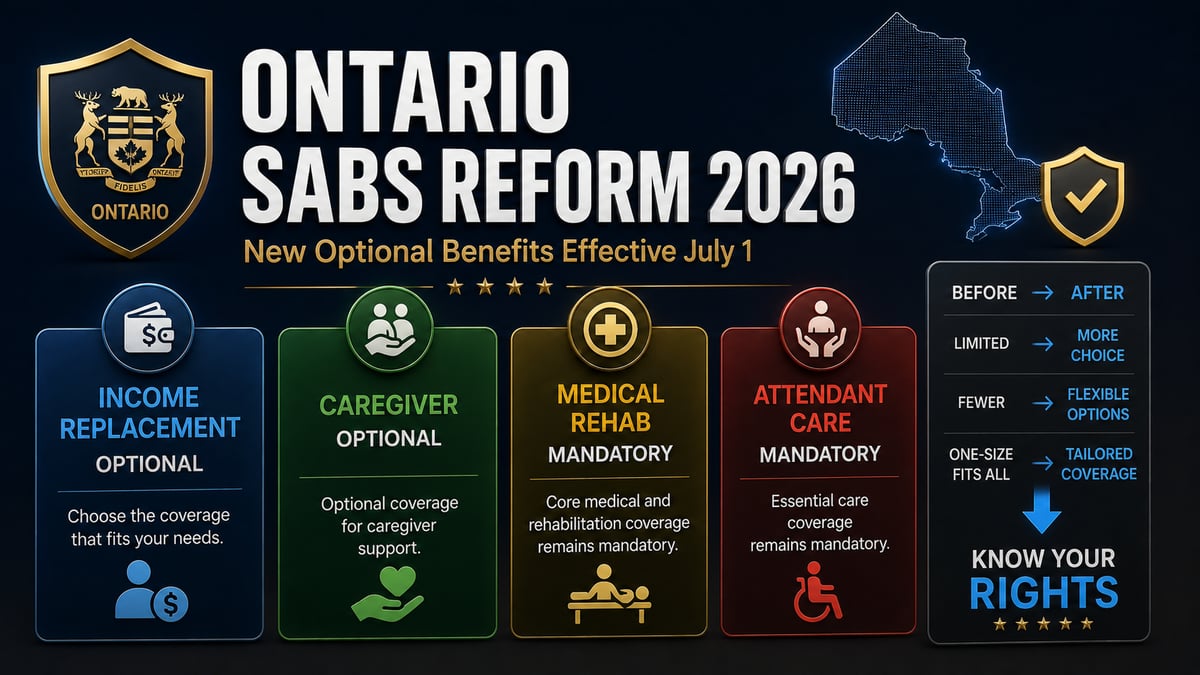
From 1 July 2026, medical, rehabilitation and attendant-care benefits are the only mandatory accident benefits on a new Ontario auto policy; income replacement, non-earner, caregiver, housekeeping and death/funeral benefits became optional. The distinction between a new contract and a renewal is crucial. Under Ontario Regulation 34/10, s. 2(1.0.2), optional benefits on a renewing policy continue at the previous limits unless the named insured and insurer agree in writing to decline or change them. A driver does not lose these benefits merely by failing to reselect them at renewal.
What the mandatory layer pays
The standard combined medical, rehabilitation and attendant-care limits are $3,500 for minor-injury-guideline cases, $65,000 for non-catastrophic injury and $1 million for catastrophic injury, subject to the regulation's conditions and durations. Insurers offer optional higher limits. For a new contract, check each optional benefit and its price on the actual quote; an old policy's renewal is a different starting point.
Who can use optional benefits
The post-reform optional benefits apply to the named insured, spouse, their dependants and drivers specified in the policy. A passenger or pedestrian may have a different priority insurer and must not assume optional coverage under the vehicle owner's policy. FSRA's consumer guidance sets out the benefit types and available choices.
Compare actual quotes, not a universal saving
Suppose Aisha's renewal shows $72 a year for income replacement. She can compare that exact premium with the policy's weekly limit, employer disability cover and emergency savings. There is no verified FSRA rule that declining every optional benefit always saves $100 a year. Price, exclusions and overlapping benefits differ by insurer and household. Check the declarations and ask a licensed broker or insurer before changing protection.