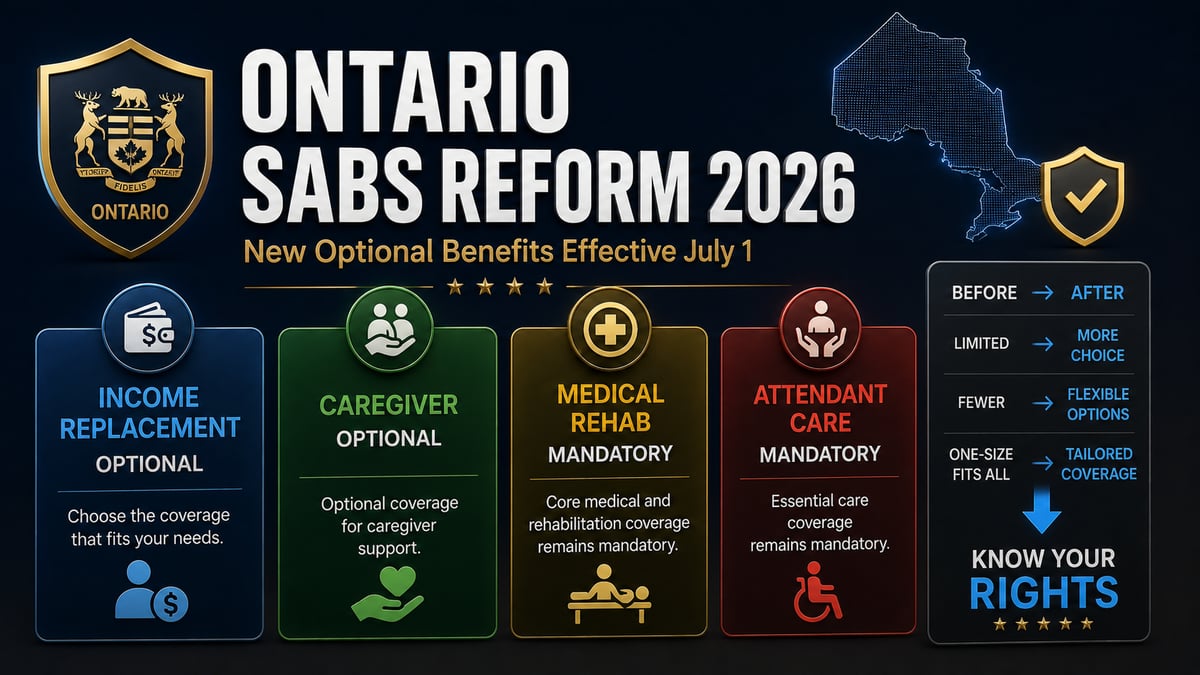
$400 per week is the standard cap on Ontario's optional income-replacement benefit (IRB), subject to 70% of gross weekly employment income and deductions for other income-replacement assistance. Since 1 July 2026, IRB is optional on a new auto policy. On an existing policy renewed after that date, prior benefits continue unless the insured and insurer agree in writing to change them. See Ontario Regulation 34/10 and FSRA's coverage table.
The $70,000 earner's limit
At $70,000 gross salary, weekly earnings are about $1,346. The 70% calculation is about $942 a week, so the standard $400 cap would bind before other offsets. On that simplified basis the remaining weekly gross-income gap is about $946. Higher optional weekly limits of $600, $800 or $1,000 may be offered; premiums vary. An employer disability benefit can reduce the auto benefit, so do not add the two full amounts together without checking the policy.
Eligibility after two years
The first 104 weeks use the regulation's substantial-inability test for the claimant's pre-accident work. Payments can continue after 104 weeks where the stricter complete-inability-to-engage-in-suitable-employment test is met; “two years maximum” is not a general rule. Eligibility may also arise from qualifying recent employment rather than being employed on the accident day. Weekly amounts can be affected by age and other benefit provisions.
What to check before a coverage decision
At renewal, compare the carried-forward coverage with any written changes proposed. For a new quote, Aisha can ask what her actual $400 or higher-limit IRB premium is and whether employer disability insurance overlaps. A $30–$60 annual price is not a universal regulated rate, and a $41,600 “maximum payout” assumes 104 full paid weeks without offsets and ignores possible post-104-week eligibility. Match the coverage to the contract, income and other protection.