How Does Switzerland's Three-Pillar Pension System Work, and How Can You Save on Taxes in 2026?
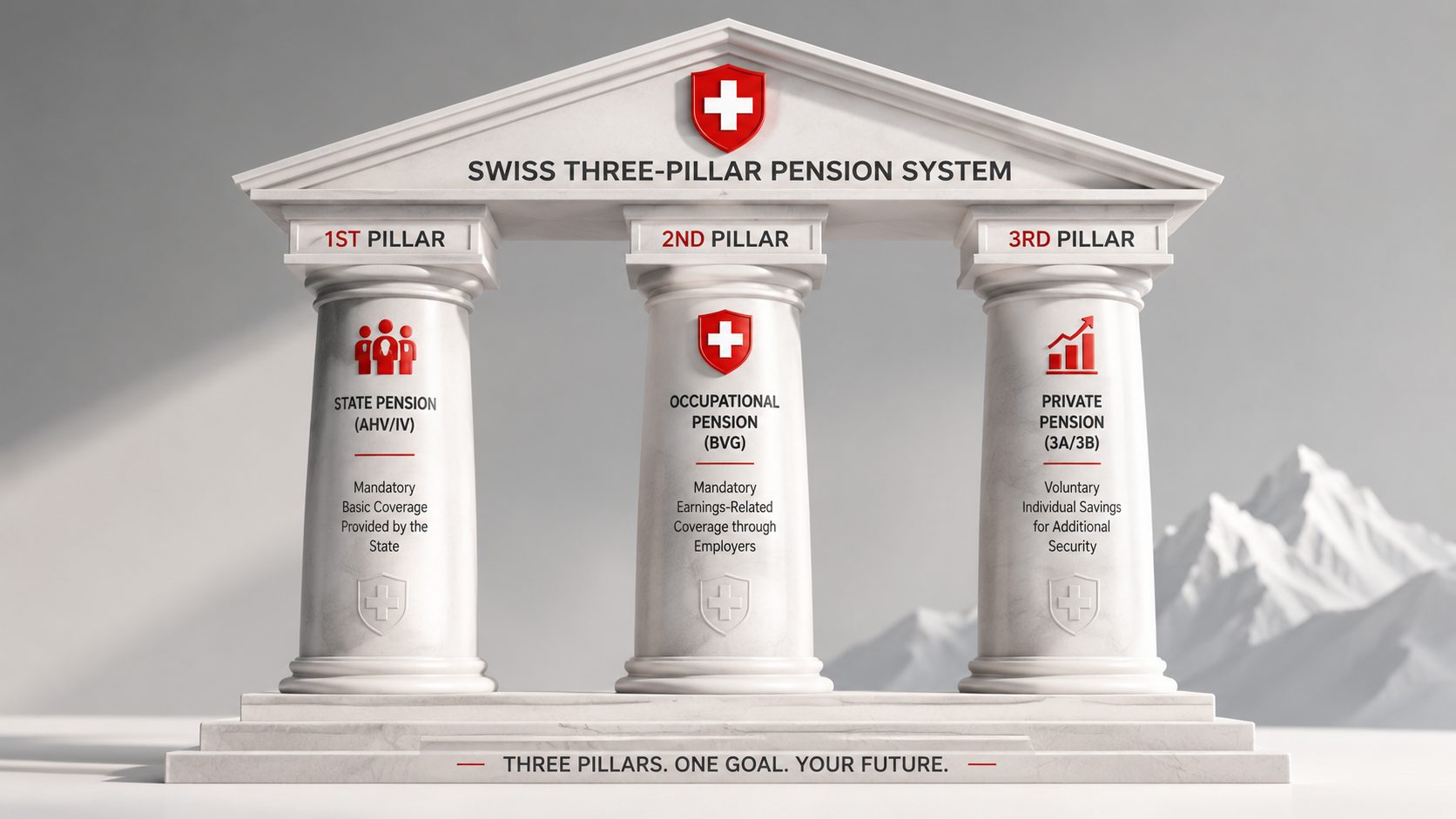
To optimize your retirement savings in Switzerland in 2026, you must contribute to the statutory state pension (Pillar 1/AHV), monitor your occupational pension fund contributions (Pillar 2/BVG), and maximize your voluntary private pension deductions (Pillar 3a) up to the 2026 annual limit of CHF 7,258 for employees. Switzerland's three-pillar system is designed to provide income security by combining state, employer, and private contributions.
Quick Answer Summary
- Pillar 1 (State/AHV): Mandatory state pension designed to cover basic living costs. Funded via payroll deductions. Retirement age is 65 years for both men and women (following AHV 21 reforms).
- Pillar 2 (Occupational/BVG): Mandatory workplace pension fund co-funded by you and your employer. Required for employees earning more than CHF 22,050 annually.
- Pillar 3 (Private/3a & 3b): Voluntary private retirement accounts. Pillar 3a is tied (restricted) and offers tax deductions up to CHF 7,258 (for employees with BVG) or CHF 36,288 (for self-employed without BVG) in 2026.
The Three Pillars of Swiss Retirement Planning
Switzerland's retirement model combines social welfare, corporate coverage, and individual responsibility:
Pillar 1: State Pension (AHV/IV/EO)
- Purpose: To secure basic subsistence in retirement or in case of disability/death.
- Funding: Pay-as-you-go (paycheck deductions split 50/50 between employee and employer, with no upper income limit).
- Benefits: Based on your contribution years and average lifetime earnings. The maximum monthly AHV pension is capped at CHF 2,450 for individuals.
Pillar 2: Occupational Pension (BVG/LPP)
- Purpose: Combined with Pillar 1, to maintain around 60% of your pre-retirement income.
- Funding: Fully funded (contributions are managed by your employer's occupational pension foundation, or Pensionskasse, co-funded by employer and employee).
- Benefits: Paid out either as a monthly lifetime pension (calculated using a conversion rate, currently 6.8% for mandatory benefits) or as a lump-sum capital payout at retirement.
Pillar 3: Private Pension (3a and 3b)
- Purpose: To close any remaining retirement income gaps voluntarily.
- Pillar 3a (Tied Pension): Strictly regulated. Contributions are tax-deductible, growth is tax-free, and withdrawals are locked until 5 years before retirement. Funds can only be withdrawn early under specific conditions (e.g. buying a primary home, starting a business, or leaving Switzerland permanently).
- Pillar 3b (Flexible Pension): Unrestricted savings, life insurance, or investment accounts. Contributions are not tax-deductible, but withdrawals are generally tax-free.
Official Swiss Pillar 3a Limits for 2026
For 2026, the Federal Social Insurance Office (FSIO) contribution limits remain unchanged:
- For Employees with a Pension Fund (Pillar 2): Max CHF 7,258 per year.
- For Self-Employed (without a Pension Fund): Max 20% of net business income, capped at CHF 36,288 per year.
2026 Pillar 3a deduction ceilings
Multi-Year Catch-Up Payments
Starting in 2026, new legislation allows residents to make retroactive top-up contributions to Pillar 3a for missed years (up to 10 years back). You can buy back up to the maximum limit of the respective year, provided you had eligible AHV income in that year. Note that buybacks are only allowed for missed years starting from 2025 onwards.
Case Study: Beat's Swiss Tax Savings in Zurich (2026)
Let's analyze Beat, a 35-year-old financial analyst living in Zurich. Beat is single, covered by a BVG pension fund, and has a taxable annual income of CHF 120,000, placing him in a marginal tax bracket of 30% (combined federal, cantonal, and municipal taxes):
Beat decides to maximize his Pillar 3a contributions in 2026 by depositing CHF 7,258 into a sustainable global equity 3a index fund:
- Pillar 3a Contribution: CHF 7,258
- Tax Deduction Claimed: CHF 7,258
- Immediate Annual Tax Savings: CHF 7,258 × 30% = CHF 2,177.40
Verdict: Beat saves CHF 2,177.40 in income tax for 2026. The net cost of his CHF 7,258 contribution is only CHF 5,080.60 out-of-pocket, representing an immediate tax-sheltered return of 42.8%.
Beat's CHF 7,258 contribution in Zurich
Payout Taxation: The Capital Withdrawal Tax
When you retire and withdraw your Pillar 3a or Pillar 2 balances, the payout is taxed under the Capital Withdrawal Tax (Kapitalauszahlungssteuer):
- The tax is calculated separately from your ordinary income tax, at a reduced rate.
- The rate is progressive, meaning large lump-sum withdrawals face higher tax rates.
- Optimization Strategy: Open multiple Pillar 3a accounts (up to 5). Since you can close accounts starting 5 years before retirement age, you can execute a staggered withdrawal (closing one account per year) to stay in lower tax brackets, saving thousands of francs in withdrawal taxes.
Use the Switzerland Pillar 3a Calculator to project your tax savings and model staggered withdrawal benefits.
Advanced Strategic Implementation & Optimization for Swiss Residents
The Swiss Three-Pillar pension system is a highly structured framework that can be optimized using Pillar 3a tax deductions.
Swiss Retirement Planning Checklist
- Max Out Pillar 3a Contributions: Fund the maximum limit (CHF 7,258 for employees) annually to lower cantonal and federal taxes.
- Implement a Staggered Withdrawal Strategy: Open up to 5 separate Pillar 3a accounts to facilitate tax-optimal withdrawals over multiple years.
- Consider Voluntary Pillar 2 Buybacks: Make cash purchases into your occupational pension to close contribution gaps and save taxes.
Step-by-Step Staggered Withdrawal Strategy
- Open Multiple Pillar 3a Accounts: Establish accounts with different financial institutions over your working career.
- Distribute Annual Contributions: Rotate or divide your annual deposits across these separate accounts.
- Plan Closing Dates: Schedule one account closure per year during the 5 years leading up to retirement.
- Optimize Capital Payout Tax: Stay in lower tax brackets by avoiding large single-year lump-sum withdrawals.
Common Pitfalls & Audit Warnings
- Keeping Pillar 3a in Low-Interest Cash: Leaving long-term Pillar 3a retirement funds in cash accounts rather than low-cost equity index funds.
- Over-contributing to Pillar 3a: Depositing more than the annual statutory cap (CHF 7,258 / CHF 36,288) results in tax office rejection and return fees.
- Ignoring Pension Fund Buyback Conditions: Making voluntary Pillar 2 buybacks within 3 years of retirement can trigger tax clawbacks.
Advanced Pension & Retirement Benefit Scenario Modeling
We model the tax savings of making Pillar 3a contributions across three Swiss cantons.
Swiss Canton Pillar 3a Comparison Table
| Metric | Case A: Canton Zug (Low Tax) | Case B: Canton Zurich | Case C: Canton Geneva (High Tax) |
|---|---|---|---|
| Gross Salary | CHF 130,000 | CHF 130,000 | CHF 130,000 |
| Pillar 3a Deposit | CHF 7,258 | CHF 7,258 | CHF 7,258 |
| Combined Marginal Rate | 16.5% | 30.0% | 38.5% |
| Direct Tax Saved | CHF 1,197 | CHF 2,177 | CHF 2,794 |
| Portfolio Value (Yr 20) | CHF 347,200 | CHF 347,200 | CHF 347,200 |
Same CHF 7,258 deposit, three cantonal outcomes
Step-by-Step Canton Tax Analysis
Case B: Canton Zurich (Moderate-High Tax)
- Deduction: Deposit the full CHF 7,258 to your Pillar 3a account, reducing your taxable income to CHF 122,742.
- Savings: Multiplying the CHF 7,258 deduction by Zurich's 30.0% combined tax rate yield CHF 2,177.40 in cash savings.
4. Staggering Pillar 3a Withdrawals: The 5-Year Exit Strategy to Save Taxes
When you retire in Switzerland, you withdraw your accumulated Pillar 3a savings as a lump sum. This withdrawal is subject to a capital withdrawal tax (Kapitalbezugssteuer) at the cantonal and federal levels.
Because Switzerland uses a progressive tax rate for capital withdrawals, withdrawing a large lump sum in a single year results in a high tax bracket.
The Staggering Strategy
To minimize this tax, you should open multiple Pillar 3a accounts (usually 3 to 5 separate accounts with different providers) during your working years.
- The Rule: You cannot make partial withdrawals from a single Pillar 3a account. The entire account must be closed at once.
- The Playbook: You can withdraw Pillar 3a funds starting five years before the official retirement age. By having five separate accounts, you can close one account per year over a five-year period, keeping your annual taxable withdrawal low and saving thousands of francs in taxes.
5. How Cantonal and Communal Tax Differences Affect Your Swiss Wealth Planning
Switzerland's federal structure means that your tax bill is heavily determined by where you live. Your income tax, wealth tax, and capital gains tax on retirement withdrawals are calculated based on your canton and municipality of residence.
For example, a high-income earner living in Geneva or Zurich might pay an effective marginal tax rate of 40% to 45%. If that same person moves to a low-tax canton like Zug or Schwyz, their marginal rate can drop below 15% to 20%. When planning to withdraw a large Pillar 2 or Pillar 3a balance, relocating to a tax-friendly canton before triggering the payout is a common tax planning strategy.
6. The Pillar 3a Buyback Rule: How to Make Up for Missed Contribution Years
Starting in 2026, Switzerland has introduced an important new pension catch-up rule. If you missed making the maximum Pillar 3a contribution in prior years (e.g., due to studying, career breaks, or living abroad), you can now perform a retroactive buyback.
However, there are several strict criteria:
- Gaps Eligible: You can only close gaps that have occurred from January 1, 2025 onwards. Gaps arising before 2025 cannot be retroactively funded.
- Max Out Current Year: You must have fully paid the maximum ordinary contribution for the current tax year first (CHF 7,258 for salaried employees in 2026).
- Income Requirement: You must have had earned income subject to AHV contributions in both the year the gap arose and the year of the buy-in.
- Annual Limit: The catch-up buy-in amount in any single calendar year is capped at the maximum small contribution limit (CHF 7,258 in 2026).
- One-time Deposit: Gaps for a single year must be paid in full in one transaction.
To model your specific savings, use our custom Pillar 3a Retroactive Buy-In Calculator to see how much tax you can save.
7. How Swiss Pillar 2 Buybacks (Einkauf) Can Lower Your Annual Tax Bill
If you have gaps in your occupational pension (Pillar 2) history — due to career breaks, years spent working abroad, or salary increases — you can perform a Pillar 2 buyback (Einkauf).
The Swiss tax authorities allow you to deduct the full buyback amount from your taxable income on your annual tax return. This is an exceptionally powerful tax shield for high-income earners in their 40s or 50s. Before performing a buyback, request a pension statement from your provider to check your exact "buyback potential" (purchasing limit), and verify that your pension fund has a healthy coverage ratio (Deckungsgrad) above 100%.