Calculator
Singapore Savings Bonds (SSB) Calculator
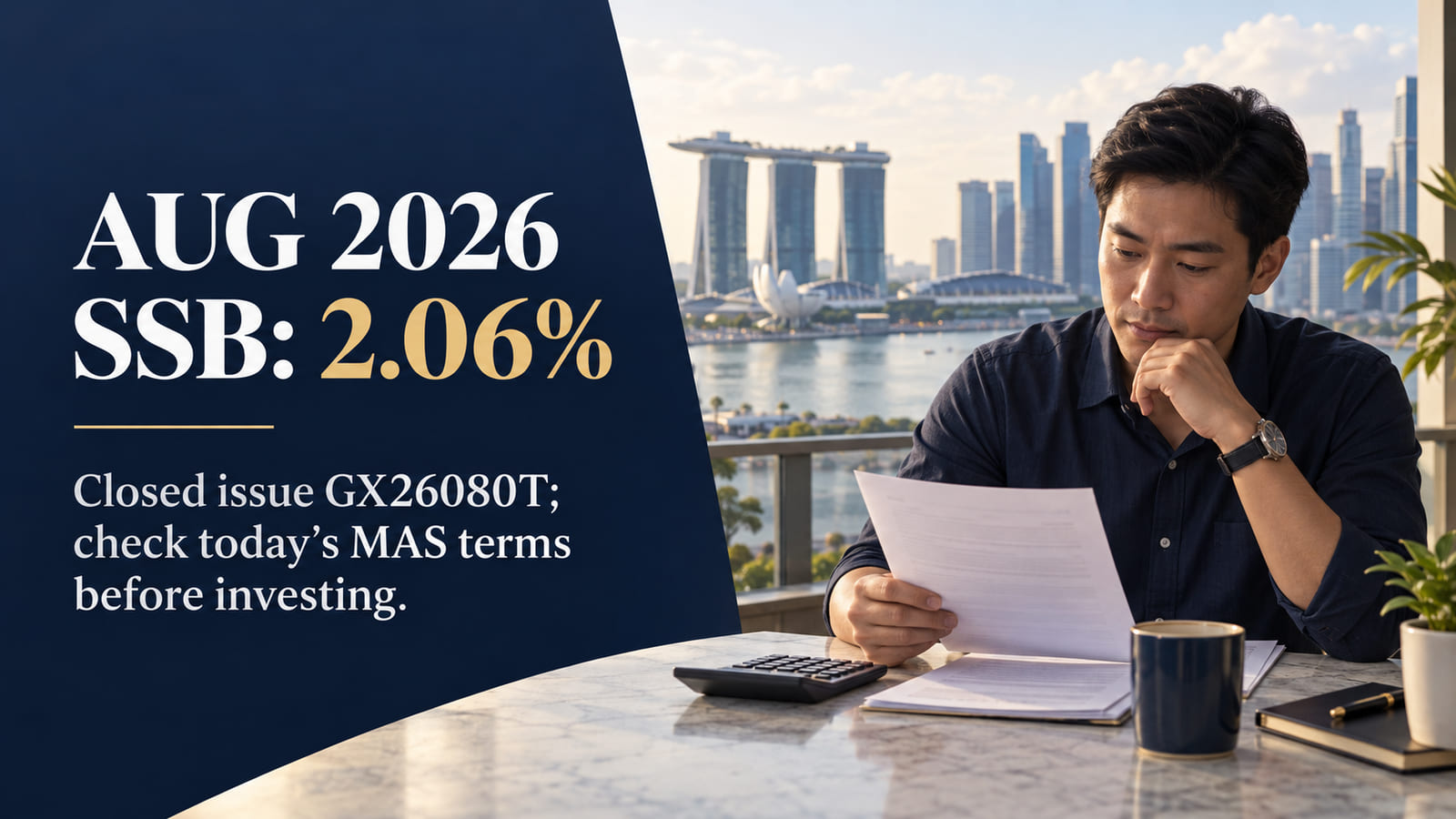
Calculate whole-year coupon receipts for the August 2026 Singapore Savings Bond GX26080T, with its published step-up ladder and S$500 blocks.
Try it nowCalculate step-up interest payouts, average annual yields, and redemption values for Singapore Savings Bonds (SSB).
S$10,000 in the August 2026 SSB issue (SBAUG26, GX26080T) earns about S$2,082 of coupons over ten years, paid every six months rather than all at maturity. Its MAS-published effective annual return over the full term is 2.06%; the simple average of the ten stated coupon rates is 2.08%. Set your amount in S$500 blocks and a whole-year holding period to see the scheduled coupons. A monthly exit is possible, but this tool does not calculate a mid-year accrued-interest payout.
A Singapore Savings Bond is a 10-year bond issued monthly by MAS and backed directly by the Singapore Government. Its annual coupon schedule is fixed before applications open, while an early redemption returns principal at face value plus accrued interest. MAS's GX26080T record confirms issue on 3 August 2026, maturity on 1 August 2036, and the first interest date of 1 February 2027. Coupons then fall in February and August. The issuer's coupon record gives each rate used by the widget.
A T-bill, fixed deposit and SSB have different exit terms. MAS allows an SSB redemption request in any month at par plus accrued interest, with a S$2 bank transaction fee. A T-bill can be sold before maturity at a market price, while an early fixed-deposit withdrawal depends on the bank's terms. Future T-bill and deposit rates cannot be inferred from today's quote, so this widget does not manufacture a ten-year return comparison by repeating one current rate. Compare current offers and access needs separately.
Applications for SBAUG26 totalled S$196.6 million against S$300 million offered, while S$179.4 million fell within individual allotment limits and was allotted. There was no issue-level quantity ceiling or oversubscription ballot. The difference between applications and allotment shows why it would be wrong to promise that every applicant received the full amount requested: an application above the person's S$200,000 total SSB holding limit cannot be filled in full. These historical allocation figures do not predict a later issue's demand.
The SBAUG26 coupons are back-loaded: the annual rate rises from 1.46% to 2.72%. MAS fixes that schedule before applications open. It does not adjust the earlier coupons when you redeem, so a short hold only receives the lower early-year payments.
The chart shows individual annual coupon rates, not a guaranteed investment return on coupons after they land in your bank account. MAS's published 2.06% effective annual return for ten years reflects the cash-flow dates; the calculator reports the 2.08% arithmetic coupon average separately. Those two percentages answer different questions.
MAS allows monthly redemption at face value plus accrued interest. A bank transaction fee of S$2 applies. Funds are normally paid by the end of the second business day of the next month, with MAS's issue notice warning that bank credit can take one more working day. A market-traded bond can have price risk if sold early; a fixed deposit's early-withdrawal terms depend on its provider.
That flexibility is useful, but it is not instant access. A request made early in a month waits until the next month for settlement; one made near the cutoff waits less. Check that month's redemption deadline before treating the SSB as emergency cash. The widget shows coupons at whole-year exits, not the day-count interest owed for a specific monthly exit.
Three constraints trip people up. Holdings are capped at S$200,000 per person across all issues. Popular issues get oversubscribed and allotted by ballot in S$500 blocks, so a S$50,000 application may only be partially filled. And you need a CDP account linked to a local bank plus Singpass to apply at all.
The August 2026 issue had S$196.6 million of applications against S$300 million offered. S$179.4 million was within the individual holding limits and allotted without an issue-level quantity ceiling. The S$17.2 million difference means some requests exceeded individual headroom; do not say every applicant got their full requested amount. The allotment outcome of a later issue can differ.
MAS describes SSBs as direct Singapore Government obligations and its issue notice states that eligible individual interest receives the qualifying-debt-security tax exemption. Check your own tax position if the bond is held through a business or a non-resident Singapore permanent establishment. The yield is fixed by issue, while your actual cash access depends on the monthly redemption calendar.
Each issue opens at the start of the month and closes a few business days before month-end; apply through DBS, OCBC, or UOB internet banking or ATMs with your CDP number handy, or through your SRS operator if you are using Supplementary Retirement Scheme funds. Allotment results land after the ballot, and the bonds start earning from the first business day of the following month.
Redemptions run on a monthly rhythm: submit in a given month's window and principal plus accrued interest normally arrives by the end of the second business day of the following month, with possible bank-credit delay. That can be a few days or close to a month depending on when you request. Keep enough instant-access cash for bills due before the payout. All successful applications in an issue start earning on the same issue date; submitting early does not create extra coupon days.
Instead of dropping S$60,000 into a single issue, spreading S$5,000 a month across twelve consecutive issues buys you two things. Your average rate tracks the whole year instead of one month's print, so a single weak issue like a low-coupon month cannot define your decade.
More usefully, each rung redeems independently. Need S$10,000 in an emergency? Redeem the two lowest-coupon rungs and leave the rest compounding. A single large holding forces an all-or-something decision; a ladder gives you a dial. The S$2 fee per transaction makes even a twelve-rung ladder cost S$24 to build, which is noise.
Because exit is free, an SSB is never a trap. If a new issue prints a materially better schedule than what your remaining years pay, the move is mechanical: redeem the old bond, apply for the new issue the same month, and accept roughly one month out of the market as the switching cost.
The discipline is to compare like with like: weigh the new issue's early years against the REMAINING years of your current bond, not against its year-1 rate you have already outgrown. Three years into a ladder, your old bond may be paying its year-4 rate, and beating that takes more than a flashy new headline number.
A Singapore Savings Bond pays a different rate each year you hold it: the schedule is printed the day the issue opens, and the rate steps up annually across the 10-year term. Total interest is just your principal multiplied by each year's scheduled rate, summed over however long you actually stay.
MAS permits redemption in any month at face value plus accrued interest, subject to the bank's S$2 transaction fee. This widget sums complete years of SBAUG26 coupons only; a mid-year redemption needs the exact coupon dates and MAS accrued-interest calculation. It does not treat coupons already paid into your bank account as though they remained invested in the bond.
Wei Lin puts S$10,000 into SBAUG26 (GX26080T). The schedule runs from 1.46% in year 1 to 2.72% in year 10. Its coupon rates have a 2.08% simple average, while MAS publishes a 2.06% effective annual return over the full term.
Year 1 pays about S$146 and year 10 about S$272, each split across two scheduled payments. A full ten-year hold pays about S$2,082 in total coupons and later returns the S$10,000 principal. The S$12,082 cumulative-receipts figure is not a single payment at maturity.
If she redeems after three complete years, the scheduled coupons sum to roughly S$501 and she gets S$10,000 principal back. A redemption within a coupon period also receives accrued interest calculated under MAS's day-count method, which this whole-year tool does not model. Redemption has no market-price loss, but the bank charges S$2 and payment timing may differ by a working day.
Compare that with a 10-year SGS bond sold early on the open market: if rates rose since purchase, the sale price sits below par. The SSB's redeem-at-par guarantee is exactly the risk she is not taking.
Review the glossary of terms used in the calculation model below. Click on highlighted links to read more in-depth definitions in our financial glossary:
| Parameter | Definition & Context |
|---|---|
| Investment Amount | Cash allocated to the bond, in S$500 multiples. Your total SSB holdings across all issues are capped at S$200,000. |
| Holding Period (Years) | Whole years from 1 to 10. The result sums stated coupons for that period; it cannot quote an exact mid-year redemption value. |
These links include relevant regulators and page-specific references. Worked examples and projections may also use stated assumptions: