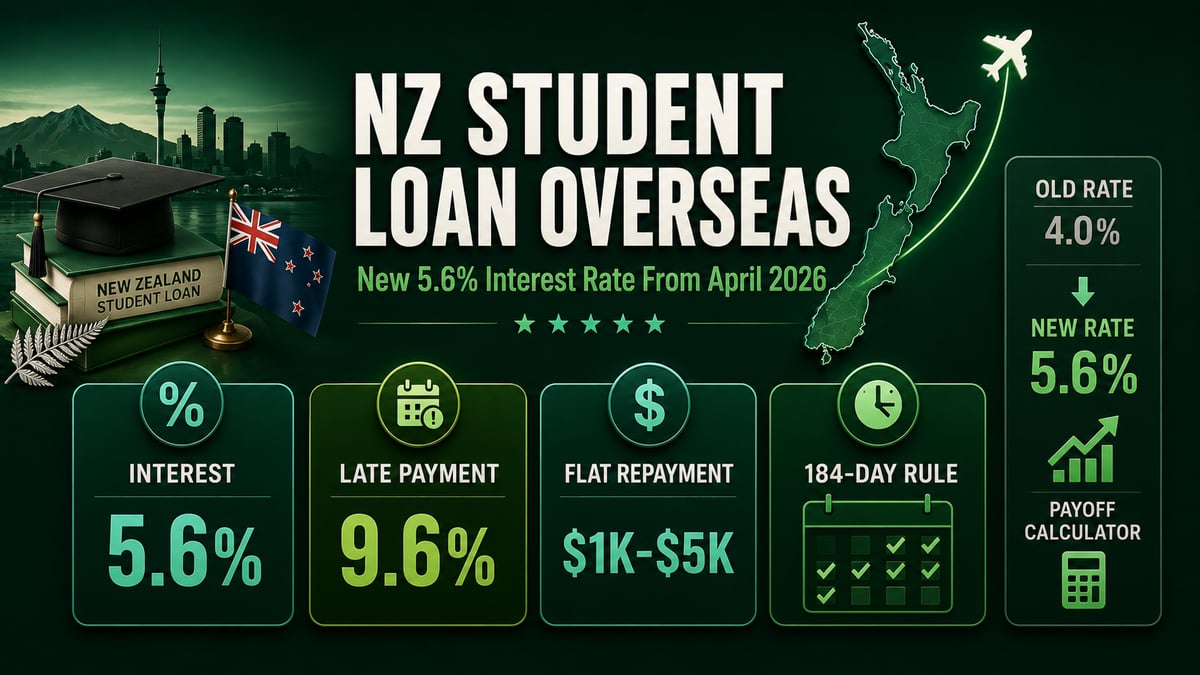
A temporary repayment suspension (TRS) can give a New Zealand student-loan borrower a one-off break of up to 12 months from overseas-based minimum repayments while travelling. It is not a renewable six-to-twelve-month hardship programme. Apply before leaving or within six months of departure, and supply an adult New Zealand alternate contact. IRD's TRS guidance explains these conditions.
What pauses and what does not
During a valid TRS, the overseas-based assessment for the covered period shows NZ$0 due, but interest continues from the day after leaving. New Zealand-based payments already due are not suspended. If still overseas when the one-off window ends, the borrower must meet the usual balance-based minimum repayments, normally by 30 September and 31 March.
A one-year illustration
Priya has NZ$40,000 outstanding and no payments for a full year under a valid suspension. At the 2026–27 standard 5.6% annual rate, a deliberately simplified year-end illustration gives NZ$40,000×1.056=NZ$42,240, or NZ$2,240 additional interest. IRD accrues daily and adds interest after 31 March, so her actual amount depends on dates and intervening activity. A chart of two consecutive years on automatic suspension would be wrong: the ordinary TRS limit is up to 12 months.
Hardship relief is separate
If Priya cannot pay after TRS ends, IRD offers separate repayment negotiations or hardship relief. She should contact IRD rather than assume the travel suspension can simply renew or that it automatically blocks all enforcement indefinitely. Certain serious-illness or overseas-work situations may qualify for separate interest-free treatment, subject to proof and specific rules.