Introduction: Moving Overseas with an NZ Student Loan
For many New Zealand graduates, moving overseas is a classic rite of passage. Whether heading to Australia, the United Kingdom, or North America, an international move opens up incredible career opportunities. However, if you have an active New Zealand Student Loan, leaving the country triggers a major shift in how your debt is managed by the Inland Revenue Department (IRD).
While student loans in New Zealand are interest-free for borrowers who reside in the country, this interest-free status is lost when you move overseas. Under the 184-day rule, if you remain outside New Zealand for more than 6 months, your loan will begin accruing interest, and you must make fixed repayments based on your total balance, regardless of your foreign income.
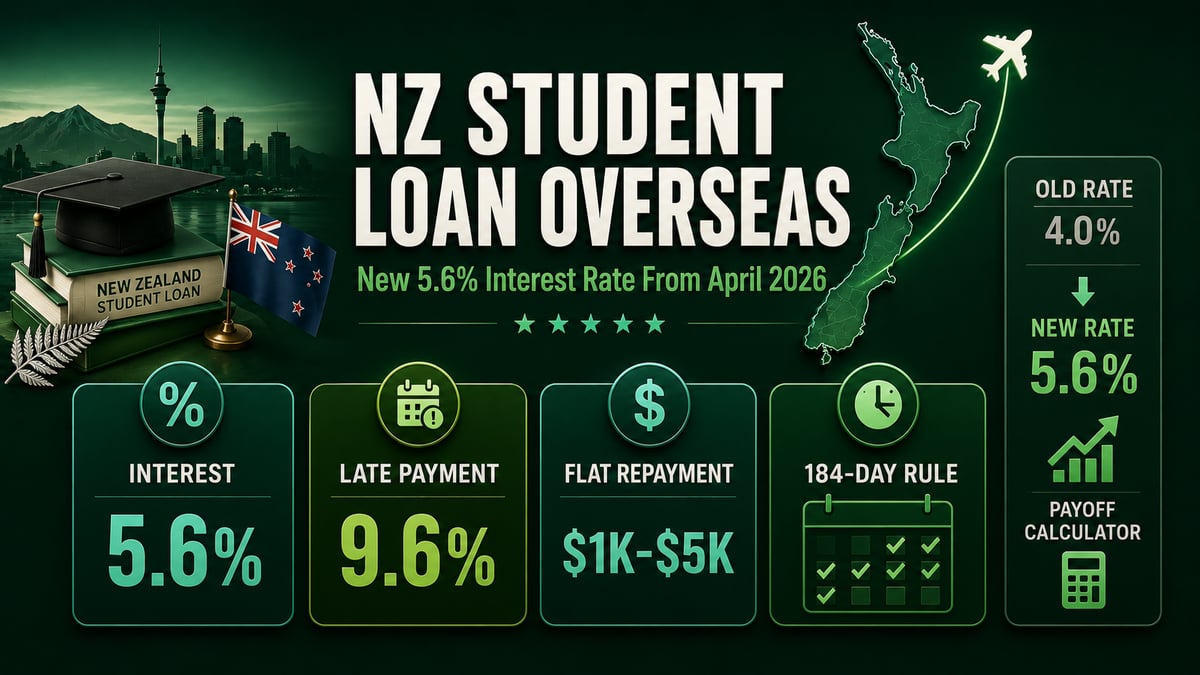
This guide explains the operational rules of overseas-based student loans, details the 5.6% annual interest rate (calculated daily and applied annually) effective April 1, 2026, outlines the balance-based repayment brackets, and explains how to avoid late payment penalties.
NZ-Based vs. Overseas-Based Student Loan Rules
| Policy Feature | NZ-Based Borrower | Overseas-Based Borrower (Effective April 1, 2026) |
|---|---|---|
| Interest Rate | 0% (Interest-Free) | 5.6% per annum (calculated daily and applied annually) |
| Late Payment Interest | None (standard collection fees) | 9.6% per annum (compounding monthly) |
| Repayment Method | Deducted from salary (12.0% of income above threshold) | Fixed annual payments based on loan balance |
| Assessment Threshold | $24,128/year (exempt below this) | No income threshold; repayments due from $1,000 balance |
| Payment Due Dates | Automated via payroll (monthly/weekly) | 30 September and 31 March (two equal installments) |
Important
If you remain overseas and only pay the compulsory amount, your loan balance can actually grow over time due to daily interest calculations if your balance is high. Check your payoff timeline using our Overseas Student Loan Calculator.
1. The 184-Day Rule: How You Lose Interest-Free Status
The boundary between interest-free and interest-bearing status is determined by the 184-day rule:
- The Rule: You must be out of New Zealand for more than 184 consecutive days (approximately 6 months) to be classified as an 'overseas-based borrower'.
- Backdating: Once you cross the 184-day mark, the IRD classifies you as overseas-based from the day after you left New Zealand. Interest is backdated and charged on your loan from the day after you leave New Zealand.
- Returning to NZ: To restore your interest-free status, you must return to New Zealand and remain in the country for at least 183 consecutive days. If you return for a short holiday (less than 32 days), it does not interrupt your overseas-based status.
- To learn more about residency rules, consult the Overseas-Based Borrower Glossary Entry.
2. Fixed Repayment Brackets: What You Owe the IRD
Unlike repayments in New Zealand which scale with your salary, overseas-based repayments are fixed annual sums determined entirely by your total loan balance at the start of the tax year. Lenders face the same repayment bracket regardless of whether they are unemployed or earning a high salary overseas:
- Under $1,000: Full balance
- $1,000 to $15,000: $1,000 per year ($500 per installment)
- $15,001 to $30,000: $2,000 per year ($1,000 per installment)
- $30,001 to $45,000: $3,000 per year ($1,500 per installment)
- $45,001 to $60,000: $4,000 per year ($2,000 per installment)
- Over $60,000: $5,000 per year ($2,500 per installment)
Fixed annual repayments for overseas-based borrowers
These payments are split into two equal installments due on 30 September and 31 March each year. If your loan balance moves into a higher bracket due to accrued interest, your compulsory repayment will also increase in the subsequent tax year.
3. The 5.6% Daily Calculated Interest Trap
Effective April 1, 2026, the IRD has increased the interest rate for overseas-based borrowers to 5.6% per annum, calculated daily and applied annually. This daily calculation creates a severe financial trap for borrowers with high loan balances, known as negative amortization:
The Math of the Trap
If you have a student loan balance of $100,000, the interest accrued in the first year at 5.6% is $5,600. Under the IRD brackets, your compulsory annual payment is capped at $5,000. If you only pay the compulsory $5,000, your payment does not even cover the interest charged, and your loan balance will grow by $600 by the end of the year. Your debt will increase indefinitely despite making payments.
To escape this trap, you must make voluntary extra payments above the compulsory amount to ensure you are reducing the principal. Use our Overseas Student Loan Repayment Calculator to model this.
4. Late Payment Interest and Repayment Suspensions
If you miss an installment due date, the consequences are severe:
Late Payment Interest Rate
If you have an overdue balance of $334 or more, the IRD charges a late payment interest rate of 9.6% per annum (up from 8.9%). This penalty interest compounds monthly and is added to your debt. For details, see the Late Payment Interest Glossary Entry.
The Instalment Relief Option
If you cannot pay, you must contact the IRD. If you agree on a structured instalment plan to clear your arrears, the IRD will reduce the penalty rate to a reduced late payment interest rate of 7.6% per annum for the duration of the plan.
The interest rates that switch on when you leave NZ
Repayment Suspension
If you cannot make payments, you can apply for a Repayment Suspension of up to 12 months. This pauses your obligation to make compulsory payments but does not stop interest from accruing. Interest continues to accrue at 5.6% during the suspension. See the Repayment Suspension Glossary Entry.
Who Is Affected? The Numbers Tell a Story
According to IRD statistics as of March 2026, there are approximately 750,000 active student loan borrowers in New Zealand. Of these, roughly 130,000 are overseas-based borrowers. The compliance rate among overseas-based borrowers sits at just 26.5% — compared to 94.7% for New Zealand-based borrowers. This means nearly three-quarters of Kiwis living abroad with student loans are not meeting their repayment obligations.
The scale of the problem is significant. Total overseas-based borrower repayments reached $83 million in the year to March 2026, up 20.5% from the previous year. Yet with interest now at 5.6%, the amount owed continues to grow for many borrowers who are only making minimum payments.
The Australian Connection
Approximately 60% of overseas-based borrowers live in Australia, making it by far the most common destination. The IRD and the Australian Tax Office (ATO) have a data-sharing agreement. The ATO provides IRD with information on the income and location of New Zealand student loan borrowers living in Australia. This means the IRD knows where you are and approximately how much you earn — the old days of disappearing across the ditch are over.
If you move to Australia, the same overseas-based borrower rules apply. Your compulsory repayments are still based on your loan balance, not your Australian income. However, if you return to New Zealand, your loan reverts to being interest-free, and your repayments are based on 12% of income above the threshold.
How to Apply for a Repayment Suspension in Practice
A temporary repayment suspension pauses your obligation to make compulsory payments for up to 12 months. It is not automatic — you must apply and meet specific criteria. Valid reasons include:
- Studying overseas (provide proof of enrolment)
- Volunteering overseas with a recognised organisation
- Serious illness or injury preventing work
- Accompanying your partner who is overseas for one of the above reasons
- Working overseas for the New Zealand government or on secondment
- Unexpected delay returning to New Zealand
To apply, log into myIR, navigate to your student loan account, and find the repayment suspension section. You will need to upload supporting documents. The IRD aims to process applications within 20 working days. If they request additional information, you must provide it within 20 working days or the application may be withdrawn.
Important: a suspension does not stop interest from accruing at 5.6%. It only pauses the compulsory repayment obligation. Your balance will continue to grow.
The 32-Day Rule: When Short Visits Home Do Not Help
Many overseas-based borrowers assume that a short holiday back to New Zealand resets their overseas-based status. It does not. The rule is clear:
- To be considered New Zealand-based, you must be physically present in New Zealand for 32 days or more in a 184-day period (approximately 6 months).
- A 2-week Christmas holiday home counts as only 14 days — well short of the 32-day threshold.
- You need to be in New Zealand for more than half the days in that 184-day period (at least 93 days) to fully interrupt the overseas-based clock.
However, if you build up enough days over multiple visits that total 32 days within any rolling 184-day window, your status can change. The myIR portal has a travelling overseas section that tracks this automatically — check it before making assumptions.
Full Worked Example: Loan Growing Despite Payments
Let us say you have a student loan balance of $80,000 and move to London. You have been overseas-based since September 2025.
The compulsory minimum payments:
- Your loan is over $60,000, so your annual compulsory repayment is $5,000
- Due in two installments: $2,500 by September 30 and $2,500 by March 31
The interest:
- Balance: $80,000
- Annual interest rate: 5.6%
- Daily interest: $80,000 × 0.056 / 365 = approximately $12.27 per day
- Annual interest: approximately $4,480
The trap:
- You pay: $5,000
- Interest charged: $4,480
- Principal reduction: only $520
The $80,000 London example: where the $5,000 payment goes
At this rate, it would take over 60 years to pay off the loan. If your loan balance is above approximately $89,285, your compulsory payments no longer cover the interest, and the loan grows despite you making every payment on time.
The only way out is to make voluntary extra payments above the compulsory amount. Every extra dollar you pay directly reduces the principal and lowers future interest.
IRD Enforcement Powers
The IRD has significant enforcement tools at its disposal for non-compliant overseas-based borrowers:
- Data sharing with the ATO to locate your income and assets in Australia
- Issuing arrest warrants to prevent you from leaving New Zealand if you return with overdue debt
- Seizing New Zealand tax refunds
- Pursuing debt collection through legal channels in countries with reciprocal arrangements
- Applying late payment interest at 9.6% on overdue amounts
If you have missed payments, do not ignore IRD correspondence. Contact them proactively to set up a payment arrangement. The IRD will typically negotiate a reduced lump sum settlement or an instalment plan rather than escalating to enforcement. A repayment plan also qualifies you for the reduced late payment interest rate of 7.6%.
Practical Advice for Borrowers Moving Overseas
If you are planning to move overseas with a student loan, here is your action plan:
Before you leave:
- Update your contact details in myIR — include your overseas address and phone number
- Set a calendar reminder for 184 days after departure
- Set up a direct debit or recurring international transfer for your repayments
- Consider making a lump sum payment before you leave to reduce the principal
After you leave:
- Check myIR regularly for assessment notices
- Pay your installments by the due dates (September 30 and March 31)
- If your financial situation changes, contact IRD before missing a payment
- If you can afford it, make extra voluntary payments to reduce the principal faster
- Remember that the interest rate resets each April 1 — check for changes annually