Calculator
IRS Mid-Year Standard Mileage Rate Split Calculator (2026)
Calculate your split-year 2026 vehicle tax deduction (H1 at 72.5¢ vs H2 at 76¢ per mile) under IRS Announcement 2026-11.
Try it nowEstimate your aggregate tax savings across the tips, overtime, senior status, and auto interest deductions of the OBBBA.
Estimate your combined savings across all four OBBBA provisions using the Flagship OBBBA Total Savings Calculator. Model deductions for tips, overtime, senior status, and domestic auto loan interest in a single tool.
The One Big Beautiful Bill Act (OBBBA) introduced four distinct tax deductions to lower tax burdens for middle-class W-2 workers, seniors, and domestic car buyers. By combining tips, overtime, senior status, and auto interest deductions, this flagship tool allows you to model your complete 2026 federal tax relief.
Since each OBBBA provision has distinct phase-out thresholds (e.g. $75K for seniors, $100K for auto interest, and $150K for tips/overtime), this calculator evaluates each phase-out independently based on your filing status and Modified AGI to determine your total qualified deduction.
The point of running all four provisions together is spotting interactions a single-deduction view hides. A tipped worker deciding between extra banquet shifts (overtime premium) and a second tipped job (more tip income) can see which dollar lands in a capped bucket and which still earns a deduction. A 64-year-old weighing December versus January retirement can watch the senior line flip from zero to $6,000 across the birthday. And any household near $100,000 to $150,000 of MAGI can see the auto and senior ramps eating deductions while tips and overtime hold, which is exactly the income band where a Roth conversion or bonus deferral decision should be made with this chart open. The combined number is also the right one for your W-4: withholding against four separate estimates usually overshoots or undershoots; withholding against the modeled total gets the paycheck right.
The stack is generous at $60,000 of income and nearly empty at $160,000, but not uniformly: the auto deduction dies first (gone at $150k single), the senior deduction starts fading at just $75k, while tips and overtime hold full strength until $150k. A raise from $95,000 to $130,000 quietly kills different deductions at different speeds, and nobody at payroll is tracking that for you.
That staggering is worth modeling before income-shifting decisions: a December bonus, a Roth conversion, or selling appreciated stock lands on top of MAGI and can knock out hundreds of dollars of deduction per thousand of extra income while you are inside multiple ramps at once. The calculator's MAGI slider shows the combined cliff for your exact mix, and watching where the total saving drops fastest tells you which threshold your household actually lives next to. Deferring $10,000 of a bonus into January can be worth more than the bonus's own interest when it holds two ramps at bay simultaneously.
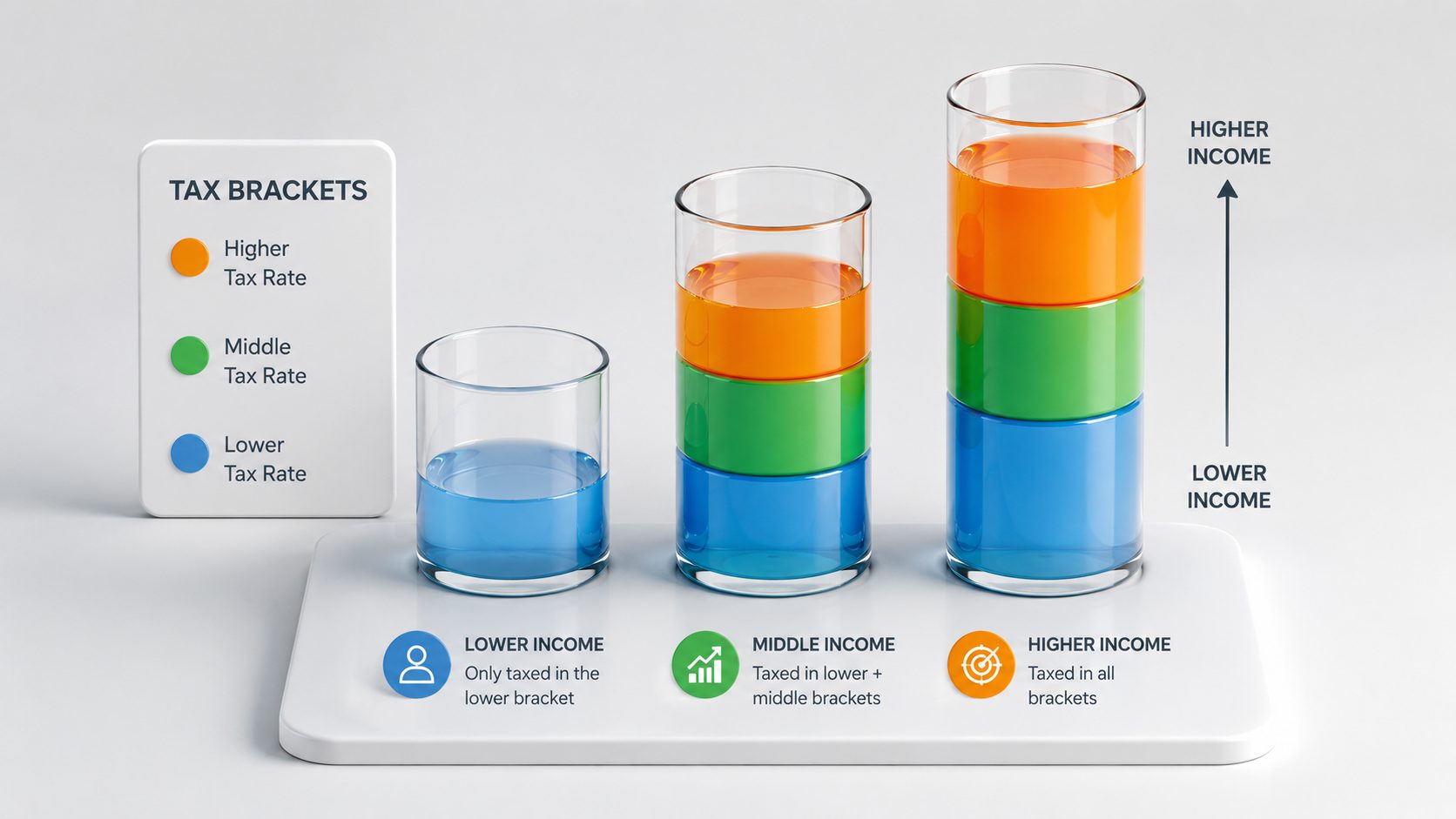
Summing caps is not the same as saving money: the deduction pile only saves at your bracket rate, and it can drag you DOWN a bracket partway through. Carla's first dollars of deduction save 22 cents each; once her taxable income falls below $50,400 the rest save 12 cents. The blended result, $3,420 on $28,500 of deductions, is exactly the kind of number a flat 'marginal rate times deduction' shortcut gets wrong.
The uncomfortable mirror image: workers in the 10% bracket get the least from the same deductions, and workers with income so low they already owe no federal tax get precisely nothing, these are deductions, not refundable credits. The biggest winners are full-cap earners in the 22-24% brackets, which is the honest summary of who OBBBA's personal provisions serve best. If your withholding already lands near zero, do not expect a windfall refund from this stack; there is no liability left for it to erase, and the calculator will show a small or zero saving for exactly that reason.
Every deduction in this stack runs out after the 2028 tax year unless Congress renews it. Plan on four filing seasons of this arithmetic and be pleasantly surprised by a fifth, not the other way round.
The sunset also frames the one genuinely time-sensitive decision here: a car purchase you were making anyway is worth timing inside the window if the US-built trim qualifies, but taking on debt or working punishing overtime purely to harvest a temporary deduction inverts the math, you spend real dollars to collect a fraction back at your bracket rate.
At filing time each deduction claims separately on the 1040 against its own reporting trail: W-2 tip and overtime boxes, the lender's interest statement, your date of birth. Nothing here requires itemizing, but everything here requires the paperwork to agree with the claim.
Two eligibility gates apply across the whole stack and get missed constantly. First, every one of these deductions requires a valid Social Security number on the return, ITIN filers are excluded by statute. Second, married taxpayers filing SEPARATELY are barred from the tips and overtime deductions entirely, the law forces joint filing to claim them, which quietly changes the filing-status math for couples who normally separate for student-loan or liability reasons. If you are weighing IBR payment optimization against a $2,000 OBBBA saving, that trade now has a price tag, and this calculator gives you the OBBBA side of it in one run.
OBBBA's four personal deductions, tips (to $25,000), overtime premium (to $12,500/$25,000), the age-65 bonus ($6,000), and US-built auto loan interest (to $10,000), all stack in the same return. This calculator sizes each one against its own phase-out, adds them up, and prices the pile through the 2026 brackets.
Each deduction has a DIFFERENT phase-out start and slope, which is why the combined answer is not obvious: at some incomes you keep three in full and lose one entirely, and the same gross income split differently between spouses can change the total by thousands.
Carla, 35, single bartender with a side of banquet shifts: MAGI $60,000, tips $12,000, overtime premium $15,000, and $4,000 of interest on a new Kentucky-built car.
Tips: fully deductible at $12,000. Overtime: capped at $12,500 of her $15,000. Senior: $0, she is thirty years early. Auto: $4,000 in full. Combined: $28,500.
Tax on $60,000: taxable $43,900 after the standard deduction, tax $5,020.
Tax on $31,500: taxable $15,400, tax $1,600.
Total saving: $3,420, about 5.7% of her income, and note the $2,500 of overtime premium above the cap earned her nothing, which is worth knowing before volunteering for every double shift in December.
Review the glossary of terms used in the calculation model below. Click on highlighted links to read more in-depth definitions in our financial glossary:
| Parameter | Definition & Context |
|---|---|
| Filing Status | Sets brackets, caps, and every phase-out threshold at once, which is why toggling it moves all four lines together. |
| Modified AGI | Total income before these deductions. All four phase-outs key off it, so this input decides how much of the stack survives. |
| Annual Tip Income | Reported, voluntary tips. Mandatory service charges are wages and never qualify. |
| Annual Overtime Premium | Only the premium half of time-and-a-half, not total overtime pay. |
The rules and figures on this page are researched from official primary sources: