
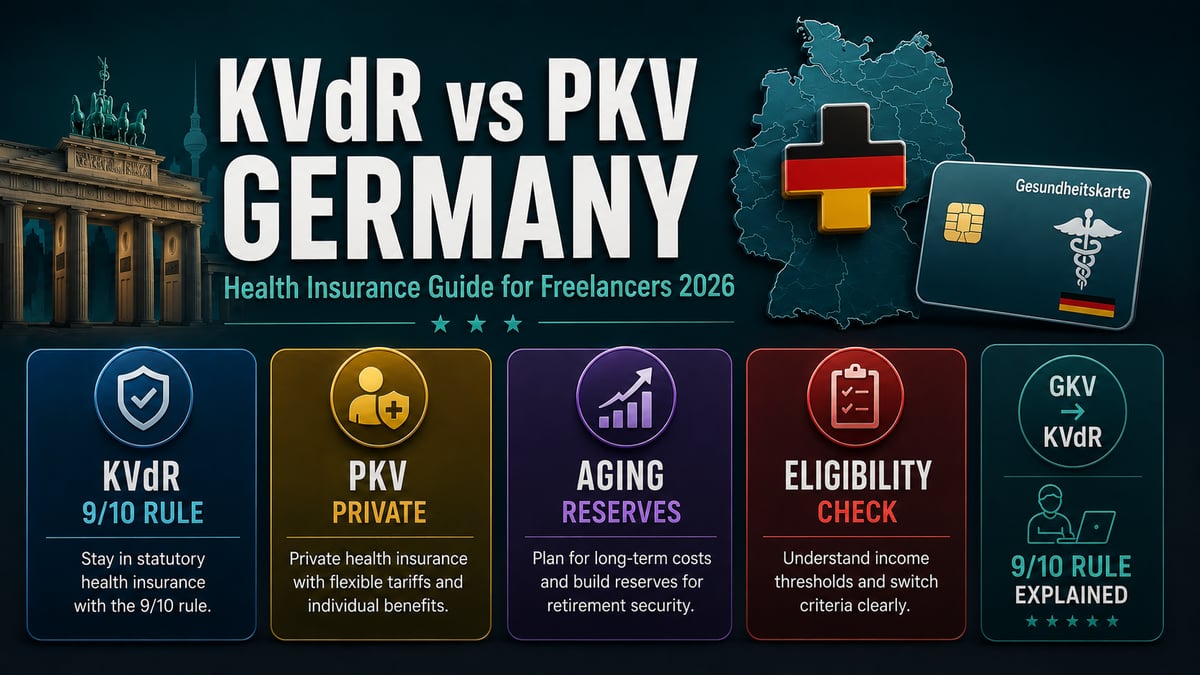
Introduction: The Health Insurance Dilemma for German Freelancers
For freelancers and self-employed professionals in Germany, choosing between statutory public health insurance (Gesetzliche Krankenversicherung - GKV) and private health insurance (Private Krankenversicherung - PKV) is one of the most critical lifetime financial decisions. While the PKV often offers lower premiums and superior medical benefits during your high-earning younger years, it can become a massive premium trap in retirement.
The key to a low-cost retirement is qualifying for the Krankenversicherung der Rentner (KVdR). The KVdR is a compulsory membership status in the public GKV that shields pensioners from high health insurance contributions. However, qualifying for the KVdR requires satisfying a strict career-long timeline known as the 9/10 rule (Vorversicherungszeit).
This guide compares KVdR status, PKV, and voluntary GKV membership in retirement, details the calculation of the 9/10 rule, and explains how children credits can save freelancers from the retirement premium trap.
Retirement Health Insurance Status Comparison
| Insurance Status in Retirement | Contribution Base | Premium Cost Share | Treatment Standard | Who It Is Best For |
|---|---|---|---|---|
| KVdR (Compulsory GKV) | Statutory pension only. Rental income, dividends, and private pensions are exempt. | GKV pension fund pays 50% of the premium (~8.15%). | Public (GKV) standard care. | Almost all GKV-eligible retirees. |
| Voluntary GKV (Failed 9/10) | All income sources (statutory pension, rental income, dividends, private pensions). | Retiree pays 100% of premium on other income (~16.3%). | Public (GKV) standard care. | Freelancers with low PKV years who failed the 9/10 rule. |
| PKV (Private Insurance) | Fixed premium based on age at entry and tariff. Income independent. | Retiree pays 100% of premium (can apply for GKV-equivalent pension subsidy). | Premium private care, private rooms. | High-net-worth retirees with substantial rental/private pension income. |
Important
Switching from private (PKV) back to statutory public (GKV) health insurance is strictly prohibited by German social security law once you reach age 55. Freelancers must plan their insurance path early. Check your eligibility using our 9/10 Rule Calculator.
1. How the 9/10 Rule is Calculated
To qualify for the KVdR, you must satisfy the Vorversicherungszeit: you must have been insured in the public GKV for at least 90% of the second half of your working career.
Step-by-Step Calculation Formula
- Determine Working Career: Find the duration in years between your first day of employment (or age 15 if you started later) and your planned date of retirement application. Let's say this is 40 years (from age 25 to 65).
- Identify the Midpoint: Divide the career duration by 2. The second half is the remaining half. In our example, the second half duration is 20 years, starting at age 45 and ending at age 65.
- Apply the 9/10 Threshold: Multiply the second half duration by 90% (0.9). In our example: 20 years * 0.9 = 18 years. To qualify, you must have GKV coverage (compulsory, voluntary, or family coverage) for at least 18 years between ages 45 and 65.
The Freelancer Hazard
Self-employed individuals often switch to PKV during their high-earning years (e.g. from age 40 to 60) to save on premiums. If a freelancer returns to GKV at age 61 and retires at age 67, they will only have 6 years of GKV coverage in the second half of their working life. Because 6 years is far below the required 90%, they will fail the 9/10 rule, locking them out of the low-cost KVdR.
2. The Child Credit (Kinderregelung) Escape Route
To help parents qualify for the KVdR, a major social security reform was introduced in August 2017. For each child, a flat credit of 3 years (36 months) of GKV membership is added to your GKV insurance record.
Key Rules of the Child Credit
- Both Parents Benefit: The 3-year credit is granted to both the mother and the father. It does not need to be split.
- Independent of Raising: The credit applies regardless of who actually raised the child and regardless of the child's birth date (first or second half of your career).
- Independent of Child's Insurance: The credit is granted even if the child was insured in the private PKV system or did not live in Germany.
This credit is added directly to your GKV years in the second half of your working life (capped at the total duration of the second half). For parents with multiple children, this credit can bridge large coverage gaps and qualify them for the KVdR, even if they spent many years in the PKV.
Real-World Child Credit Example
Birgit first started working at age 20 and retires at age 60 (working life = 40 years). The second half of her career is the 20-year period from age 40 to 60. The 9/10 rule requires 18 years of GKV coverage. Birgit was self-employed and privately insured (PKV) for 6 years during this period, leaving her with only 14 actual GKV years. However, because she has two children, she receives a 6-year credit (3 years * 2). Her virtual GKV years become 14 + 6 = 20 years (capped at the 20-year second-half duration). Because 20 is greater than 18, Birgit qualifies for the KVdR!
3. Voluntary GKV vs. PKV: The Retirement Income Tax Trap
If you fail the 9/10 rule, you cannot join the KVdR. This leaves you with two health insurance paths in retirement, both of which feature high costs:
Path A: Voluntary GKV (Freiwillige GKV)
If you remain in the public GKV without KVdR status, you are classified as voluntarily insured. In this status, your health contribution rate (~14.6% plus supplementary contribution = ~16.3% total in 2026) is levied on all retirement income sources, including:
- Statutory pensions
- Private pension payouts (Riester, Rürup, private annuities)
- Company pensions (Betriebsrente)
- Rental and lease income
- Dividends, interest, and capital gains
This can result in massive monthly premiums, capping out at the maximum GKV contribution (Beitragsbemessungsgrenze, approximately €800-€900/month including long-term care insurance).
Path B: Private PKV in Retirement
If you remain in the PKV, your premium remains fixed based on your contract tariff. While your pension, rental income, and dividends pay 0% contributions, your private premium remains high and can increase due to medical inflation. Although you can apply for a tax-free subsidy from the statutory pension insurance (equal to half of what your GKV contribution would be on your statutory pension), the net premium can still consume a massive portion of your pension if your GKV pension is small.
To compare these paths, review our KVdR vs PKV Comparison tool.
Understanding the 9/10 Rule: A Detailed Walkthrough
The 9/10 rule (Neunzehntelbelegung) is the gatekeeper for KVdR eligibility. Here is how the Deutsche Rentenversicherung and your Krankenkasse calculate it:
Step 1: Determine the Rahmenfrist (Framework Period)
The framework period starts on the day you first began any form of employment (Erwerbstätigkeit) or were first eligible for GKV membership. It ends on the day you apply for your pension. If you started working at age 20 and apply for your pension at age 66, your Rahmenfrist is 46 years.
Step 2: Find the Second Half
Divide the Rahmenfrist by two. The second half is everything from the midpoint to your pension application date. In the 46-year example, the second half is 23 years — from age 43 to 66.
Step 3: Calculate the Required GKV Coverage
Multiply the second half duration by 90%. In our example: 23 years × 0.9 = 20 years and 8 months. You must have been insured in the GKV (as a compulsory member, voluntary member, or through family insurance) for at least 20 years and 8 months of those 23 years.
What Counts as GKV Coverage?
- Pflichtversicherung (compulsory membership as an employee)
- Freiwillige Versicherung (voluntary membership, including as a freelancer)
- Familienversicherung (family insurance through a GKV-insured spouse or parent)
- Note: Under current law (confirmed by BSG ruling B 12 KR 26/22 R), voluntary GKV membership counts. This was not always the case — older regulations excluded it. If you have voluntary GKV periods before 1993 or between certain reform dates, verify with your Kasse.
The Freelancer Penalty: Why Selbstständige Often Miss KVdR
Freelancers and self-employed professionals face a structural disadvantage with the 9/10 rule. Here is a typical scenario:
Maria is a freelance graphic designer. She started working at age 22 and plans to retire at age 67 — a Rahmenfrist of 45 years. The second half is 22.5 years (age 44.5 to 67). She needs 20 years and 3 months of GKV coverage in that second half.
Maria was in GKV as a student and young employee until age 30. Then she went freelance and switched to PKV to save on premiums. She stayed in PKV from age 30 to 60. At age 60, worried about retirement, she returned to GKV as a voluntary member.
Her GKV coverage in the second half (age 44.5 to 67): only 7 years (ages 60 to 67). She needs 20.25 years but has only 7. She fails the 9/10 rule by a wide margin and cannot enter KVdR.
The result: Maria enters retirement as a voluntary GKV member paying 16.3% contributions on ALL her income sources — including rental income from a property she owns and her private pension payouts.
How the Child Credit Can Rescue You
The Kinderregelung (child credit) was introduced in August 2017 and clarified by BSG ruling B 12 KR 26/22 R. For each child, you receive a flat credit of 3 years (36 months) of GKV membership added to your insurance record in the second half of your working life.
Key Points
- The credit applies to both parents — mother and father each get 3 years per child
- The child does not need to have been born in the second half of your career; the credit is added regardless
- The child does not need to have been insured in Germany or in GKV
- The credit is capped at the total duration of the second half (you cannot exceed 100%)
Example With Children
Same Maria from the example above, but she has two children. Her GKV years in the second half remain 7 actual years. But with the child credit: 7 + 3 + 3 = 13 years. She still falls short of 20.25 years. With three children: 7 + 9 = 16 years — still not enough. With four children: 7 + 12 = 19 years — close but still short. With five children: 7 + 15 = 22 years — and she qualifies.
While five children is an extreme example, the child credit can make a meaningful difference for parents with multiple children who had moderate PKV periods.
KVdR Contribution Breakdown With Actual Numbers
Here is how the math works for a KVdR member with a monthly statutory pension of €2,000:
| Component | Rate | Your Share | DRV Share | Total |
|---|---|---|---|---|
| General KV Beitrag | 14.6% of €2,000 = €292 | €146 (7.3%) | €146 (7.3%) | €292 |
| Zusatzbeitrag (avg 2.9%) | 2.9% of €2,000 = €58 | €29 (1.45%) | €29 (1.45%) | €58 |
| Pflegeversicherung | 3.6% of €2,000 = €72 | €72 (100%) | €0 | €72 |
| Total | €247/month | €175/month | €422/month |
What makes up the €422 contribution on a €2,000 pension
If Maria had the same €2,000 pension but as a voluntary GKV member with additional rental income of €1,500/month and capital gains of €500/month, the calculation differs by income type. Rental and capital income are taxed at the reduced KV rate of 14.0% (erm??igter Beitragssatz) rather than the standard 14.6%:
On her €2,000 statutory pension:
- KV (14.6% + 2.9% = 17.5%) + PV (3.6%) = 21.1%
- Total contribution: 21.1% x €2,000 = €422
- DRV pays half of the KV portion: 8.75% x €2,000 = €175
- Maria pays: €422 - €175 = €247
On her €2,000 rental and capital income:
- KV reduced rate (14.0% + 2.9% = 16.9%) + PV (3.6%) = 20.5%
- Total contribution: 20.5% x €2,000 = €410
- Maria pays 100%: €410
True monthly cost: €247 + €410 = €657/month
Maria's real monthly cost as a voluntary GKV retiree
Over a 20-year retirement, that extra €410/month on passive income (compared to KVdR where passive income is exempt) adds up to over €98,000 in extra health insurance costs.
Effective contribution rates by income type (voluntary GKV)
The PKV Option: Premiums and Subsidies
If Maria stays in PKV, her premium depends on her tariff. Assuming she joined at age 30 with a good health rating and maintained her tariff, her 2026 retirement premium might be around €650/month for KV+PV. She can apply for the DRV Zuschuss (subsidy), which would pay half of what her GKV contribution would be on her pension — approximately €175/month. Her net PKV cost: €475/month.
In this scenario, PKV is cheaper than voluntary GKV (€657/month) but more expensive than KVdR (€247/month). The best outcome is always KVdR. The second-best depends on your specific numbers.
Switching Tariffs Within PKV (Section 204 VVG)
If you are locked into PKV (past age 55), you are not stuck with your current premium. Section 204 VVG gives you the right to switch to a cheaper tariff within your insurer without a new health assessment, provided the new tariff offers comparable or reduced benefits. Your Alterungsrückstellungen (aging reserves) transfer to the new tariff.
Options to reduce your PKV premium:
- Increase your Selbstbeteiligung (deductible)
- Switch to a tariff with the Hausarztprinzip (gatekeeper doctor model)
- Reduce coverage (e.g., drop private room coverage)
- Switch to the Standardtarif (available if you were insured before 2009, max premium capped at GKV Höchstbeitrag)
The Beitragsentlastungstarif (BET)
If you are still working and in PKV, consider a Beitragsentlastungstarif (premium relief tariff). This is an additional savings plan within your PKV where you pay extra premiums during your working years, building up a fund that reduces your premium from a specified age (typically 65 or 67). The relief is guaranteed and tax-free (no Abgeltungssteuer on the gains). For freelancers without an employer subsidy, the BET must be self-funded, but spreading it over 20-30 years keeps the monthly cost manageable.