A $19,000 debt stack gives two different first wins
Priya has $19,000 across three debts and can pay $900 a month. A balance-first plan closes her first account in month 6; a rate-first plan waits until month 12. Both finish in month 24, but the rate-first plan costs $364.85 less interest in this worked example. The difference comes from where the extra $500 goes each month, not from a magic payoff product.
| Debt | Starting balance | APR | Required monthly minimum |
|---|---|---|---|
| Small personal loan | $3,000 | 8% | $75 |
| Credit card | $7,000 | 22% | $175 |
| Car loan | $9,000 | 5% | $150 |
The three minimums total $400. Priya directs the other $500 to her target debt. This is a hypothetical fixed-rate model: interest accrues once each month at APR / 12, payments arrive at month-end, the $900 budget stays constant, and unused money from a cleared balance moves to the next target in the same month. Real card issuers often accrue interest daily, so statements will differ by a few dollars.
What the two payment orders actually do
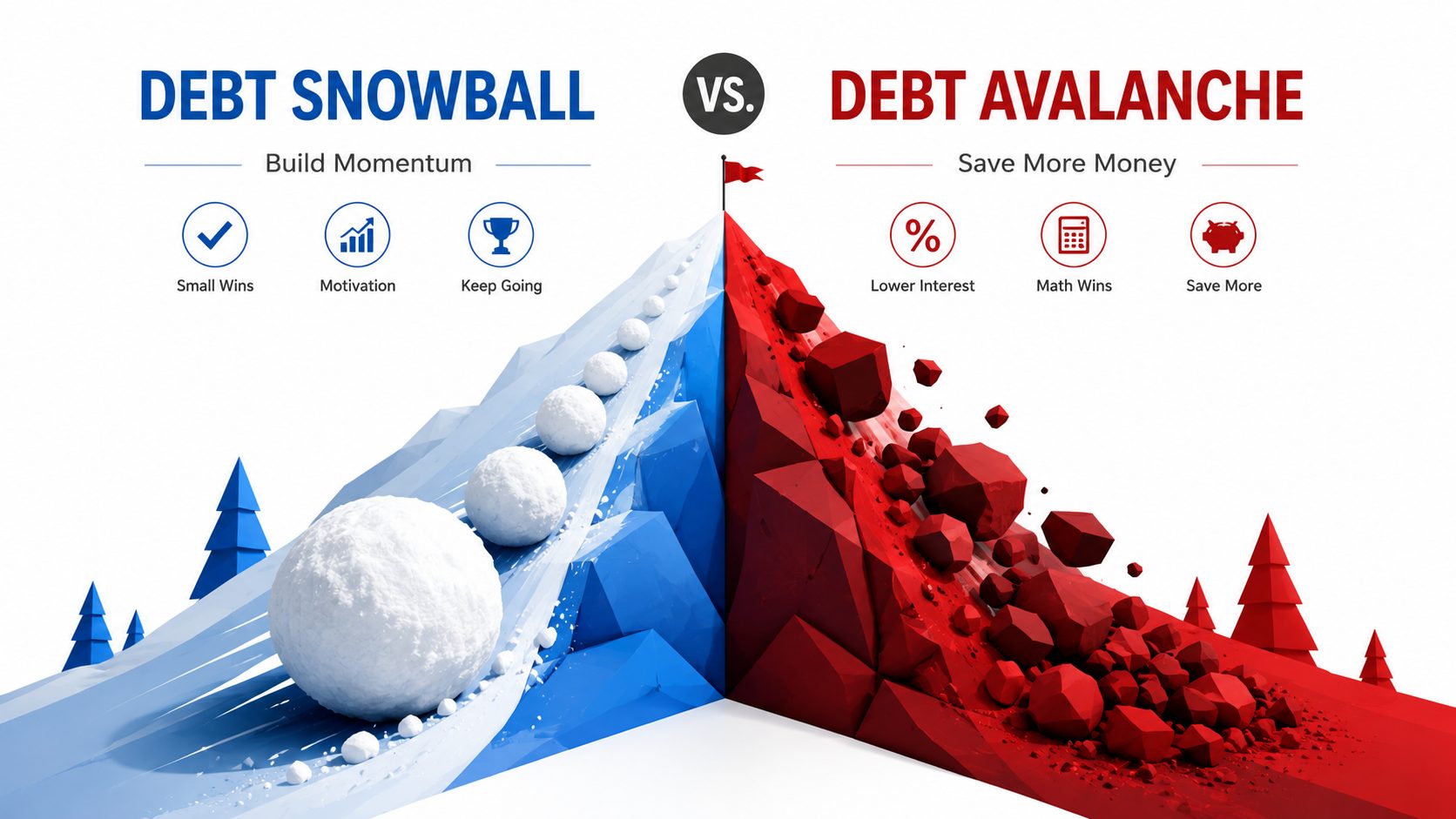
The snowball pays the $3,000 loan first, then the card, then the car loan. The avalanche pays the 22% card first, then the 8% loan, then the 5% car loan. Under the stated assumptions, the snowball pays $2,089.19 of interest. The avalanche pays $1,724.34. They reach zero in the same month because the total budget and balances are identical; the avalanche leaves a smaller final payment.
| Measure | Smallest balance first | Highest APR first |
|---|---|---|
| First account cleared | Month 6 | Month 12 |
| Total interest | $2,089.19 | $1,724.34 |
| Last account cleared | Month 24 | Month 24 |
| Final month's payment | $389.19 | $24.34 |
Interest on Priya’s $19,000 debt stack
Priya can value that early closed account. It may make three bills feel manageable. The price of that six-month earlier win is $364.85 in this example. Neither outcome predicts what another person's accounts will do.
Month of Priya’s first closed account
When the two methods give exactly the same answer
Suppose your smallest debt is also your most expensive: $3,000 at 26%, followed by $4,000 at 22%, then $8,000 at 8%. Both methods choose the $3,000 account, then the $4,000 account, then the $8,000 account. With the same minimums and total payment, their schedules and interest costs are identical. A comparison that shows different savings for those inputs has a calculation error.
This ordering check is worth doing before you trust an online debt payoff figure. List every balance, APR, minimum and any promotional-rate expiry. Without those inputs, a claimed interest saving cannot be reproduced.
The monthly budget also changes the result. Keeping Priya's three balances, APRs and minimums fixed but lowering the total payment to $650 gives the snowball a modeled $3,212.38 interest bill and a month-35 payoff. The avalanche costs $2,659.54 and ends in month 34. Raising the budget to $1,100 gives $1,647.09 interest for snowball and $1,363.51 for avalanche; both finish in month 19. The higher the payment, the shorter the time interest accrues. These are recalculations of one hypothetical portfolio, not typical borrower outcomes.
| Total monthly budget | Snowball interest and end | Avalanche interest and end |
|---|---|---|
| $650 | $3,212.38, month 35 | $2,659.54, month 34 |
| $900 | $2,089.19, month 24 | $1,724.34, month 24 |
| $1,100 | $1,647.09, month 19 | $1,363.51, month 19 |
Make the next payment safely
First cover every required minimum. Then direct the extra to the chosen target. When a debt closes, keep paying the same total $900 if the budget still allows it. Spending the freed-up minimum slows both plans. If the $900 has become unaffordable, contact the lender before missing a payment and ask about hardship options. The CFPB's debt worksheet and the FTC's debt guide explain these routes.
Check whether a consolidation offer actually lowers the total cost. A lower monthly bill can come from a longer term, origination fees or a promotional rate that later jumps. Compare the payoff balance, all fees and the date the debt ends. A lender cannot promise that rolling balances into one loan will save money without those details.
The avalanche minimizes interest under fixed terms and a fixed budget. The snowball can be useful when closing an account early helps you keep paying. Choose the method you can execute. Verify its monthly schedule against statements; headline savings are conditional.
Watch for a promotional card rate. A card advertised at 0% today may become the most expensive balance when the offer ends, and deferred-interest promotions can work differently again. Enter the actual end date in a schedule; a single fixed APR for all 24 months would hide that change. If a debt is in collections, confirm its balance and legal status before sending money to an unfamiliar caller. Payment priority is a budgeting method; it does not replace the creditor's account terms or a hardship agreement.
The same-order test also catches a subtler mistake: if all debts carry the same APR and the total monthly payment stays fixed, moving an extra dollar among them does not change the interest on the combined balance for that month. Different account-closing dates may still matter administratively, but a calculator should not manufacture an interest saving from the order alone. Fees, varying rates and minimums can break that equality, so the comparison must say which of those features it includes.