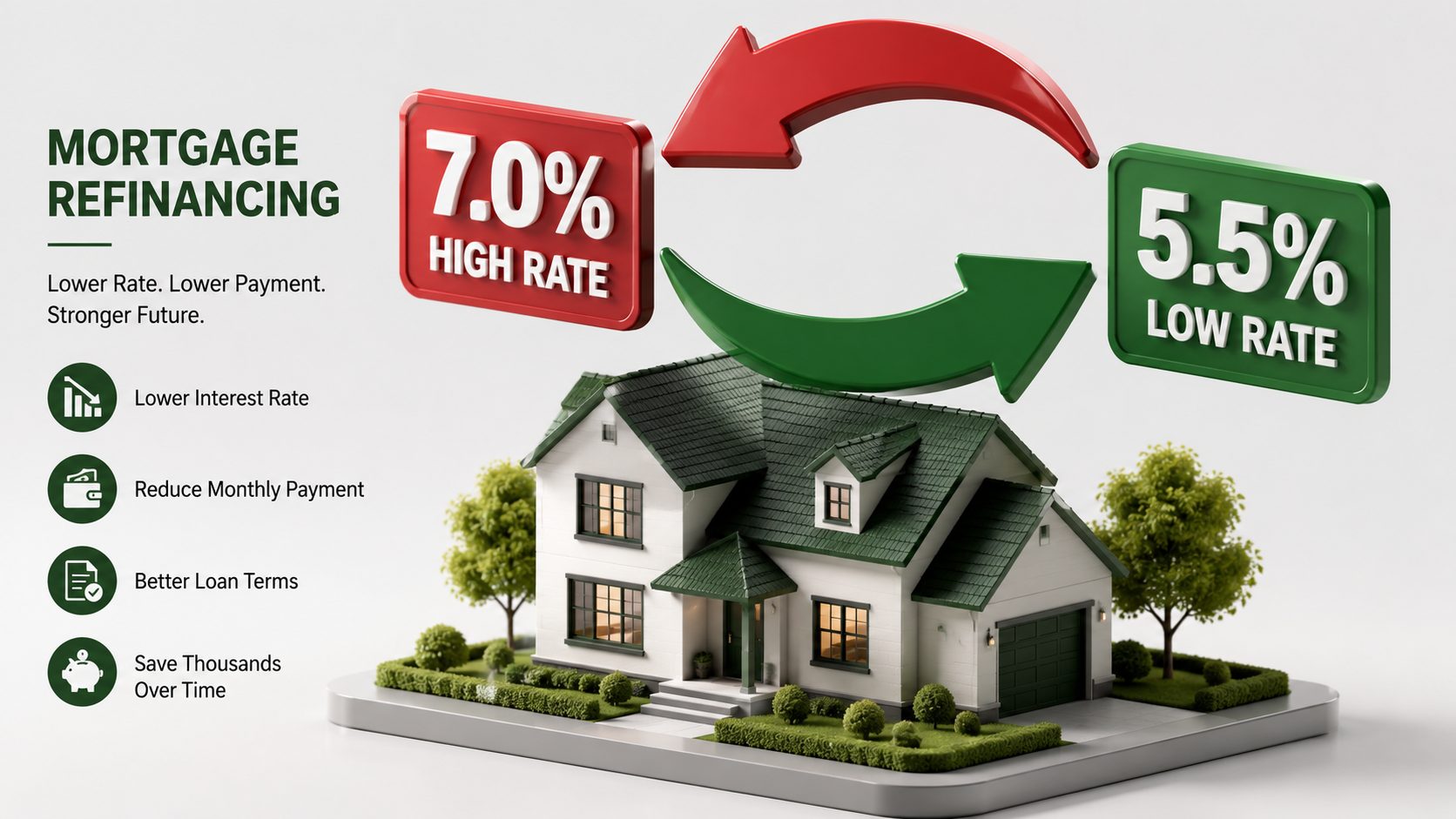
A smaller bill can conceal a later payoff
On a hypothetical $250,000 balance, resetting the payoff clock can lower the bill while increasing lifetime interest. A refinance replaces one mortgage with another. It may lower the rate, change the term, turn equity into cash or change the loan structure. The monthly payment is only one part of that trade. The Consumer Financial Protection Bureau warns that a lower payment can come from a longer term rather than a cheaper loan. Compare the new quote with the years left on your existing loan, not only with the original mortgage term.
A useful first question is: what will I owe on the date I expect to leave this loan? A household selling in two years needs a different answer from one expecting to keep the mortgage for twenty. Cash paid at closing, interest paid along the way and principal still owed all matter. Rate advertisements do not supply those three figures. Ask each lender for the Loan Estimate and check the amount financed, points, lender credits, prepayment terms and projected payments.
Reproduce one same-balance example
Assume a $250,000 remaining principal, 20 years left at a fixed 6.5% nominal annual rate, and principal-and-interest payments monthly. Compare a new 20-year fixed loan at a hypothetical 5.5% with $5,000 paid in cash at closing. These are illustrative rates, not a September 2026 market quote or an offer. Applying the standard amortization formula gives the old payment about $1,863.93 and the new payment about $1,719.72. Taxes, homeowners insurance and HOA dues are excluded because a refinance does not eliminate them.
| Scenario | Monthly principal and interest | Total interest if held to payoff |
|---|---|---|
| Keep 6.5%, 20 years left | $1,863.93 | $197,343.88 |
| Refinance at 5.5%, 20 years | $1,719.72 | $162,732.38 |
| Refinance at 5.5%, reset to 30 years | $1,419.47 | $261,010.10 |
Monthly principal-and-interest payment for a $250,000 balance
The 30-year version frees roughly $444.46 a month against the old loan, but leaves payments running ten years longer. It adds about $63,666 in lifetime interest versus simply keeping the old 20-year schedule, before the $5,000 closing cost. A new borrower might deliberately choose liquidity over the fastest payoff; that is a budget decision, not proof that the refinance “saves thousands.” CFPB mortgage-shopping guidance explains the long-term cost of a longer term.
The two break-even numbers tell different stories
With the same 20-year term, the payment difference is about $144.21 monthly. Dividing $5,000 of cash closing costs by that difference gives a payment-only payback of roughly 34.7 months. This is a quick cash-flow screen, useful only when the old and new terms, balance and payment definitions match. It ignores that the lower-rate loan also reduces principal faster.
For a more complete exit-date comparison, add (1) payments made through that date, (2) cash closing costs and (3) the remaining balance. Using full-precision amortization on the illustration, at month 24 the old-loan sum is about $281,706.75 and the new same-term sum is about $281,749.04. The refinance is still about $42 worse at that point. At month 35 the sums are about $295,650.62 and $293,457.25: roughly $2,193 better for the refinance. At month 60 the difference grows to roughly $7,155. These are comparisons of financing cash outflow and payoff balance, not house value or an investment return.
Net advantage from same-term refinance at chosen exit month
The full calculation matters most when your planned horizon is short, when fees are large, or when a lender proposes a different term. If you roll fees into the new principal instead of paying cash, increase the financed balance before recalculating both payment and exit balance.
“No closing cost” usually moves the cost
Closing costs can include origination charges, title work, appraisal, taxes and prepaid items. A lender's credit can offset some charges in exchange for a higher rate; financing the charges increases the loan balance. The CFPB's no-cost refinance explanation says the services and costs do not disappear. Freddie Mac likewise advises comparing the actual closing-cost line items, not an advertised headline. Its refinance cost guide gives a broad 3%–6% orientation, but your lender's Loan Estimate is the relevant quote.
Two offers with the same rate can still differ because one has discount points and the other does not. A point is 1% of principal as a pricing convention, but whether paying it improves your outcome depends on the rate reduction and how long you keep the loan. Do not add escrow deposits or prepaid interest to “lost fees” without checking whether they replace amounts you would pay anyway. The CFPB closing-fee explainer separates categories to compare.
A cash-out quote changes the question
A cash-out refinance increases the debt as well as changing the rate. Compare the extra cash received, what it is used for, the new balance and total interest separately. Borrowing against a house to pay cards may lower the stated interest rate but puts the home at risk if repayments become unaffordable. A lender's approval is not a safety assessment for your budget.
Tax treatment should not be sold as an automatic bonus. The IRS mortgage-interest guide says home-mortgage interest generally requires itemizing and meeting qualified-home and debt-use rules. Refinanced acquisition debt generally retains its status only up to the old principal balance; interest on cash-out proceeds used for other purposes can fall outside the home-acquisition deduction. Points paid on a refinance are generally spread over the new loan's life, with exceptions. Tax rules differ for rental or business property.
Decide from the signed terms
Before signing, get comparable Loan Estimates using the same desired loan amount, term and rate-lock timing. Calculate the balance and total cost at your likely exit date. Stress the result if you move earlier, keep the property longer or the quoted cost is financed. Confirm whether the old loan has any prepayment charge and whether the new rate is fixed for the whole period. If a change improves monthly breathing room but raises long-run cost, write down why the liquidity is valuable to you. The refinance is a decision about both affordability and debt trajectory; the table above is a method you can repeat with your own loan statements, not a promise about today's rates.