How Does Mortgage Amortization Work, and How is Your Payment Split?
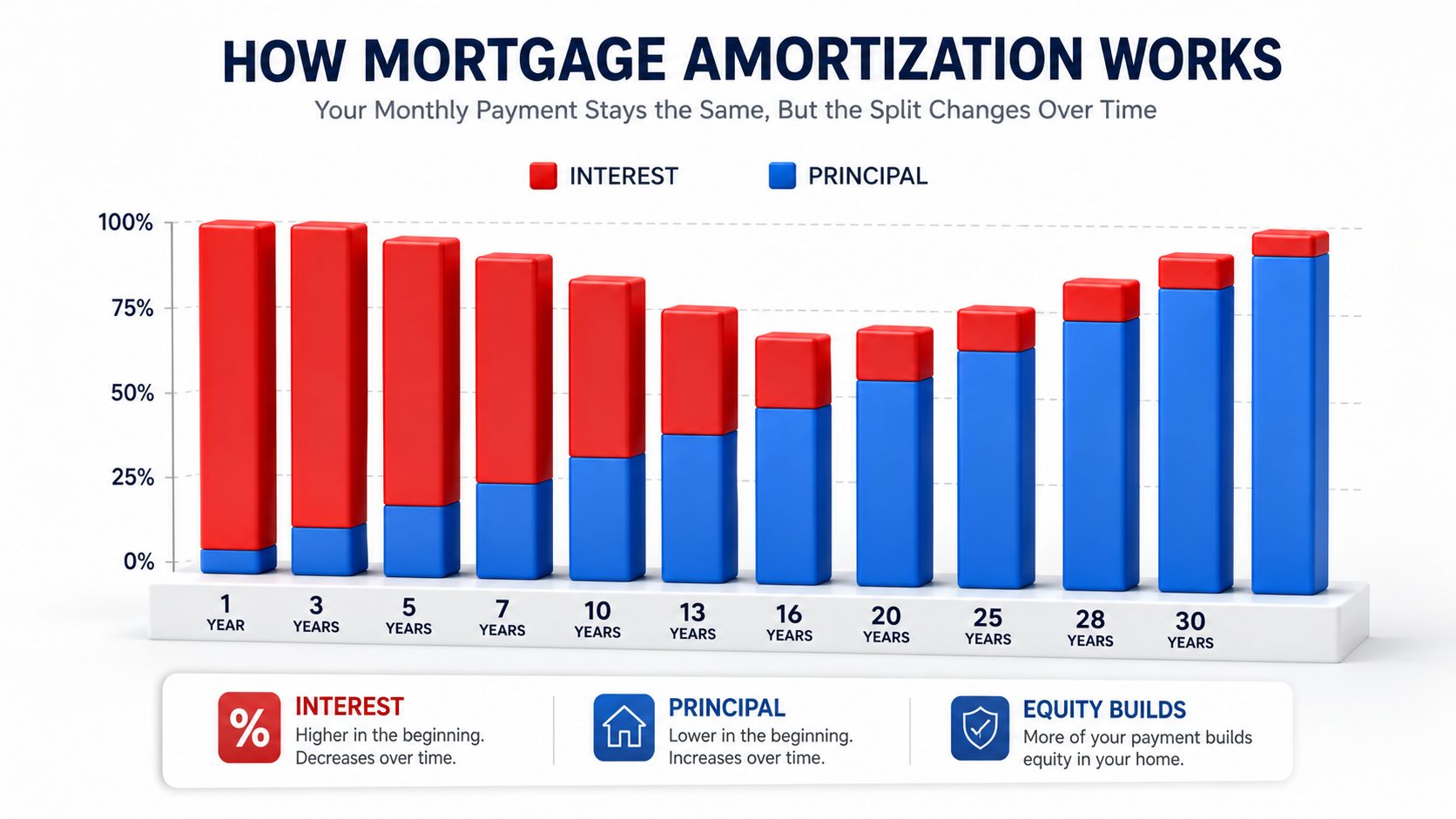
To understand mortgage amortization, you must analyze how your monthly principal and interest payment is split over the life of the loan: in the early years of a 30-year fixed mortgage, interest dominates your payment because it is calculated based on your high remaining unpaid principal balance, whereas principal reduction only dominates in the final years. By making extra principal prepayments early in the term, you directly lower the outstanding balance, saving massive amounts of compound interest and shortening your loan term.
Quick Answer Summary
- Amortization: The scheduling of loan repayments. While your total monthly payment remains constant, the split between principal (paying off the debt) and interest (paying the bank) changes every month.
- The Early Years: If your monthly payment is $2,000, in Month 1, up to $1,600 goes to interest and only $400 pays down the principal. By Year 15, the split is roughly equal.
- Prepayment Power: Every extra dollar you pay directly reduces your principal, meaning you pay less interest in all subsequent months.
What is an Amortization Schedule?
An amortization schedule is a complete table showing every monthly payment of your mortgage from Month 1 to Month 360 (for a 30-year loan). For each payment, the table details exactly how much money is allocated to interest and how much goes to reducing the principal balance.
In a standard fixed-rate mortgage, the total monthly payment is identical. However, the internal composition of that payment changes dynamically every month.
The Early-Year Interest Trap Explained
When you first buy a home, your unpaid principal balance is at its maximum. Because interest is calculated as a percentage of this unpaid balance, your interest payment is also at its peak. As you slowly pay down the principal, the interest portion decreases, and the principal portion increases.
- The Shocking Math: On a $300,000 mortgage at 6% interest, your monthly payment is $1,798. In Month 1, $1,500 goes to interest and only $298 reduces your principal. Over the first five years, you pay nearly $90,000 to the bank, but your loan balance only drops by about $20,000!
The Amortization Math: How Interest is Calculated Monthly
To see how your bank calculates your monthly interest split:
- Take your current outstanding loan balance.
- Multiply it by your annual interest rate (e.g. 6% = 0.06).
- Divide by 12 to find the interest owed for that month.
- Subtract this interest from your total monthly payment to find the principal reduction.
Monthly Interest Owed = (Outstanding Balance × Annual Interest Rate) ÷ 12
Case Study: Jessica & Brian's Denver Home Loan
Let's look at Jessica and Brian, who bought a home in Denver with a 30-year fixed mortgage of $300,000 at 6% interest. Their monthly payment is $1,798.65.
Let's look at their payment split at different stages of the loan:
| Payment Number | Outstanding Principal | Interest Paid | Principal Paid |
|---|---|---|---|
| Payment 1 | $300,000.00 | $1,500.00 | $298.65 |
| Payment 120 (Year 10) | $251,583.56 | $1,257.92 | $540.73 |
| Payment 240 (Year 20) | $162,965.17 | $814.83 | $983.82 |
| Payment 359 (Last Year) | $3,572.70 | $17.86 | $1,780.79 |
Jessica & Brian's $1,798.65 payment over the loan's life
Verdict: In the first 10 years, they paid over $166,000 in interest, while only reducing their loan balance by $48,416.44. This highlights why making prepayments early in the loan is so powerful.
How Extra Payments Accelerate Equity Growth
Because interest is calculated on the outstanding balance, any extra payments you make to principal directly lower the interest owed in all future months. This accelerates your movement down the amortization schedule, meaning you pay off your home years earlier.
- Example: If Jessica and Brian add an extra $200/month to their $1,798 payment starting in Month 1, they will pay off their mortgage 5.5 years early and save $34,300 in interest.
Prepayment Strategies: One Extra Payment a Year
If you want to shorten your term without doubling your monthly payment, use these strategies:
- One Extra Payment Per Year: Making one extra payment annually (or adding 1/12th to your payment every month) shaves 4 to 5 years off a 30-year mortgage and saves over $35,000 in interest on a $300,000 loan.
- Round Up Payments: Round up your payment to the nearest hundred. Adding an extra $100/month to a $1,798 payment can save over $20,000 in interest.
How to Direct Payments to Principal (Avoid Lender Traps)
When sending extra money to your bank, you must specify that the extra amount is to be applied to the "principal balance only." If you do not, some lenders will apply it to the next month's payment (prepaying interest), which does not reduce your balance or save you interest fees.
Use the US Mortgage Calculator to view your complete amortization schedule and see how prepayments shorten your loan term.
Advanced Strategic Implementation & Optimization for Homeowners
Optimizing your mortgage amortization schedule can save you tens of thousands of dollars in interest and build equity faster.
Amortization Optimization Checklist
- Make Extra Principal Payments: Direct bonuses or side income directly toward your mortgage principal to cut years off the loan.
- Choose Accelerated Bi-weekly Payments: Pay half your monthly payment every two weeks to make an extra monthly payment each year.
- Avoid Long Terms: Opt for a 15-year or 20-year term if your budget allows, to significantly reduce total interest costs.
Step-by-Step Principal Paydown Strategy
- Obtain an Amortization Schedule: Request a complete monthly payment breakdown from your lender.
- Determine Monthly Surplus: Find the amount of spare income you can consistently dedicate to debt paydown.
- Set Up Recurring Principal Add-ons: Instruct your bank to add an extra principal payment to each regular payment.
- Monitor Balance Milestones: Track how your principal balance drops relative to the original schedule.
Common Pitfalls & Audit Warnings
- Ignoring Prepayment Penalties: Exceeding your lender's annual prepayment allowance (typically 10% to 20% of the original principal) triggers heavy penalties.
- Misapplying Extra Payments: Failing to specify that extra payments should go directly to principal rather than prepaying future interest.
- Extending Term During Refinancing: Refinancing a loan with 18 years remaining back into a 30-year mortgage increases total interest costs.
Advanced Loan Repayment & Amortization Scenario Modeling
We model the interest savings of making extra principal payments on a $400,000 mortgage at 6.0% interest.
Amortization Schedule Comparison Table
| Metric | Option A: Standard | Option B: Accelerated | Option C: Extra Payments |
|---|---|---|---|
| Monthly Payment | $2,398 | $2,398 | $2,398 + $250 Principal |
| Frequency | Monthly | Bi-weekly (Accelerated) | Monthly |
| Annual Payment | $28,776 | $31,174 | $31,776 |
| Repayment Duration | 30 Years | 24.3 Years | 23.8 Years |
| Total Interest Cost | $463,280 | $358,420 | $346,120 |
| Total Cash Saved | $0 | $104,860 | $117,160 |
Total interest on a $400,000 loan at 6%, by strategy
Step-by-Step Prepayment Math
Option C: Extra Principal Payments ($250/Month Add-on)
- Action: Direct an extra $250 monthly straight to principal from Month 1.
- Savings: Interest cost drops from $463,280 to $346,120, saving $117,160 in total cash.
- Timeline: You own the home fully 6.2 years earlier.
4. Early Overpayment: How One Extra Payment Per Year Changes Everything
Because mortgage interest is calculated based on your remaining principal balance, making extra payments early in the loan term has a massive compounding effect on your total interest costs.
The Extra Payment Strategy
By making just one extra principal payment per year (or paying 1/12th extra every month), you can shave years off your mortgage.
Let's assume a $400,000 loan at 6.0% interest on a 30-year term (Monthly payment: $2,398):
- Standard Payoff: You pay off the loan in 30 years. Total interest paid: $463,352.
- One Extra Payment Yearly: You contribute an extra $2,398 once a year.
- You pay off the loan in 25 years (saving 5 years of payments).
- Total interest saved: $98,400.
5. Interest-Only Mortgages: When They Make Sense and the Hidden Risks
An interest-only mortgage allows you to pay only the interest portion of the loan for a set period (typically 5 to 10 years), resulting in low initial monthly payments.
The Risks
Once the interest-only period ends, the loan recasts, and you must start paying both principal and interest over the remaining term. If you have a 30-year mortgage and pay interest-only for 10 years, you must pay off the entire principal balance over just 20 years, resulting in a 40%+ jump in your monthly payment. Use interest-only loans only if you have a guaranteed plan to sell the home or refinance before the recast period begins.
6. The Impact of Your First 5 Years of Amortization
Because of how the amortization formula is structured, your mortgage payments during the first five years go almost entirely toward paying interest rather than reducing the principal.
If you have a $300,000 mortgage at 6% interest, your monthly payment is $1,798.
- In Month 1, $1,500 goes to interest and only $298 goes to principal.
- By Month 60 (End of Year 5), you have paid a total of $107,880 in payments, but your loan balance has only decreased by $20,200.
The first five years: money in vs balance down
Understanding this front-loaded interest structure highlights why making even small extra principal payments during the first few years has the biggest long-term savings impact.